Key Takeaways
A Senate vote backing an Iran war powers resolution, paired with Republican pressure for details on President Trump's deal to end the conflict, points toward de-escalation — the single biggest swing factor for crude's geopolitical risk premium. For investors, the read-through runs straight into energy names like Exxon and Chevron and defense primes such as Lockheed Martin, where war and peace move the demand and pricing narrative in opposite directions.
What Happened
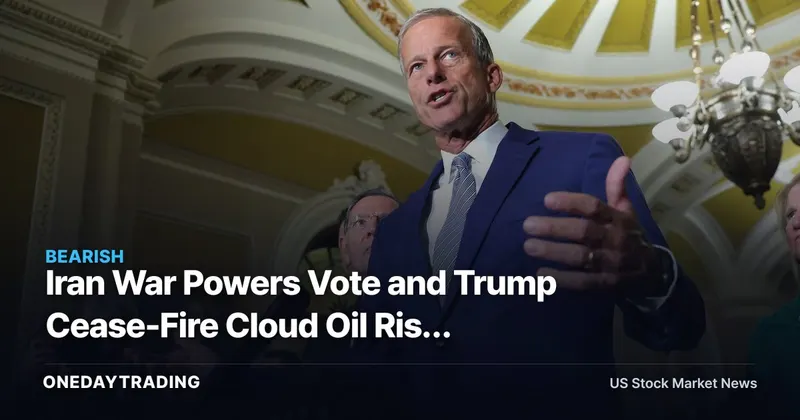
The Senate advanced a war powers resolution aimed at constraining further U.S. military action against Iran, a procedural signal that lawmakers want a say before any escalation. At the same time, Senate Republicans are pushing Trump for specifics on the framework he has floated to end the war.
The open questions are substantive: how much sanctions relief Iran would receive, what nuclear restrictions would be imposed and verified, and whether the arrangement requires formal congressional approval. Each of those variables carries direct market consequences, because sanctions relief governs how much Iranian crude can legally re-enter global supply.
Background and Context
Oil has carried a conflict-driven risk premium tied to fears of supply disruption through the Strait of Hormuz and broader Middle East instability. A credible path to ending hostilities tends to deflate that premium. Sanctions relief would compound the effect by adding barrels to a market already balancing OPEC+ policy and uneven global demand.
Market and Stock Impact
- Exxon Mobil (XOM), Chevron (CVX): Upstream earnings are highly leveraged to crude prices; a fading war premium and potential return of Iranian supply pressure realized prices and cash flow, even as their integrated downstream cushions some of the hit.
- Lockheed Martin (LMT), RTX: Defense primes benefit from elevated conflict spending and replenishment demand; a durable cease-fire trims the urgency around munitions and missile-defense reorders at the margin.
- Refiners and broad equities: Lower input costs and reduced macro tail risk are a tailwind for the S&P 500, since cheaper energy eases inflation and consumer cost pressure.
- Iran-supply-sensitive trade: Sanctions relief is the key variable — without it, added barrels stay sidelined and the bearish oil case weakens considerably.
Investor Checkpoints
- Watch whether the deal requires a Senate vote — congressional approval signals durability versus a fragile executive-only arrangement.
- Track the specific sanctions-relief terms and any timeline for Iranian barrels returning to market.
- Monitor WTI and Brent levels around the announcement; a sustained move below recent ranges confirms the premium is unwinding.
- Check next-quarter guidance from XOM and CVX for price-deck assumptions and capital-return pace.
Outlook
If the framework holds and sanctions ease, the bear case for oil strengthens and energy earnings face a lower price deck, while broad indices gain from reduced macro risk. The counter-scenario is real: GOP demands for detail, unresolved nuclear-verification questions, and the lack of congressional sign-off all leave room for the deal to stall or unravel — which would snap the risk premium back into crude and re-rate defense demand higher.
📊 Analysis
Signal Bearish
Why A path to ending the Iran conflict and possible sanctions relief deflates crude's geopolitical risk premium and adds potential supply, pressuring oil and energy producers.
Tickers$XOM$CVX$LMT$RTX$NOC
This article was independently written by OneDayTrading from public reporting. Read the original (CNBC)