Donald Trump’s Midterm Test: The Investor Briefing
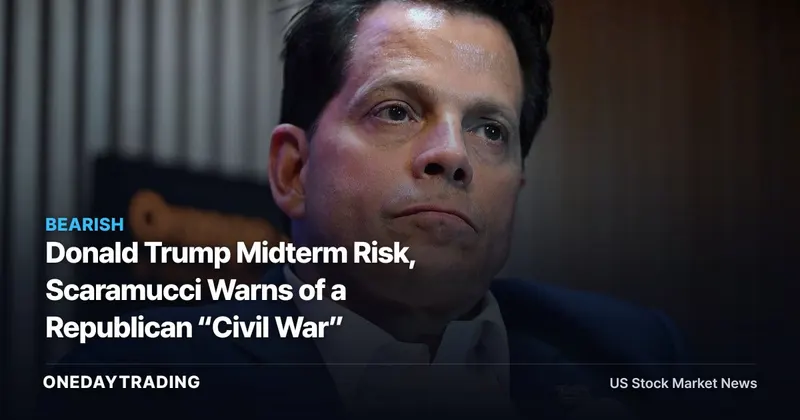
Donald Trump enters Tuesday’s midterm elections with political, economic and geopolitical uncertainty converging into a potentially bearish macro signal for investors. Anthony Scaramucci told CNBC that the president would get “trounced” and that such a result would trigger an intellectual “civil war” among Republicans. The election result is unknown, so the investable issue is not the prediction itself; it is whether the ballot changes political control while the Iran war remains without a visible diplomatic path.
- CNBC’s All-America Economic Survey found last month that 65% of respondents disapproved of Donald Trump’s handling of the economy.
- The same CNBC survey found last month that 80% of respondents rated the economy as fair or poor, making economic dissatisfaction the clearest quantitative evidence behind the political warning.
- Prediction markets assigned Democrats around a three-in-four chance of winning control of the Senate in Tuesday’s election, though those markets are not substitutes for political polls.
What Anthony Scaramucci’s Warning Means for Investors
A midterm election is a vote for political representation, while its market relevance comes from the possibility that control of government changes the path of oversight and decision-making. Scaramucci’s thesis is that a severe defeat would force Republicans to decide whether their future remains tied to Donald Trump or moves toward another political identity. He framed that dispute by saying the party is no longer the party of Ronald Reagan or George W. Bush.
For markets, the immediate distinction is between what has been priced and what remains unresolved. The prediction-market probability shows that a Democratic Senate victory is already treated as more likely than not by those platforms. It does not establish the result, the scale of any defeat or whether the predicted Republican conflict will occur.
That gap matters because Scaramucci’s argument contains several contingent steps: Donald Trump must first be defeated at the ballot, the defeat must be sufficiently forceful to alter internal party calculations, and Republicans must then respond with the ideological contest he expects. Investors should treat each link as a scenario, not as a confirmed outcome.
Economic Disapproval Behind Donald Trump’s Political Risk
The survey evidence gives the forecast its strongest factual base. CNBC reported that 65% of respondents last month disapproved of Donald Trump’s management of the economy, while 80% described the economy as fair or poor. Those readings measure public assessments; they do not reveal the election result or establish a direct market return.
Scaramucci described the midterms as the electorate’s customer-relations survey of the president. His analogy connects economic sentiment to voting behavior, though the supplied evidence does not quantify how respondents will vote. The analytical takeaway is narrower: dissatisfaction with the economy is broad enough to make the election a meaningful test of Trump’s political standing.
Attribution also matters. Scaramucci is the founder of SkyBridge Capital and served as White House communications director for 10 days in 2017 during Donald Trump’s first term. The White House previously said his “relevance ended almost a decade ago” and did not immediately answer CNBC’s current request for comment. His access and former role give context to the remarks, not independent confirmation of his forecast.
Democratic Party Odds and the Republican “Civil War” Scenario
Prediction markets put the Democratic Party’s Senate-control prospect at around a three-in-four chance for Tuesday’s election. That figure expresses the prices and judgments embedded in those platforms. Because their methods differ from traditional political polling, it should not be read as a guaranteed probability or proof that Democrats will prevail.
If the result matches Scaramucci’s expectation, his next concern is an internal struggle over the identity of the Republican Party. He expects elements of the MAGA movement to remain influential and pointed to Donald Trump’s several hundred million dollars of PAC money as a reason the next presidential candidate may resist moving far from him in 2028.
The counter-scenario is straightforward. The election may not produce the result Scaramucci predicts, Democrats may not gain Senate control, or Republicans may avoid the conflict he anticipates. Those open outcomes limit the case for converting a political forecast into a definitive market position before votes establish the balance of power.
Iran War Risk Complicates the Post-Election Setup
The election is not the only unresolved variable. Scaramucci said he was bearish on a diplomatic breakthrough after the ballot because he saw no alignment among the Iranians, Israelis and Americans on a negotiated solution. A U.S. official separately told MS Now that the United States launched “defensive” strikes on Iran’s Qeshm Island overnight.
“Wars are very bad for business,” Scaramucci told CNBC, adding that they are not good for the stock market. That is his assessment rather than a reported market move. The facts supplied here contain no index level, sector return, commodity price or company exposure that would support a more specific trading conclusion.
The key mechanism is uncertainty around whether military action expands or diplomacy becomes viable. Escalation would preserve the business risk identified by Scaramucci; a negotiated agreement would weaken that concern. Neither outcome is known, and the available evidence does not establish alignment among the parties to a possible settlement.
Supported Winners, Losers and Limits
- Potential political winner — Democratic Party: Prediction markets placed its chance of winning Senate control at around three-in-four for Tuesday’s election. The result remains unknown.
- Potential political loser — Donald Trump: Scaramucci expects him to be “trounced,” and CNBC’s last-month survey recorded 65% economic disapproval and an 80% fair-or-poor assessment of the economy. A forecast and survey sentiment are not election results.
- Risk area — Republicans: Scaramucci expects an intellectual “civil war” following a severe defeat. Whether that conflict develops is unconfirmed.
- Risk area — business and the stock market: Scaramucci linked the Iran war to an unfavorable business and market environment. The fact sheet identifies no individual U.S.-listed company with a supported revenue, cost or valuation exposure, so assigning stock-specific winners or losers would exceed the evidence.
Election-Night and Post-Ballot Risk Check
- Senate control: Compare the result with the prediction markets’ roughly three-in-four chance assigned to Democrats. The price is an expectation, not an outcome.
- Donald Trump’s standing: Assess whether the vote supports Scaramucci’s “trounced” characterization and whether Republicans respond with the ideological conflict he predicts.
- White House response: CNBC had not received an immediate answer to its current request for comment. Any later response would provide the administration’s direct position on Scaramucci’s claims.
- Iran diplomacy: Watch whether the Iranians, Israelis and Americans show evidence of alignment after the ballot, or whether military strikes continue without a negotiated path.
Bottom Line: Politics Is the Catalyst, Outcomes Are Still Open
The bearish case rests on a clear combination: weak public assessments of Donald Trump’s economic management, prediction-market expectations favoring Democratic Senate control, a possible Republican Party rupture and no evident alignment around an Iran-war settlement. The balancing case is equally important: election results, Senate control, diplomatic negotiations and the predicted Republican conflict are all unknown. Investors therefore have a defined set of checkpoints, but the fact sheet does not support a company-specific trade before those political and geopolitical questions begin to resolve.
📊 Analysis
Signal Bearish
Why Economic dissatisfaction, unresolved election risk and Scaramucci’s pessimism about diplomacy create a negative macro backdrop, though no market outcome is confirmed.
This article was independently written by OneDayTrading from public reporting. Read the original (CNBC)