At a Glance
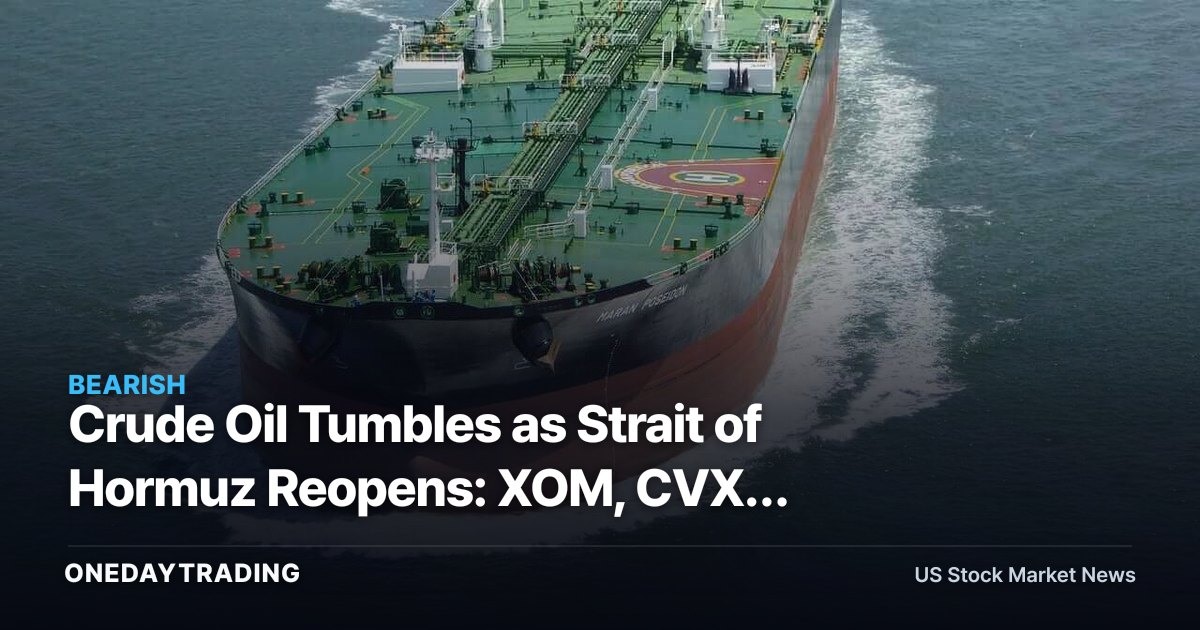
Crude oil prices dropped sharply after news that the Strait of Hormuz, the chokepoint for roughly a fifth of global seaborne oil, has reopened. The move unwinds the geopolitical risk premium that traders had built into prices on fears the passage would be disrupted, shifting the supply narrative from scarcity back toward normal flow.
Why It Matters Now
The Strait of Hormuz sits between the Persian Gulf and the open ocean, and tankers carrying Saudi, Iraqi, Kuwaiti, UAE and Iranian barrels must transit it. When the route is threatened, the market prices in the chance that millions of barrels per day cannot reach buyers, so prices spike on fear rather than on an actual loss of supply. A reopening reverses that logic almost immediately: the feared shortfall does not materialize, speculative long positions are unwound, and the premium evaporates.
For investors, the key point is that this is a sentiment-and-flow story, not a demand story. Lower crude squeezes the revenue line of producers whose earnings track the oil price almost one-for-one, while it lowers input costs for fuel-intensive businesses. The speed of the drop also signals how much of the prior rally was risk-driven rather than fundamental, which matters for anyone trying to gauge a fair value for energy equities.
FAQ
- Why does oil fall when a shipping route reopens? The market had priced in a supply disruption; once transit resumes, that risk premium is no longer justified and prices retrace.
- Who benefits from cheaper crude? Airlines, shippers, refiners and consumers, because jet fuel and diesel are major variable costs.
- Who is hurt? Upstream oil producers and oilfield-service firms, whose margins and cash flow are tightly linked to the realized crude price.
- Is this a lasting move? Risk-premium reversals can be sharp but are reversible if tensions around the strait flare up again.
Related Stocks & Sectors
- ExxonMobil (XOM), Chevron (CVX): Integrated majors with large upstream output see lower per-barrel revenue, though downstream refining can partly offset.
- Occidental (OXY), oilfield services (SLB): More leveraged to crude price swings and drilling activity.
- Airlines (DAL, UAL): Fuel is among the largest operating costs, so a sustained drop supports margins.
- Energy ETF and broad crude (USO): Directly tracks the price decline.
What to Watch
- Whether WTI and Brent hold the lower range or rebound as headlines around the strait evolve.
- Tanker traffic and shipping-insurance rates as a real-time read on whether flow has truly normalized.
- OPEC and producer commentary on output, which could counteract the price drop.
- Next energy-sector earnings for how realized prices feed into guidance.
Overall Outlook
The bull case for energy names rests on the strait remaining a recurring flashpoint, keeping a floor of risk premium in crude and supporting producer cash flows. The bear case is that, absent an actual supply loss, prices gravitate back to demand fundamentals, pressuring upstream-heavy stocks while handing a cost tailwind to airlines and refiners. The deciding variable is not the headline itself but whether physical flows through Hormuz stay uninterrupted in the weeks ahead.
📊 Analysis
Signal Bearish
Why A reopened Strait of Hormuz removes the supply-disruption risk premium, pushing crude lower and pressuring oil-producer revenues.
Tickers$XOM$CVX$OXY$SLB$DAL$USO
This article was independently written by OneDayTrading from public reporting. Read the original (Yahoo Finance)