At a Glance
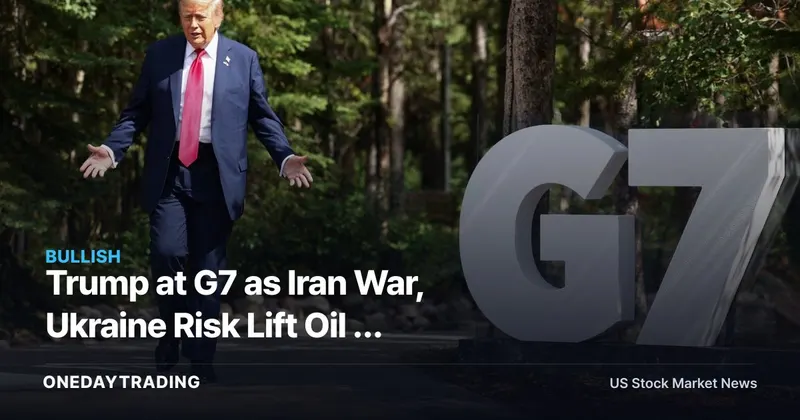
President Trump is traveling to the G7 summit while global attention centers on an active Iran war and the ongoing Russia-Ukraine conflict. For investors, these are not merely diplomatic headlines — Middle East conflict and European war directly touch oil supply, defense spending, and broad risk sentiment.
Why It Matters Now
The G7 is the forum where the world's largest advanced economies coordinate policy, and the agenda reportedly spans both the Iran conflict and Russia's war in Ukraine. Any signal on sanctions, energy supply, or military support can move commodity and equity markets quickly, because the Middle East sits at the heart of global crude flows and the Strait of Hormuz remains a key chokepoint.
Geopolitical escalation typically injects a risk premium into oil prices, which flows through to energy producers and can pressure consumer-facing sectors via higher fuel costs. At the same time, sustained conflict in two theaters tends to support defense procurement narratives, keeping aerospace and weapons makers in focus. Markets often react first to the uncertainty itself, then reprice as the policy outcome becomes clearer.
FAQ
- How does an Iran war affect U.S. stocks? It raises oil-price risk and broad volatility, generally lifting energy and defense names while weighing on sentiment-sensitive growth sectors.
- What is the G7's role here? It is where leaders align on sanctions, energy, and support for Ukraine — decisions that can ripple into commodities and equities.
- Is this bullish or bearish overall? Directionally positive for energy and defense, but a net headwind for broad market risk appetite if tensions escalate.
- What is the biggest single risk? A supply disruption in the Middle East that spikes crude and reignites inflation fears.
Related Stocks & Sectors
- Exxon Mobil (XOM) — major integrated oil producer leveraged to higher crude prices.
- Chevron (CVX) — large-cap energy name that benefits from a war-driven risk premium.
- Lockheed Martin (LMT) — defense prime exposed to elevated military demand from twin conflicts.
- RTX Corp (RTX) — missiles and aerospace supplier tied to defense procurement.
- Energy and Defense sectors — the clearest beneficiaries of sustained geopolitical tension.
What to Watch
- Any G7 statement on Iran sanctions or energy supply coordination.
- Crude oil price action and Strait of Hormuz headlines.
- New commitments on Ukraine military aid that signal defense demand.
- Market volatility gauges as a read on risk appetite.
Overall Outlook
The bull case for energy and defense rests on a durable geopolitical risk premium: conflict in the Middle East supports oil, and a two-front backdrop underpins defense budgets. The risks cut the other way for the broad market — a crude spike could rekindle inflation worries and pressure rate-sensitive sectors, while a de-escalation or diplomatic breakthrough at the G7 could unwind the premium just as fast. Investors should treat headline-driven moves as volatile and policy-dependent rather than a settled trend.
📊 Analysis
Signal Bullish
Why Active Middle East and Ukraine conflicts plus G7 focus raise a geopolitical risk premium that historically supports energy and defense stocks.
This article was independently written by OneDayTrading from public reporting. Read the original (CNBC)