Summary
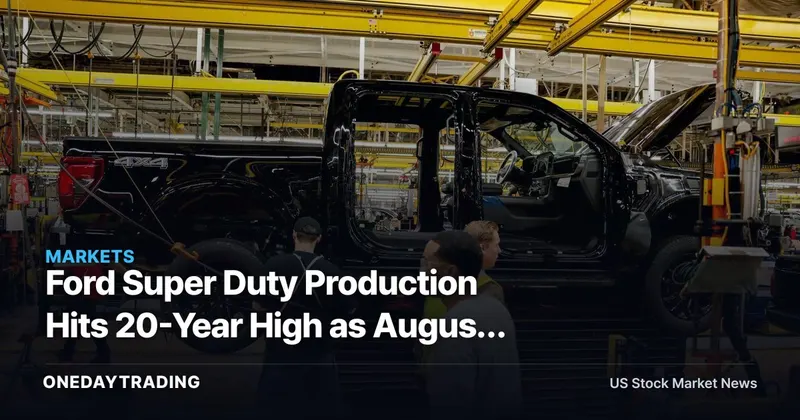
Ford Motor Company (NYSE: F) is restoring production of its highly profitable Super Duty trucks to a 20-year high after supplier fires disrupted output, strengthening the mix of vehicles available for sale. That operational recovery is running against a weaker demand signal: Ford reported an eighth consecutive month of year-over-year U.S. new-vehicle sales declines in August.
The investor question is whether higher Super Duty volume can improve revenue and contribution margins fast enough to offset softer overall deliveries. Production has recovered; the demand trend has not.
The Full Story
Ford Super Duty production reaching a 20-year high matters because heavy-duty pickups typically carry more profit per unit than lower-priced passenger vehicles. Restoring supply after supplier fires allows Ford to convert existing commercial, contractor and large-towing demand into shipments, while factory utilization improves as bottlenecks clear.
Ford’s August U.S. sales decline marks the eighth consecutive year-over-year monthly drop, according to CNBC’s reporting. The sequence indicates a broad volume problem rather than a single disrupted month, raising the risk that incentives, financing costs or cautious buyers are limiting demand across Ford’s lineup.
The mix shift therefore does most of the near-term work. A larger share of Super Duty deliveries can support gross profit even when total units fall, but that benefit depends on sustained pricing and production discipline. If Ford builds trucks faster than dealers can absorb them, inventory and incentive pressure would erode the advantage.
Structural Background
Super Duty is tied to the physical economy: construction, energy services, agriculture and commercial fleets. Those customers value payload and towing capability, making the line less interchangeable than many consumer vehicles. Supplier fires exposed the other side of the equation—one component disruption can idle profitable capacity and delay revenue recognition.
Ford now has to balance plant recovery with channel demand. The key distinction is between constrained supply, which higher production fixes, and weak end-demand, which it does not.
Stock & Sector Ripple
- Ford (F): Super Duty output at a 20-year high improves the high-margin mix and restores lost capacity, but eight straight months of declining U.S. sales keeps volume and incentive risk elevated.
- U.S. pickup-truck market: Ford’s result highlights how heavy-duty demand can remain strategically important even as aggregate new-vehicle purchases soften.
- Auto suppliers: The production recovery shows the earnings sensitivity of component availability; future disruptions could again halt profitable truck lines.
- Commercial-fleet buyers: Stronger Super Duty availability supports replacement schedules, while weaker consumer sales could signal tighter household budgets.
Bull vs Bear Scenarios
The constructive case is operational leverage: recovered supplier capacity lifts Super Duty shipments, favorable mix raises profit per vehicle, and commercial demand absorbs output without heavy discounting. The downside case is that August’s sales streak reflects persistent demand weakness; dealers then require incentives, turning extra production into inventory rather than cash generation.
Valuation risk follows the margin path. Investors may reward evidence that truck profitability is converting into earnings, but a continued sales decline would make the production milestone look like a supply-side repair without a demand-side payoff.
Investor Action Points
- Track Ford’s next U.S. sales release for whether the year-over-year decline extends into a ninth month.
- Watch Super Duty deliveries and dealer inventory for proof that restored production is reaching customers without aggressive incentives.
- Monitor supplier continuity after the fires, especially any renewed interruption to heavy-duty truck output.
- Assess the next earnings update for mix, pricing and commercial-fleet demand rather than headline unit volume alone.
FAQ
Why did Ford Super Duty production reach a 20-year high?
Ford restored Super Duty manufacturing after supplier fires disrupted production. The recovery returned output to its highest level in two decades, improving availability of a highly profitable truck line.
What does Ford’s eighth straight U.S. sales decline mean?
Ford’s August U.S. new-vehicle sales fell year over year for the eighth consecutive month, according to CNBC’s report. The streak points to sustained volume pressure that higher Super Duty production alone cannot resolve.
Can Super Duty trucks offset weaker Ford sales?
Super Duty trucks can support Ford’s financial mix because the line is described as highly profitable and serves commercial, towing and heavy-duty users. The offset is strongest if deliveries rise without excess inventory or higher incentives.
Market data check: F
F last traded near $13.9 (+0.40%). Our composite signal — blending price momentum and news flow — reads 🟡 neutral. Price momentum scores 53/100.
Data as of publication. Price via market feeds; for reference only, not investment advice.
📊 Analysis
Signal Neutral
Why Ford’s restored high-margin Super Duty production is a positive supply recovery, but the eighth consecutive month of declining U.S. sales creates an equally material demand risk.
This article was independently written by OneDayTrading from public reporting. Read the original (CNBC)