Summary
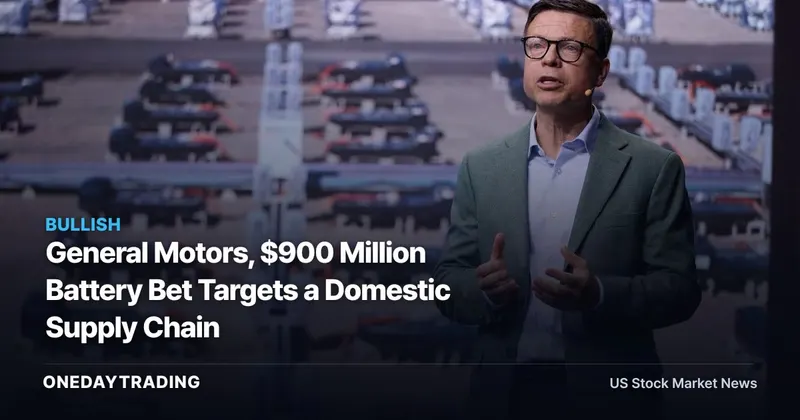
General Motors is developing next-generation battery cells with more domestically sourced materials and expects commercial sodium-ion production with Peak Energy around 2029, according to CNBC. For investors in GM and the U.S. auto sector, the central issue is not simply a new chemistry: CNBC’s reporting suggests that GM is trying to build a differentiated domestic supply chain while Ford Motor faces government scrutiny over its CATL licensing relationship.
According to CNBC, GM is committing $900 million to new battery laboratory facilities near Detroit, including a battery-cell prototyping manufacturing facility of more than 500,000 square feet that is scheduled to begin operations later in 2026. The investment is directionally constructive for GM, but CNBC’s evidence does not establish commercial economics, manufacturing performance or a precise production date.
GM’s Domestic Battery Strategy and the 2029 Target
Sodium-ion battery cells are the technology GM and Peak Energy are developing for energy storage systems, with commercial production expected around 2029, according to CNBC. GM is also prioritizing domestic battery-cell production for future all-electric vehicles, although CNBC does not provide a timetable for that part of the strategy.
The distinction matters. According to CNBC, GM’s sodium-ion partnership has a stated commercial-production horizon, while its broader electric-vehicle localization plan remains an objective without disclosed timing. Investors therefore have one identifiable milestone around 2029, but not a complete schedule connecting laboratory work, cell prototyping and future electric-vehicle production.
Kurt Kelty said GM aims to establish a domestic supply chain within two to three years, according to CNBC. That target should be treated as a plan rather than a completed result: CNBC also reports that Sam Abuelsamid of Telemetry believes domesticating a battery supply chain will likely take years.
China’s Battery Concentration Defines the Strategic Problem
According to CNBC, China accounts for 85% of the world’s electric-vehicle battery cathode active material, more than 90% of the world’s anode active material and 80% of battery production control. Those figures describe the scale of the concentration GM is attempting to address; they do not prove that GM can replace the relevant inputs on its proposed timetable.
CNBC reports that GM is already producing other battery chemistries for energy storage systems and electric vehicles with undisclosed amounts of materials from China. According to CNBC, this makes the domestic initiative a transition from an existing exposure, not evidence that GM has already established a fully domestic battery chain.
The missing disclosure is material to the investment interpretation. Because CNBC does not report how much Chinese material GM currently uses, investors cannot quantify the company’s starting dependence or the amount that a future domestic supply chain might displace.
GM, Ford and Two Battery-Supply Approaches
According to CNBC, GM manufactures lithium iron phosphate cells with LG Energy Solution in the United States for energy storage systems. Ford, by comparison, licensed technology from CATL for lithium iron phosphate battery cells supporting its electric-vehicle and energy-storage plans, according to CNBC.
The Trump administration is emphasizing expansion of the U.S. battery supply chain and reduced reliance on China, according to CNBC. Transportation Secretary Sean Duffy expressed profound concern about Ford’s China ties and specifically cited the CATL licensing arrangement, CNBC reported.
According to CNBC, this policy backdrop may make the origin and control of battery technology more consequential for automakers. The evidence supports a strategic contrast between GM’s domestic-development objective and Ford’s licensed-technology approach, but it does not establish the financial outcome of either path.
The $900 Million Capital Commitment
GM is spending $900 million on new battery laboratory facilities at its global technology campus near Detroit, according to CNBC. CNBC also reports that a GM battery-cell prototyping manufacturing facility covering more than 500,000 square feet is scheduled to begin operations later in 2026.
According to CNBC, those facilities provide a concrete checkpoint for a strategy that otherwise extends toward commercial sodium-ion production around 2029. The analytical value of the facilities lies in whether they advance GM from early-stage development toward repeatable cell prototyping; CNBC supplies the investment and facility scale but no performance, cost or stability results.
That gap limits any return-on-investment judgment. According to CNBC, no specific cost, performance or stability figures have been disclosed for the battery chemistries, so the $900 million commitment demonstrates capital allocation rather than verified commercial advantage.
Stock and Sector Ripple
- General Motors: According to CNBC, GM has paired a $900 million laboratory investment with a Peak Energy sodium-ion partnership targeting commercial production around 2029. This could improve GM’s strategic positioning if domestic sourcing progresses, but CNBC provides no evidence yet on production economics or the timing of domestic batteries for future electric vehicles.
- Ford Motor: According to CNBC, Ford’s CATL technology license has become a focus of concern for Transportation Secretary Sean Duffy. That creates a policy-sensitive contrast with GM’s stated domestic-development path, although CNBC does not report a financial penalty or operating disruption for Ford.
- U.S. battery production: According to CNBC, the sector faces a concentrated global supply structure in which China controls 80% of battery production. GM’s planned facilities may add domestic development capability, but CNBC reports that full supply-chain domestication is likely to take years.
Bull vs. Bear Scenarios
Bull case: According to CNBC, GM is investing in laboratories, preparing a large cell-prototyping facility and working with Peak Energy toward commercial sodium-ion production around 2029. If those steps build a viable domestic supply chain, CNBC’s reporting suggests GM could be better aligned with the administration’s push to reduce China reliance.
Bear case: CNBC describes the program as early-stage and reports that GM’s other battery chemistries still use undisclosed amounts of Chinese materials. According to CNBC, China’s 85% share of global electric-vehicle cathode active material, more-than-90% share of global anode active material and 80% control of battery production show the scale of the execution challenge.
The decisive uncertainty is commercial proof. According to CNBC, investors do not yet have exact 2029 launch timing or specific cost, performance and stability data, while the schedule for domestically produced battery cells in GM’s future all-electric vehicles is also unavailable.
Investor Action Points
- Track the prototyping facility: According to CNBC, the more-than-500,000-square-foot GM facility is scheduled to begin operations later in 2026. Confirmation that operations have started is the nearest disclosed physical milestone.
- Test the two-to-three-year supply-chain target: According to CNBC, Kelty said GM is aiming for a domestic supply chain within two to three years. Investors should look for evidence that sourcing has shifted, because CNBC does not quantify GM’s current use of Chinese materials.
- Demand commercial metrics before assigning an advantage: According to CNBC, no specific cost, performance or stability figures are available. Future disclosure on those measures would determine whether sodium-ion development represents more than strategic positioning.
- Monitor the 2029 commercialization path: According to CNBC, GM and Peak Energy expect commercial sodium-ion production around 2029, but no exact date is given. The relevant checkpoints are disclosed production timing and evidence that development has moved beyond the early stage.
📊 Analysis
Signal Bullish
Why CNBC's reporting indicates that GM is investing in domestic battery development that could strengthen its strategic position, although commercialization and supply-chain execution remain uncertain.
This article was independently written by OneDayTrading from public reporting. Read the original (CNBC)