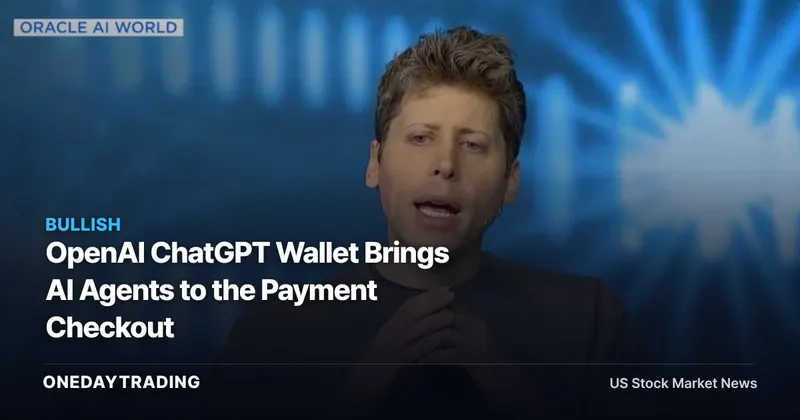
OpenAI ChatGPT Wallet Moves AI From Product Search to Payment
OpenAI announced ChatGPT Wallet on Friday, moving its “dots” AI agents beyond finding products and into completing purchases with user approval. For investors, the immediate read-through is strongest for payments: American Express, Mastercard and Visa helped build the feature, while merchants and consumer platforms still control whether agents can reach checkout.
ChatGPT Wallet is a payment feature that lets an OpenAI dots agent purchase an item on a user’s behalf after the user passes a security check. The investment thesis is not that agent-led commerce has already reached scale. It is that payment networks have secured a defined role in a new checkout channel before OpenAI has disclosed broader availability, merchant coverage or transaction economics.
How ChatGPT Wallet Handles a Purchase
Eligible users enter card information once, ask a dot to find an item and approve each purchase through a security check. OpenAI says the agent does not access the user’s card details. Instead, the payment network supplies a token for that specific transaction containing a scoped card number, security code and expiration date.
That design matters because it separates the agent’s shopping task from the underlying card credentials. The network remains inside the transaction flow, while the user retains an approval step. American Express, Mastercard and Visa cardholders also keep their existing rewards and protections when using ChatGPT Wallet, reducing the need for consumers to trade established card benefits for agent-assisted checkout.
Chaya Nayak told CNBC that OpenAI’s current priority is building a safe, easy-to-use foundation with merchants and network partners. Her framing sets a disciplined benchmark: the launch should first be judged by whether the payment and approval process works across participating sites, not by a revenue contribution that OpenAI has not claimed.
The User Base Is Large, the Initial Access Is Narrow
According to CNBC, OpenAI’s ChatGPT chatbot had more than 1.2 billion weekly active users as of the end of the third quarter. CNBC also reported that OpenAI’s ChatGPT chatbot had nearly 100 million paying users as of the end of the third quarter. Those figures define the potential distribution base, while the wallet’s actual addressable population at launch is narrower.
ChatGPT Wallet is initially limited to OpenAI Pro subscribers in the U.S. who are over 18 years old, CNBC reported. Luke Gebb described the contained rollout as a sensible way to observe the product before expanding it. The duration of that test and the timing or scope of any broader rollout were not provided.
This distinction is central for payments investors. A broad chatbot audience can make distribution possible, but wallet usage still requires eligible access, a supported card, a willing merchant and approval of an individual purchase. The published audience figures therefore measure reach, not completed transactions.
OpenAI’s Agentic-Commerce Path Meets Merchant Control
OpenAI introduced dots agents in late September and rolled out a revamped shopping experience in March. ChatGPT Wallet extends that sequence from product discovery toward purchase completion. Nayak told CNBC that the company wants users who find an item they want to be able to reach the transaction endpoint.
Merchant access is the constraint that keeps this from being a closed-loop commerce system. United Airlines said Wednesday that it would block agents from accessing its systems to book tickets, while Amazon prevents agents from purchasing products on its platform. Those decisions show that an agent’s ability to identify a product does not guarantee permission to transact on the seller’s infrastructure.
OpenAI published tools and guidance with the announcement to help businesses navigate agentic commerce, including guidance on avoiding inadvertent blocks on its agents. Nayak said the ecosystem needs time to develop infrastructure that can support a seamless experience across sites. The complete list of supported merchants was not disclosed, making merchant participation the most important missing operating indicator.
Payment-Network and Platform Read-Through
- American Express: The company is a named development partner, and its cardholders retain existing rewards and protections. Luke Gebb’s comments also place American Express directly inside the limited-rollout process. The potential benefit is participation in an additional checkout interface; the limiting factor is the absence of disclosed transaction volume.
- Mastercard: Mastercard helped build ChatGPT Wallet and supplies the network relationship needed for transaction-specific payment credentials. Its exposure depends on eligible users choosing supported cards and merchants allowing the agent to complete purchases.
- Visa: Visa has the same confirmed partnership role and preservation of cardholder rewards and protections. The announcement supports a role for established payment rails in agentic commerce, though no fee structure or wallet-specific payment activity was reported.
- Meta: Meta is connected to the competitive setting through its Muse offering, which preceded OpenAI’s late-September introduction of dots agents. The available facts do not establish a payments partnership between Meta and ChatGPT Wallet or quantify any commercial effect.
- United Airlines and Amazon: Both represent the merchant-control risk. United Airlines said it would block agents from booking tickets through its systems, and Amazon prevents agents from buying products on its platform. Their restrictions narrow where agent-assisted demand can convert into a completed purchase.
Bull and Bear Cases for Agent-Led Checkout
Bull case: OpenAI has connected a large chatbot audience to a purchase flow built with American Express, Mastercard and Visa. Transaction-specific tokens, user approval, retained rewards and existing card protections may reduce friction for eligible users without requiring them to abandon familiar payment benefits. If more merchants permit access, the partner networks could remain central as the shopping interface shifts from direct browsing to agent instructions.
Bear case: The rollout is limited, OpenAI is not initially taking a cut of transactions, and no future fee structure has been stated. Merchant resistance can interrupt the path to checkout, as the United Airlines and Amazon policies demonstrate. Without a merchant list, rollout schedule or transaction data, investors cannot determine whether the wallet becomes a meaningful payment channel or remains a constrained product test.
The balance between those cases turns on conversion rather than audience size. ChatGPT’s reported users create a distribution opportunity, but the relevant commercial chain has several gates: eligibility, merchant access, card selection, security approval and successful completion. Evidence at each gate would be more informative than another top-line user figure.
Investor Checkpoints After the ChatGPT Wallet Launch
- Merchant access: Track whether OpenAI identifies additional participating businesses or whether more platforms adopt restrictions similar to United Airlines and Amazon.
- Rollout scope: Look for changes beyond U.S. Pro subscribers over 18, since OpenAI has not stated the timing or reach of broader availability.
- Payment activity: Seek disclosed wallet transactions or completed-purchase indicators. Weekly active users and paying users do not establish checkout adoption.
- Economics: Watch for any future transaction-fee structure. OpenAI said it is not taking a cut initially, leaving the wallet’s direct monetization model unspecified.
The next investable signal is not another demonstration of an agent finding an item. It is evidence that merchants allow the agent through, users approve the purchase and the payment networks complete the transaction repeatedly. Until those operating facts emerge, ChatGPT Wallet is best read as strategically positive for established card rails, with commercial scale still conditional on access and execution.
Market data check: American Express Company
American Express Company last traded near $319.26 (+0.38%). Our composite signal — blending price momentum and news flow — reads 🟡 neutral. Price momentum scores 53/100.
Data as of publication. Price via market feeds; for reference only, not investment advice.
📊 Analysis
Signal Bullish
Why ChatGPT Wallet creates a potential agentic-commerce channel for partner payment networks while preserving card rewards and protections, though adoption and monetization remain unproven.
Tickers$AXP$MA$V$META$UAL$AMZN
This article was independently written by OneDayTrading from public reporting. Read the original (CNBC)