CNBC’s FSA Finding and the Investor Read-Through
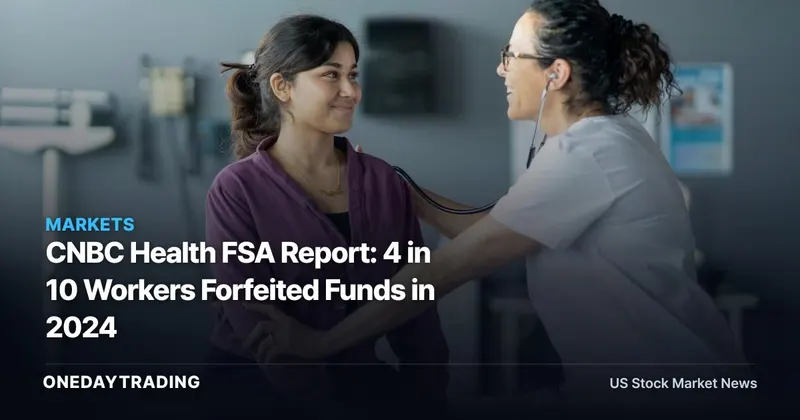
CNBC reported on 2026-11-07 that 4 in 10 workers with health FSAs forfeited unused funds in 2024, according to the Employee Benefit Research Institute. For investors, the useful signal is not a direct stock catalyst. It is a financial-behavior mechanism connecting pretax benefit elections, healthcare spending and forfeiture risk without establishing revenue or earnings effects for any listed company.
A health flexible spending account, or health FSA, lets a worker set aside pretax money for eligible health expenses. Its central trade-off is precise: contributions can reduce applicable taxes, while money left unused may return to the employer at the end of the plan year.
The evidence therefore resists a simple “lost money” interpretation. Jake Spiegel said a participant can retain an advantage over nonparticipation when the forfeited balance is smaller than the tax savings generated by the contribution. That threshold—not whether the ending balance reaches zero by itself—is the relevant test of an individual outcome.
Employee Benefit Research Institute Data Define the Scale
The Employee Benefit Research Institute examined more than 3.3 million accounts representing $3.9 billion in contributions, CNBC reported. Among account holders who forfeited money, the average loss was $404 in 2024, compared with $436 in 2023. Those figures describe affected account holders; they do not establish the total amount forfeited nationwide in 2024.
Access has widened across the worker groups in the supplied evidence. Bureau of Labor Statistics figures cited by CNBC show that 72% of state and local government workers had access to a health FSA in 2026, versus 68% in 2017. Private-sector access was 47% in 2026, compared with 40% in 2017.
Broader access increases the relevance of benefit-election behavior, but it does not reveal how many workers will forfeit funds in 2026 or how many will choose an FSA for 2027. Participation, contribution size, eligible spending and plan terms remain separate variables.
Why a Forfeiture Can Still Leave a Net Tax Benefit
FSA contributions generally avoid federal and payroll taxes and may also avoid state and local taxes. Sean Lovison of Purpose Built Financial Services illustrated the arithmetic with a 35% total tax rate and the $3,400 maximum contribution for 2026. Under that example, estimated tax savings equal $1,190.
The comparison is between the participant’s applicable tax savings and the amount forfeited. If the forfeiture is below the tax benefit, participation can still produce a net advantage relative to paying the same eligible expenses with after-tax money. The calculation is personal because each worker’s applicable taxes, contribution and unused balance can differ.
The IRS maximum contribution rises from $3,400 in 2026 to $3,500 in 2027. That higher ceiling expands the amount a worker may elect to contribute, not the amount every worker should contribute. The final number of workers electing health FSAs for 2027 is unknown.
Plan Rules Determine the Real Use-It-or-Lose-It Risk
Employers may permit a carryover or provide a grace period, but they cannot offer both. The maximum health FSA carryover is $680 in 2026, while the maximum grace period is 2.5 months. Many plans use Dec. 31 as the spending deadline, though an individual worker’s actual deadline and available provision depend on that worker’s plan.
Rachel Rouleau stressed the importance of checking plan-specific deadlines. She is associated in the reporting with Health-E Commerce, the parent company of FSA Store and HSA Store. That relationship identifies businesses serving FSA and HSA users, but the fact sheet supplies no sales, traffic, margin or market-share data from which to infer an equity impact.
Health savings accounts, or HSAs, differ on the balance-sheet question for the account holder: HSA balances can roll over from year to year and may be invested. The distinction matters because an FSA’s possible forfeiture changes the contribution decision, while an HSA does not impose the same year-end balance outcome.
Healthcare Spending Channels Without a Listed-Stock Catalyst
- Healthcare services: Eligible FSA spending includes certain healthcare services. Using available funds may redirect a participant’s pretax balance toward qualifying care, although the evidence provides no provider-level revenue data.
- Eligible consumer health products: Over-the-counter medications, menstrual care products, sunscreen, first-aid supplies and certain health-monitoring devices may qualify. The supported implication is a spending channel, not a forecast for product demand or retailer earnings.
- FSA-focused retail: Health-E Commerce owns FSA Store and HSA Store. No listed parent, ticker, financial result or measurable commercial benefit is established, so attaching a U.S.-listed equity symbol would overstate the evidence.
- Employers and account holders: Employers set the available carryover or grace-period structure, while workers bear the consequence of contribution estimates that exceed eligible spending. The facts do not quantify employer gains or individual net benefits.
Net Savings Case Versus Forfeiture Risk
Constructive case: Pretax treatment can outweigh an unused balance. In the supplied 2026 example, $1,190 of estimated tax savings creates room for some forfeiture before the participant loses the net advantage over nonparticipation. A carryover or grace period may further reduce the amount exposed to forfeiture when the plan offers one of those provisions.
Risk case: Healthcare needs are uncertain when workers make contribution elections. A participant who overestimates eligible spending can surrender part of the balance, and the maximum contribution should not be treated as an optimal election. The $404 average forfeiture among affected account holders in 2024 cannot determine any particular worker’s result.
The balanced reading is neutral for equities. The data support a household tax-efficiency question and identify categories of eligible healthcare spending, yet they do not connect FSA behavior to reported sales, profits or valuation changes at a public company.
FSA Checkpoints Before the Next Benefit Election
- Confirm the governing deadline: Determine whether the plan uses Dec. 31 or another plan-specific date before assuming when funds must be spent.
- Identify the available protection: Check whether the employer offers a carryover, a grace period or neither; both cannot be offered together.
- Compare savings with exposure: Apply the worker’s relevant tax rates to the contribution, then compare the resulting tax benefit with the balance at risk of forfeiture.
- Calibrate the next election: Review expected eligible healthcare services and qualifying products before choosing a 2027 contribution, recognizing that the permitted maximum is $3,500 rather than a recommended amount.
📊 Analysis
Signal Neutral
Why FSA participation can preserve a net tax benefit despite forfeitures, but the evidence identifies no measurable directional impact on a listed company or sector.
This article was independently written by OneDayTrading from public reporting. Read the original (CNBC)