What Berkshire Hathaway’s Outperformance Really Signals
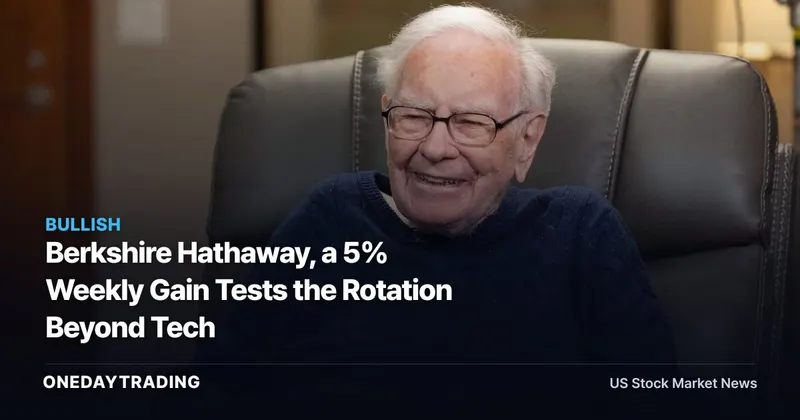
Berkshire Hathaway shares outperformed during a week of falling technology stocks, giving investors a clear contrast between the conglomerate and the major indexes. The Nasdaq Composite declined 3.4% this week, according to CNBC, a steeper drop than the S&P 500’s almost 2.7% decline. Berkshire’s more-than-5% gain therefore represents both absolute strength and a wide relative spread.
That spread is the central market signal. Berkshire Hathaway is a conglomerate whose listed equity holdings and operating businesses expose shareholders to several distinct sources of value rather than a single technology theme. When leadership narrows or technology shares weaken, that mix can attract attention because the company’s outcome is not determined by one holding alone.
The tape has already registered that distinction through Berkshire’s weekly gain and its 5.8-percentage-point year-to-date lead over the S&P 500. It has not resolved whether this is a durable reassessment of Berkshire’s operating value or a temporary relative move during technology-stock weakness. Future performance for Berkshire Hathaway, Alphabet, Apple and Sirius XM remains unknown.
Capital Strength Behind the Berkshire Hathaway Trade
Berkshire Hathaway reported 365.5 billion dollars in cash as of June 30, according to CNBC. It also repurchased 4.5 billion dollars of its shares in Q2 2026. Those figures give the market two concrete reference points: substantial financial capacity and a demonstrated willingness to return capital through repurchases.
A repurchase reduces shares held by outside investors and can increase each remaining share’s proportional claim on the company, all else equal. Its value still depends on the price paid and the subsequent performance of the businesses and investments underneath Berkshire. The fact sheet provides the amount repurchased, not the valuation judgment behind those purchases.
Berkshire Hathaway’s stated value of 1,222,245,324,463 dollars also frames the scale of the move. At that size, a sustained rerating requires more than enthusiasm around one portfolio position. Operating execution, capital deployment and the performance of major holdings must collectively support the market’s assessment.
Alphabet Keeps Berkshire Connected to the Technology Debate
Berkshire’s outperformance does not mean it is detached from technology. At the end of June, Berkshire Hathaway reported owning almost 106 million Alphabet shares. The Alphabet position was valued at 37.8 billion dollars on June 30 and at 30.2 billion dollars currently, according to CNBC.
That change matters because Alphabet is Google’s parent company and a large Berkshire equity holding. It places technology exposure inside the same portfolio investors may be treating as a counterweight to technology weakness. The diversification thesis is therefore about degree, not complete insulation.
Greg Abel, who leads Berkshire Hathaway, said artificial intelligence was “going to have a significant impact on America and businesses” and added that “we saw Google as a significant player,” CNBC reported. His comments connect the Alphabet holding to a long-duration strategic view, though they do not establish how the investment will perform.
The next documentary checkpoint is Berkshire Hathaway’s disclosure covering the third quarter ended September 30. Whether the company changed its Alphabet position during that quarter is unknown. A larger, smaller or unchanged holding would provide evidence about capital allocation, but none of those outcomes can be assumed in advance.
Berkshire Hathaway Energy Adds Opportunity and Regulatory Risk
Abel also discussed opportunities for Berkshire Hathaway Energy, placing the energy business alongside Alphabet in Berkshire’s strategic exposure. The fact sheet does not quantify that opportunity, so it should not be treated as current revenue, earnings or an achieved result.
The more measurable utility issue sits at Pacific Power, a unit of Berkshire Hathaway’s PacifiCorp. Pacific Power asked California regulators for a proposed 57% rate increase that would add 120 dollars per month to the typical residential bill. Regulatory approval is unknown, making the request a live condition rather than a secured financial benefit.
The proposal involves 103 million dollars, while Pacific Power faces 637 million dollars in claims related to fires in 2020 and 2022. For investors, the transmission mechanism runs through regulation and liabilities: an approved increase could affect customer bills and the utility’s financial position, while rejection or modification would produce a different outcome. The next useful evidence is the regulators’ decision and its final terms.
Portfolio Winners, Exposures and Pressure Points
- Berkshire Hathaway: Shares gained more than 5% this week, beat falling major indexes and stood 5.8 percentage points ahead of the S&P 500 year-to-date. The 4.5-billion-dollar Q2 2026 repurchase adds a capital-return support point.
- Sirius XM: Berkshire Hathaway owns Sirius XM shares and made a 27-million-dollar addition. Sirius XM posted 14% growth in Q3, while its shares gained 18.6% since the earnings release and 62.0% year-to-date.
- Alphabet: The position links Berkshire to Google’s parent company and to Abel’s long-term view of artificial intelligence. Its valuation moved from 37.8 billion dollars on June 30 to 30.2 billion dollars currently, creating a clear portfolio pressure point.
- Apple and Coca-Cola: Berkshire Hathaway owns both companies. Apple remains a major exposure at a current value of 78 billion dollars, while the fact sheet supplies no current valuation for Coca-Cola and no basis for comparing their future performance.
- Pacific Power and PacifiCorp: The proposed 57% rate increase could affect the utility’s financial position, subject to regulatory approval, while the 637-million-dollar fire-claims figure defines a separate liability risk.
Risk Check: What the Weekly Rally Does Not Settle
- Relative strength can reverse: One week of outperformance does not determine the future path of Berkshire Hathaway, the S&P 500 or the Nasdaq Composite.
- Alphabet remains material: The decline in the stated value of Berkshire’s position shows that technology weakness can still transmit into the portfolio.
- Utility economics depend on policy: Pacific Power has requested a rate increase; California regulators have not been confirmed as approving it.
- Leadership is part of the valuation question: Warren Buffett revealed on May 3, 2025, that he would step down as CEO at the end of 2025. Investors must assess Abel’s capital allocation through disclosed actions rather than assume continuity or change.
The Next Tests for Berkshire Hathaway Investors
The bullish evidence is visible: Berkshire Hathaway gained more than 5% this week, leads the S&P 500 by 5.8 percentage points year-to-date, holds 365.5 billion dollars in cash as of June 30 and repurchased 4.5 billion dollars of shares in Q2 2026. Those facts support the view that the company can serve as a differentiated large-cap holding when technology leadership weakens.
The counterweight is equally concrete. Alphabet’s position value has declined from its June 30 level, Pacific Power’s proposed increase remains subject to regulators, and future share performance is unknowable. The most informative next checks are Berkshire’s third-quarter Alphabet disclosure, the California regulatory outcome and later evidence of how Abel deploys capital across Berkshire Hathaway Energy, listed holdings and repurchases.
Market data check: Berkshire Hathaway Inc. New
Berkshire Hathaway Inc. New last traded near $570.89 (-0.25%). Our composite signal — blending price momentum and news flow — reads 🟡 neutral. Price momentum scores 56/100.
Data as of publication. Price via market feeds; for reference only, not investment advice.
📊 Analysis
Signal Bullish
Why Berkshire Hathaway’s weekly gain, year-to-date benchmark lead and share repurchases support a positive reading, tempered by Alphabet and Pacific Power risks.
Tickers$BRK-B$GOOGL$AAPL$SIRI
This article was independently written by OneDayTrading from public reporting. Read the original (CNBC)