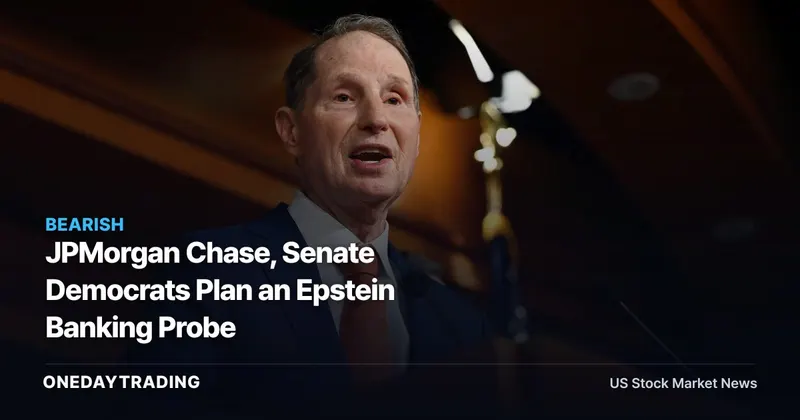
JPMorgan Chase Faces a New Layer of Epstein Scrutiny
JPMorgan Chase investors now face a governance question layered onto a banking controversy that has already produced large settlements. CNBC reported on 2026-11-05 that Democratic Senate Finance Committee staffers plan to investigate how senior executives handled Jeffrey Epstein after Democrats take control of Congress, with Ron Wyden likely to chair the committee beginning in January.
The planned Senate Finance Committee investigation is an examination of executive decisions surrounding Epstein’s banking relationship, not a completed finding of new wrongdoing. Its immediate significance for JPMorgan Chase is therefore less about a quantified financial charge than about whether congressional scrutiny uncovers information beyond the depositions, settlements and allegations already disclosed.
Why Mary Callahan Erdoes Is Central to the Planned Probe
The expected focus is the gap between what senior management knew and when JPMorgan Chase ended the relationship. Mary Callahan Erdoes, CEO of the bank’s asset and wealth management division, said in a 2023 deposition that she knew as early as 2006 that Epstein had been accused of paying cash to have underage girls brought to his home.
Epstein became a JPMorgan client in 1998. He pleaded guilty in 2008 to a Florida state criminal charge of procuring an underage girl for prostitution and became a registered sex offender, while the bank did not terminate his client relationship until 2013.
Jamie Dimon said in his own 2023 deposition that Erdoes had authority to end the relationship. That testimony gives investigators a defined decision chain to examine: awareness of accusations, authority over the account and the timing of the eventual exit. It does not establish what the committee will conclude.
The Settlements Set the Financial Baseline
JPMorgan agreed in mid-2023 to a $290 million settlement with Jeffrey Epstein’s victims without admitting wrongdoing. JPMorgan also agreed in 2023 to pay the U.S. Virgin Islands $75 million to settle a lawsuit alleging that the bank facilitated and benefited from Epstein’s sex trafficking.
Those amounts are the clearest financial reference points available to investors. They show that the relationship has already generated material payments, while the fact sheet provides no estimate for any additional cost tied to the planned Senate investigation.
In 2023, U.S. Virgin Islands lawyer Mimi Liu told a federal judge that JPMorgan “was a full-service bank for Jeffrey Epstein’s sex trafficking.” She also criticized reporting that followed 16 years of money flowing through his JPMorgan accounts. These were allegations made by the territory’s lawyer, not findings supplied by the planned congressional inquiry.
Executive Accountability Extends Beyond One Relationship Manager
JPMorgan blamed former investment banking chief Jes Staley for concealing or failing to report criminal activity related to Epstein. Staley denied knowing about Epstein’s crimes. He left JPMorgan in 2013, later became CEO of Barclays and stepped down from that role in 2021.
James Comer said in July, after a closed-door interview with Staley, that the former executive had encouraged JPMorgan to retain Epstein as a client. For investors, the unresolved issue is whether an inquiry remains centered on Staley or traces responsibility through a broader group of senior decision-makers.
Epstein died by suicide in jail in August 2019 after his arrest on federal child sex-trafficking charges. His prior relationships included Donald Trump and Bill Clinton; Trump has not been charged with wrongdoing in connection with Epstein.
Ron Wyden’s Broader Banking Record Raises the Stakes
Ron Wyden released a report in August accusing senior officials at multiple banks of “looking the other way” while Epstein moved hundreds of millions of dollars to finance a years-long sex-trafficking operation. His office said bankers delayed reporting suspicious financial activity to the U.S. government and named officials responsible for that reporting.
The report also addressed suspicious activity reported by Deutsche Bank after Epstein’s death and transfers through accounts at Bank of America. That broader frame matters because the planned inquiry may test bank controls and executive escalation decisions across institutions, even though the specific new investigation described by CNBC centers on JPMorgan Chase.
Leon Black, the former CEO of Apollo Global Management, paid Epstein $158 million for financial advice in the years after Epstein’s 2008 conviction. Black sued the House oversight panel in September over subpoenas and sued Robert Garcia on Wednesday over statements linking him to Epstein’s crimes; the outcomes of those lawsuits are not provided.
What the Planned Probe Could Mean for JPMorgan Stock
- Bear case: Congressional examination could intensify attention on the judgment of current and former JPMorgan Chase executives. A focus on who had authority, what was known and why the client relationship continued until 2013 could keep governance and control questions attached to the bank.
- Countercase: JPMorgan has already settled the victims’ case and the U.S. Virgin Islands lawsuit without admitting wrongdoing. The fact sheet identifies no new claim, penalty or quantified financial exposure arising from the planned investigation.
- Escalation risk: Ron Wyden is likely to begin chairing the Senate Finance Committee in January, placing a lawmaker who has already criticized banks’ Epstein controls in a position to direct the inquiry.
- Scope constraint: The investigation has not been formally announced. Its start date, final scope, witnesses and subpoena targets are unknown, and JPMorgan Chase’s response to the plan is not given.
The Evidence Investors Should Track Next
The first checkpoint is the Senate Finance Committee’s formal description of the inquiry. Investors need to see whether it concentrates on Mary Callahan Erdoes, expands to Jamie Dimon or Jes Staley, or reaches the bank’s wider processes for escalating and reporting suspicious activity.
The second checkpoint is documentary scope. Requests for depositions, internal communications or reporting records would indicate which decisions the committee intends to reconstruct. Until those targets are identified, the distance between renewed political scrutiny and additional financial exposure cannot be measured from the supplied facts.
The third checkpoint is JPMorgan Chase’s response. A detailed account of executive authority and the decision to retain Epstein through 2013 would help investors compare the bank’s position with the 2023 testimony and prior allegations.
The Department of Justice records provide another potential source of information after Congress ordered the agency to make its Epstein files public. Those files became a major focus in late 2025 and early 2026, with Donald Trump’s name referenced thousands of times; that fact does not imply wrongdoing, and Trump has not been charged in connection with Epstein.
For JPMorgan stock, the live issue is not a known new liability. It is whether the committee produces evidence that changes the established record of executive knowledge, authority and control failures. January’s expected committee leadership change is the next identified event at which that risk may become more concrete.
Market data check: JP Morgan Chase & Co.
JP Morgan Chase & Co. last traded near $340.69 (-3.24%). Our composite signal — blending price momentum and news flow — reads 🟡 neutral. Price momentum scores 24/100 (soft).
Data as of publication. Price via market feeds; for reference only, not investment advice.
📊 Analysis
Signal Bearish
Why The planned investigation could renew scrutiny of JPMorgan Chase’s executive oversight and handling of Jeffrey Epstein, while its scope and financial consequences remain unknown.
This article was independently written by OneDayTrading from public reporting. Read the original (CNBC)