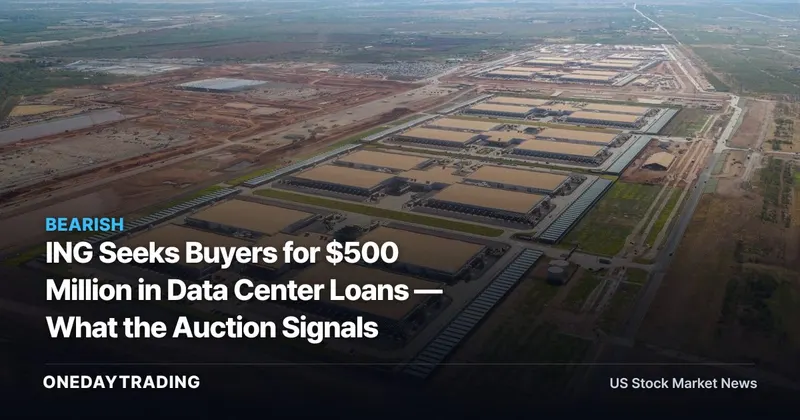
ING’s Loan Auction Puts AI Financing Under the Microscope
ING’s reported effort to find buyers for around $500 million of data center loans turns an abstract concern about AI financing into a transaction investors can evaluate. CNBC’s article dated 2026-11-06 says Bloomberg reported that the bank is marketing a portfolio of 12 data center loans. The immediate read-through is cautious for banks financing data center construction and for AI infrastructure companies whose projects depend on continued access to capital.
This is not evidence that the underlying projects have failed or that ING expects losses. It does show that risk tied to data center lending is being offered to a broader pool of investors at a moment when the market is questioning the financing behind AI infrastructure. For shareholders, the critical evidence will come from demand for the loans and the terms required to place them, neither of which has been disclosed.
What ING’s BWIC Process Actually Tests
A bids-wanted-in-competition auction, or BWIC, is a competitive process through which investors bid for pieces of a loan portfolio. Bloomberg reported that ING plans to use this format, with bids of $10 million or more due by Nov. 19. The year associated with that deadline is not stated in the article body.
The process matters because it can reveal whether private credit investors, asset managers and insurers are prepared to absorb data center exposure from banks. Hank Calenti, global markets strategist at SMBC, told CNBC that buyers could come from each of those groups. Their participation would support the view that the auction is a distribution exercise rather than a broad rejection of AI infrastructure debt.
Calenti framed the ambiguity directly: the sale could represent ordinary business or an attempt by financiers to leave before conditions become less favorable. That distinction cannot be settled from the announcement alone. The identities of prospective bidders, the prices or discounts being sought, and whether ING will accept any bid remain unknown.
The $25 Million Stargate Link Raises the Equity Stakes
The reported portfolio includes a $25 million piece connected to the Stargate project in New Mexico. OpenAI, SoftBank and Oracle are involved in that project, making Oracle the clearest U.S.-listed operating company directly connected to this portion of the auction.
For Oracle investors, the loan’s inclusion is a financing signal rather than evidence about project performance. The fact sheet provides no project returns, construction status or terms for the debt. Any equity conclusion therefore has to remain conditional: weak bidding could reinforce concern about the availability or cost of financing, while broad participation could suggest that investors remain willing to hold the exposure outside bank balance sheets.
The portfolio also contains certain loan assets involving Vantage Data Centers and CyrusOne. The individual borrowers, values and terms across all 12 data center loans have not been disclosed, so the aggregate $500 million figure cannot be used to rank the exposure of the named projects.
Why Banks May Want to Distribute Data Center Credit
For ING, the balance-sheet question is whether the benefit of transferring exposure outweighs the economic cost of doing so. Calenti said that assessment includes the discount received, the value of exiting, the ability to free cash for further lending and the need to explain the exposure internally. Since the auction’s pricing is unavailable, investors cannot determine which side of that trade-off currently dominates.
A completed sale could move some credit risk from ING to successful bidders. Failure to sell, or bids requiring an undisclosed discount, would carry a different implication. No bids have been identified, and there is no confirmation that a transaction will close.
ING is not the only bank linked to efforts to manage this category of exposure. The Financial Times reported on May 3 that JPMorgan Chase and Morgan Stanley had explored approaches to reduce lending exposure to data center construction. The year of that report date is not explicitly stated in the CNBC article body. Taken together, the reports establish that multiple banks have examined ways to distribute or reduce exposure; they do not establish common motives, losses or completed sales.
The Nasdaq’s 5.5% Drop Shows How Sensitive the Theme Has Become
The Nasdaq Composite Index closed Thursday’s session down 5.5%, according to CNBC, its worst day since April 2025. The move demonstrates that investors were assigning greater risk to the technology-heavy market during that session, though the fact sheet does not quantify how much of the decline came from data center financing concerns.
Pruksa Iamthongthong, head of APAC equities at Aberdeen Investments, said near-term volatility could persist while the market assesses potential delays to U.S. data center construction and constraints around compute capacity. That formulation identifies the key transmission channel: financing uncertainty can affect expectations for construction, which can then influence how investors assess companies connected to AI infrastructure.
The tape has already registered concern through the Nasdaq Composite Index decline. What it has not priced with observable transaction evidence is the clearing level for ING’s loans, the depth of bidder demand or the probability that the portfolio is sold. Those missing inputs separate market anxiety from a measurable credit outcome.
Related Stocks and Sectors
- ING: The bank is the subject of the reported $500 million portfolio auction. The investment question is whether distribution frees capacity on acceptable terms or requires a concession that has not been disclosed.
- Oracle: Its connection comes through the Stargate project in New Mexico. The auction includes a $25 million piece linked to that project, though no operating or financial impact on Oracle has been established.
- JPMorgan Chase and Morgan Stanley: The Financial Times reported that both had explored approaches to reduce data center construction lending exposure. Investors should distinguish exploration from a completed transfer or a disclosed loss.
- AI infrastructure and bank lending: The event links project financing with equity sentiment. Its broader significance depends on whether investors compete for the loans and on the economic terms of any accepted bids.
What the Nov. 19 Bidding Deadline Can Clarify
- Bidder participation: Evidence that private credit investors, asset managers or insurers submitted bids would help establish the depth of non-bank demand.
- Transaction pricing: Any disclosed price or discount would show the cost ING faced to distribute the loans. No such figure is currently available.
- Accepted bids: Offers alone would not confirm a sale. Investors need to see whether ING accepts bids and completes a transaction.
- Loan-level disclosure: Additional details on the borrowers, values and terms of the 12 loans would allow a more precise assessment of which projects carry the exposure.
A Bearish Signal, Not a Proven Credit Break
The cautious interpretation rests on observable facts: ING is reportedly offering 12 data center loans worth around $500 million, a portion is linked to Stargate, other assets involve Vantage Data Centers and CyrusOne, and the Nasdaq Composite Index fell 5.5% in Thursday’s session. Those facts justify treating AI infrastructure financing as a live market risk.
The countercase is equally important. Hank Calenti’s explanation leaves room for ordinary loan distribution, and the auction may attract buyers willing to hold the assets. The event becomes more consequential if bidding is weak or if ING accepts terms that imply a meaningful concession; it becomes less alarming if broad demand supports placement on acceptable terms.
The next decisive evidence is the reported BWIC process itself. Bid participation, disclosed pricing and any accepted sale will determine whether this was routine balance-sheet management or a clearer warning from the market financing the AI data center build-out.
Market data check: ING Group, N.V.
ING Group, N.V. last traded near $31.94 (-2.11%). Our composite signal — blending price momentum and news flow — reads 🟡 neutral. Price momentum scores 33/100 (soft).
Data as of publication. Price via market feeds; for reference only, not investment advice.
📊 Analysis
Signal Bearish
Why The reported loan sale and a 5.5% Nasdaq Composite Index decline point to greater investor caution around AI infrastructure financing, though no sale outcome is known.
This article was independently written by OneDayTrading from public reporting. Read the original (CNBC)