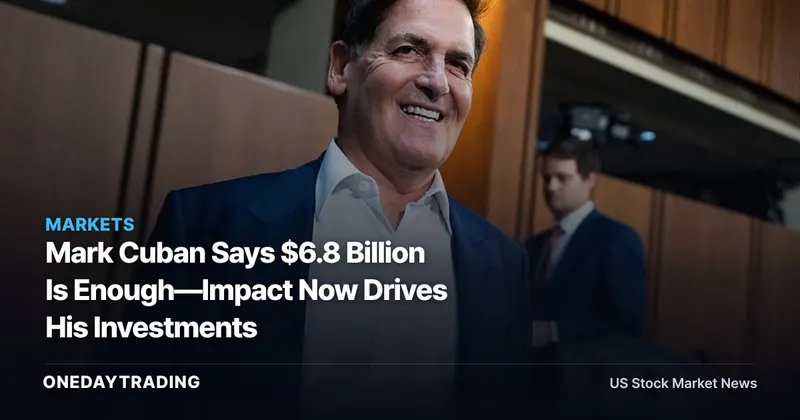
Mark Cuban Reframes the Purpose of Capital
Mark Cuban’s message is relevant to investors because it separates capital accumulation from capital allocation: in a CNBC article dated 2026-11-07, he said increasing his net worth no longer matters to him and that investments capable of affecting other people’s lives now take priority. The exact date of his X post was not stated.
Forbes currently estimates Mark Cuban’s net worth at $6.8 billion and ranks him as the 597th wealthiest person in the world, according to CNBC. Those figures establish the scale of the capital behind his comments, while providing no evidence that his approach creates a positive or negative catalyst for any public stock.
Impact-driven investing, as Cuban describes it, means evaluating an investment partly by what the deployed money can do for other people rather than by how much it adds to his personal wealth. His sharpest formulation was that his next dollar could affect other people’s lives more than his own.
From MicroSolutions to Broadcast.com
The history in the report explains why Cuban can define “enough” from a position of substantial financial security. Mark Cuban sold MicroSolutions for $6 million in 1990. Mark Cuban and his co-founders then sold Broadcast.com to Yahoo for $5.7 billion in 1999, a transaction that made him a billionaire.
He connected the change in emphasis to the period after buying a majority stake in the Dallas Mavericks in January 2000. Speaking to CNBC Make It, Cuban said he had become more interested in winning than in making money. The price paid for that majority stake was not provided, so the transaction cannot support a return calculation or a judgment about capital efficiency.
The sequence supports a narrow analytical distinction. The MicroSolutions and Broadcast.com sales document wealth creation; the Dallas Mavericks comment documents a change in what Cuban said motivated him. It does not establish that purpose replaced financial discipline, nor does it reveal the return standards he applies when choosing investments.
Cost Plus Drugs and Shark Tank Show the Stated Priority
Cuban cited Cost Plus Drugs, which he launched, and investments made across 15 seasons of Shark Tank as examples of seeking impact. These examples identify where he says his priorities appear in practice, though the supplied evidence does not quantify their effect on customers, portfolio companies or his own finances.
That limitation matters for an equity-market audience. A mission can shape where capital is directed, but investors still need measurable evidence before translating a stated purpose into revenue durability, operating performance or investment value. None of those company-level metrics appears in the available facts.
The investment read-through is therefore about decision criteria, not a disclosed change in financial results. Cuban’s statement suggests that maximizing his place on the Forbes 400 is not his objective. It offers no asset list, liability schedule or portfolio weighting beneath the current net-worth estimate, preventing a balance-sheet analysis of how closely his holdings match that preference.
The Financial-Mindset Debate Behind Cuban’s Claim
- Who defines enough: Christine Hargrove said individuals must decide for themselves what constitutes enough. Her view frames financial confidence and a sense of purpose around money as signs of a healthy mindset.
- Purpose versus measurement: Cuban says impact drives his investments, while the evidence provides no quantified impact. Investors can treat the statement as a declared objective, not as proof that the objective has been achieved.
- Security versus universal relevance: Cuban speaks with a currently estimated $6.8 billion net worth. His circumstances make the principle clear, but the facts do not establish that every investor has comparable freedom to prioritize nonfinancial effects.
- Stress as an economic constraint: A 2024 TIAA Institute report said financial stress and related mental-health challenges can impair workplace performance through distraction and absenteeism. TIAA Institute is the research arm of TIAA.
Why the Public-Market Signal Is Neutral
This is not an earnings announcement, guidance revision or disclosed transaction. No listed company is identified as receiving new capital, losing funding or changing strategy because of Cuban’s post. Assigning a bullish or bearish stock-market direction would therefore outrun the evidence.
Yahoo appears in the history because it acquired Broadcast.com in 1999. That relationship explains an important step in Cuban’s wealth creation, but the facts do not establish a current operating or investment consequence for Yahoo. Cost Plus Drugs and the Dallas Mavericks are relevant to his stated priorities, yet no public-market symbol or fresh financial result is supplied for either entity.
The sector connection is broadest in financial behavior and capital allocation. For retail investors, the useful question is whether a declared objective can be tied to observable decisions. Here, Cuban supplies examples of where he seeks impact; he does not supply the financial or social measurements required to compare those investments.
What Evidence Could Change the Assessment
- Quantified impact: Check future disclosures or statements for a defined measure of how Cost Plus Drugs or Cuban’s Shark Tank investments affect other people’s lives. The current evidence offers no such figure.
- Investment criteria: Look for details showing how Cuban weighs impact against financial return when the two objectives conflict. His comments identify the priority without describing the decision rule.
- Portfolio evidence: Any future information about assets, liabilities or allocation would make the Forbes estimate more analytically useful. Those underlying components are absent here.
- Consistency over time: Compare later investments with the standard Cuban stated—whether the next dollar can do more for others than for him—rather than assuming every investment automatically satisfies it.
Christine Hargrove’s Test: Purpose Without Overclaiming
Christine Hargrove is president-elect of the Financial Therapy Association and Assistant Director of the Love and Money Center at the University of Georgia. She argued that confidence about saving or spending, combined with a sense of purpose, can indicate a healthier relationship with money.
That assessment complements Cuban’s statement without converting it into investment performance. Cara Macksoud was also identified in the source discussion of financial behavior, while the confirmed evidence centers on Hargrove’s view and the TIAA Institute finding about financial stress.
CNBC Select was identified as editorially independent in the source material. Its presence does not alter the core analytical boundary: Cuban’s comments establish what he says motivates his capital allocation, not a verified outcome for investors or beneficiaries.
Mark Cuban’s Outlook Depends on Proof of Impact
The constructive case is that an investor with substantial resources has articulated a clear destination for incremental capital and named Cost Plus Drugs and Shark Tank investments as examples. A defined purpose may make future allocation choices easier to evaluate against his own stated standard.
The countercase is evidentiary. There is no quantified impact, no current portfolio breakdown and no disclosed return framework connecting purpose to financial performance. The next meaningful signal will not be another wealth ranking; it will be evidence that Cuban’s chosen investments produce the effects he says now drive them.
📊 Analysis
Signal Neutral
Why Cuban’s investment philosophy has no quantified financial impact or direct, evidence-supported catalyst for a listed company.
This article was independently written by OneDayTrading from public reporting. Read the original (CNBC)