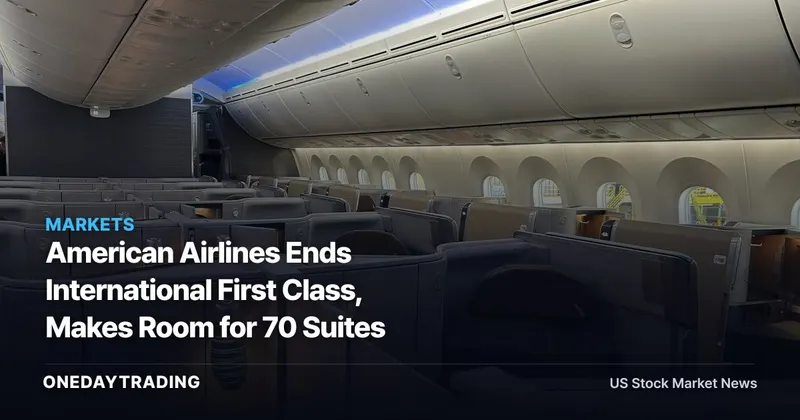
American Airlines Replaces Exclusivity With Premium Capacity
American Airlines ended long-haul international first-class service when its final flight departed Sydney for Los Angeles on Friday morning local time. The investor read-through is not simply that a cabin label disappeared: the airline is replacing a narrow premium tier with a larger business-class cabin whose commercial value will depend on pricing, demand and execution. CNBC reported that the final international first-class section contained 8 suites, while the new American Airlines business-class cabin will accommodate 70 passengers.
A mega business-class cabin is a large collection of lie-flat premium suites designed to serve as an airline’s top long-haul product without a separate international first-class section. American Airlines was the last U.S. airline still offering that distinct tier on long-haul international routes. Delta Air Lines and United Airlines had already moved their comparable top cabins to business-class suites.
The central investment thesis is therefore about capacity allocation. American Airlines is expanding the number of seats in the premium product it intends to sell broadly, while removing a smaller product that sat above it. That can create more premium inventory, though the fact sheet provides no replacement-cabin pricing or financial results attributable to the change.
How American Airlines Reworks the Boeing 777-300ER Cabin
American Airlines plans 70 business-class suites in each remodeled Boeing 777-300ER cabin. Before the overhaul, the configuration carried 8 first-class suites and 52 business-class pods. The redesign consolidates those premium areas around a single larger business-class proposition, although the completion date for remodeling the fleet is not stated.
The comparison matters because the airline is not merely renaming the former first-class seats. It is changing the mix and scale of premium accommodation across the cabin. For investors, the relevant question is whether the expanded suite inventory can be sold at prices that compensate for the space assigned to each premium passenger.
A price snapshot reported by CNBC illustrates the distinction the airline is retiring. This week, American Airlines offered a one-way business-class ticket between Los Angeles and London for $12,994 and a one-way first-class ticket for $15,669. Those prices describe the outgoing configuration, not the future 70-suite cabin, so they cannot establish the replacement product’s pricing or revenue contribution.
The Business-Class Expansion Extends Beyond One Aircraft
American Airlines said it is growing business-class cabins across its fleet. A current Boeing 787-9 Dreamliner subfleet has 51 business-class suites, while the airline is evaluating whether to increase its smaller Boeing 787-8 Dreamliners from 20 suites currently to a count somewhere in the 30s. The final Boeing 787-8 suite count has not been decided.
Nat Pieper, American Airlines’ chief commercial officer, framed the strategy directly: “You need more business-class seats.” His statement supports the capacity thesis, but it does not establish the eventual demand, achieved price or financial return from adding those seats. The distinction is essential because cabin supply is observable before commercial performance is.
American Airlines will retain a separate lie-flat domestic first class on its Airbus A321T cross-country subfleet until early 2027. That means the current decision ends international long-haul first class before the domestic product carrying the first-class name disappears. Investors should treat those transitions as separate cabin changes rather than one completed fleetwide event.
Why Business Class Can Absorb the Top Tier
Henry Harteveldt, founder of Atmosphere Research Group, said individual business-class pods, comfortable seats, bedding and suitable wine are sufficient for many travelers. He also observed, “It’s not like the bed can go any flatter than 180 degrees.” The implication is that physical differentiation becomes harder once business class already delivers a fully flat bed and a private pod.
This narrows the distinction between premium tiers to service details and incremental comfort rather than a fundamentally different sleeping position. In that setting, a larger business-class cabin may offer a clearer commercial proposition than maintaining a small international first-class section. Whether that proposition improves American Airlines’ economics remains unquantified in the supplied evidence.
United Airlines demonstrates that the larger-cabin concept is not confined to American Airlines: United Airlines plans 64 new suites for its relevant aircraft configuration. Mike Leskinen, United Airlines’ CFO, said on Thursday, “I don’t think we found the limit on segmentation,” followed by, “We’re not done.” His comments indicate continuing product segmentation, without specifying another configuration or its financial outcome.
A Split Global and Short-Haul Premium Market
The U.S. long-haul shift does not mean first class is disappearing everywhere. Singapore Airlines, Lufthansa, British Airways and Air France have unveiled updated first-class cabins and service improvements. Their actions show that international first class and enlarged business class can coexist as different strategic choices.
British Airways said last month that it would install 106 business-class suites on its Airbus A380 aircraft while also upgrading first class. That combination is an important counterexample to the idea that a very large business-class cabin necessarily eliminates the tier above it. It also keeps the American Airlines decision company-specific rather than evidence of a universal global endpoint.
The direction differs again on shorter routes. JetBlue Airways, Frontier Airlines and Allegiant Air are introducing domestic or short-haul first-class seats. Bobby Schroeter, Frontier Airlines’ chief commercial officer, discussed the airline’s comparative pricing last month, though the fact sheet supplies no price or financial projection.
Implications for American Airlines, Delta Air Lines and United Airlines
- American Airlines: The remodeled Boeing 777-300ER cabin will contain 70 business-class suites, replacing the prior mix of 8 first-class suites and 52 business-class pods. The opportunity is more inventory in the airline’s principal long-haul premium cabin; the risk is that neither replacement pricing nor attributable financial performance is available.
- Delta Air Lines: Its earlier replacement of international long-haul first class with business-class suites places American Airlines’ decision within an established U.S. carrier pattern. The supplied evidence does not provide Delta Air Lines cabin counts, pricing or financial effects.
- United Airlines: Its planned 64 new suites and management’s interest in further segmentation point to continued premium-product development. No resulting revenue, cost or profitability figures are provided.
- Airlines sector: The evidence supports a divergence by market rather than a uniform retreat from first class: U.S. long-haul carriers have consolidated around business-class suites, selected international airlines retain upgraded first class, and smaller airlines are adding the label on domestic or short-haul services.
The Bull and Bear Cases for Larger Premium Cabins
Bull case: More business-class suites give American Airlines more premium seats to offer than under the outgoing configuration. The product also occupies the tier that Delta Air Lines and United Airlines already use at the top of long-haul service. If travelers accept business-class pods as sufficient, the expanded cabin could support the airline’s premium-capacity strategy.
Bear case: Additional suites do not guarantee that demand will fill them at attractive prices. American Airlines has not disclosed pricing for the replacement 70-suite cabin, the completion date for the Boeing 777-300ER remodeling, or financial results specifically attributable to these cabin changes. International airlines continuing to upgrade first class also show that the premium market has not converged on a single model.
The neutral stance reflects that evidence gap. The physical capacity decision is confirmed, while the commercial outcome is not. A directional stock conclusion would require information about achieved pricing, demand and financial contribution that the fact sheet does not provide.
Investor Checkpoints for the American Airlines Cabin Strategy
- Track when American Airlines discloses a completion date for the Boeing 777-300ER remodeling program.
- Check whether the airline finalizes its Boeing 787-8 configuration in the 30s, compared with 20 suites currently.
- Look for pricing of the replacement 70-suite business-class cabin rather than applying this week’s $12,994 business-class or $15,669 first-class ticket examples to the new layout.
- Require separately identifiable financial results before attributing revenue or profitability changes to the cabin redesign.
📊 Analysis
Signal Neutral
Why A larger premium cabin may broaden sellable business-class capacity, but pricing, completion timing and financial results from the overhaul remain unknown.
This article was independently written by OneDayTrading from public reporting. Read the original (CNBC)