At a Glance
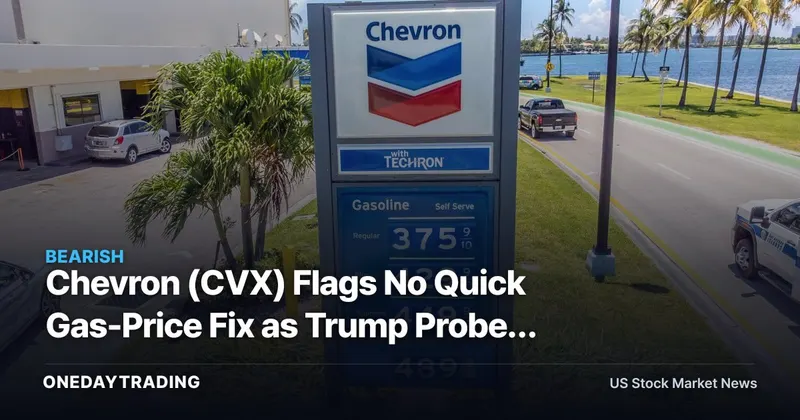
Chevron has pushed back on the idea that pump prices can fall fast, telling investors and consumers that any relief will take time. The comments land just as President Donald Trump ordered an investigation into Big Oil over alleged consumer gouging, putting integrated majors and refiners at the center of a political and regulatory crosscurrent.
Why It Matters Now
The friction here is structural, not rhetorical. Retail gasoline prices are set far downstream of the wellhead — they track crude benchmarks, refining margins (the crack spread), seasonal demand, regional fuel specifications and local taxes. When Chevron says a fix takes time, it is effectively pointing at a supply chain where a producer cannot simply flip a switch on prices it does not fully control. That is the WHY behind the cautious tone: even if a major wanted to cut prices to appease Washington, the marginal barrel and the refining bottleneck dictate the spread.
The gouging probe channel matters because it threatens the part of the business that has actually been earning: downstream refining and marketing. For integrated names like Chevron, upstream production and downstream refining are distinct profit pools. A government inquiry that targets pricing behavior pressures the downstream margin narrative precisely when crude is the bigger swing factor. The political optics also raise headline risk — buyback pacing, capital returns and forward guidance can all get scrutinized in an election-charged energy debate.
For investors, the read-through splits the sector. Pure upstream producers are leveraged to crude, refiners to crack spreads, and integrated majors sit in between with diversification as a buffer. A gouging investigation reframes part of the energy thesis from commodity price to regulatory and reputational risk.
FAQ
- Why can't Chevron just lower gas prices? Pump prices reflect crude costs, refining margins, distribution and taxes — most of which a single producer does not set unilaterally.
- What is the actual policy action? Trump ordered an investigation into Big Oil over alleged consumer gouging, a regulatory rather than legislative step.
- Who is most exposed? Integrated majors and refiners whose downstream pricing is the focus of any gouging review.
- Is this an earnings event? Not directly, but it adds headline and regulatory risk to forward guidance and capital-return narratives.
Related Stocks & Sectors
- Chevron (CVX) — the subject; integrated model gives diversification but puts it squarely in the gouging-probe spotlight.
- ExxonMobil (XOM) — the other US supermajor, exposed to the same downstream pricing scrutiny and political framing.
- ConocoPhillips (COP) — upstream-heavy, more leveraged to crude than to retail pump optics.
- Refiners (VLO, MPC) — most directly tied to crack spreads and the margin layer a gouging probe would examine.
- Energy sector broadly — sentiment risk if the inquiry widens to industry pricing practices.
What to Watch
- The scope and formal terms of the ordered investigation — whether it targets refiners, marketing, or producers.
- Refining margin trends (crack spreads) as the real driver of downstream profit.
- Crude benchmark moves, which set the floor under pump prices regardless of policy.
- Chevron and Exxon next earnings commentary on downstream margins and capital returns.
Overall Outlook
The bull case rests on diversification and discipline: integrated majors have multiple profit pools, and a probe over gouging is hard to convert into binding price controls in a market where crude and refining economics dominate. The risk case is that political pressure caps the downstream margin story, injects headline volatility, and complicates the capital-return thesis that has supported large-cap energy valuations. The deciding variable is whether the investigation stays rhetorical or produces concrete constraints — and whether crude cooperates in the meantime.
Market data check: CVX
CVX last traded near $171.45 (0.00%). Our composite signal — blending price momentum and news flow — reads 🟡 neutral. Price momentum scores 50/100.
Data as of publication. Price via market feeds; for reference only, not investment advice.
📊 Analysis
Signal Bearish
Why A federal gouging probe plus management's admission of no quick price relief adds regulatory and headline risk to Big Oil's downstream margin narrative.
Tickers$CVX$XOM$COP$VLO$MPC
This article was independently written by OneDayTrading from public reporting. Read the original (CNBC)