What Changes
Trump Media investors now have to price a business whose relevance may rise with its proximity to presidential communication, but whose risk rises for precisely the same reason. Sunday’s posting spree did not establish that the United States earned “hundreds of billions” from securities or other assets. It did demonstrate how quickly unsupported financial claims, official policy themes and synthetic media can converge on a publicly listed company’s platform.
Truth API is a $100,000-a-month Truth Social service that provides subscribers early access to announcements about policy decisions capable of moving markets. That proposition turns timing into the product. If subscribers believe the feed delivers consequential information before it reaches the wider public, the service may command a high price; if access, disclosure or trading rules become the dominant issue, the same feature may impose legal, compliance and reputational costs on Trump Media.
The transmission mechanism matters. A presidential statement can alter expectations about a company, industry, conflict or government asset; those expectations can move security prices before the underlying economic outcome is measurable. Early distribution therefore raises questions beyond whether a post is accurate: investors must also consider who received it first, whether it described policy or political messaging, and whether any market-sensitive statement was supported by evidence.
By the Numbers
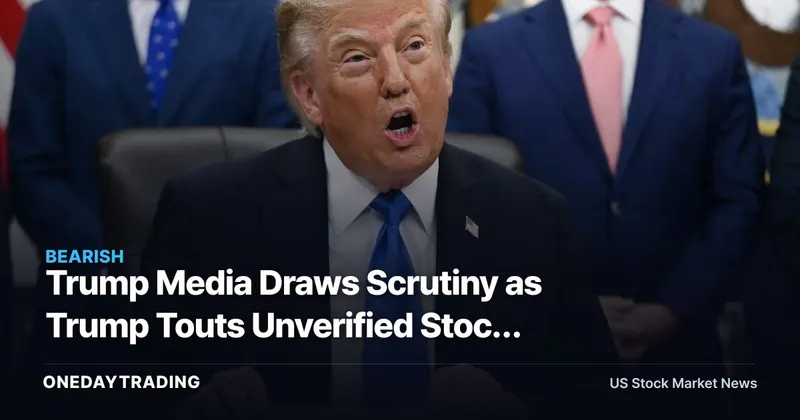
Trump, 80, spent more than 10 hours on Sunday posting dozens of apparently AI-generated images, according to CNBC. Among them was an image depicting him at multiple White House monitors tracking the stock market, paired with the unsupported assertion that he had generated hundreds of billions of dollars for the country through stocks and other holdings. The post did not provide a portfolio, acquisition cost, valuation method, realized proceeds or comparison date.
The administration’s Intel position offers a narrower, verifiable reference point within the reporting: a 10% stake acquired in August 2025 that is now worth more than $50 billion. That figure describes the current value of one holding, not the government’s profit on it. Without the stake’s cost basis and without evidence covering the other claimed assets, investors cannot convert the stated valuation into either realized gains or support for the much larger claim.
Winners & Losers
- Trump Media & Technology Group: Truth Social gains attention and potential strategic value when the president uses it as a primary publishing channel. Truth API could monetize demand for fast access at $100,000 per month, but its value depends on subscriber demand, the reliability of the information and the service’s ability to withstand regulatory examination.
- Intel: The company is directly tied to the story through the administration’s 10% stake, reported to be worth more than $50 billion. That establishes Intel as a significant government holding, but the source supplies no purchase price, operating benefit, policy concession or evidence that Sunday’s posts changed Intel’s business outlook.
- Market participants without early access: Traders face a potential information-timing disadvantage when policy-sensitive announcements reach paying customers first. The financial impact remains unquantified, and the reporting identifies no specific trade or market move caused by the service.
- Investors relying on social-media graphics: Several posts about Iran used infographics without verifiable sources, while the White House did not immediately provide further details. Unsupported visuals may create a strong narrative without supplying the evidence required to assess an asset, policy or economy.
Risk Check
- Regulatory risk: U.S. senators urged the SEC in July to investigate whether Trump Media’s Truth API violates applicable federal securities laws. A request for investigation is not an SEC finding, and the source reports neither an enforcement action nor a legal conclusion.
- Valuation-language risk: A holding worth more than $50 billion does not establish a $50 billion profit. Investors should separate market value, unrealized appreciation and realized government proceeds before treating political claims as financial performance.
- Credibility risk: The president’s stock-gain assertion arrived without supporting evidence, while multiple Iran-related economic claims were also presented without verifiable sourcing. Repeated uncertainty can weaken the informational value of a platform even as it increases engagement.
- Geopolitical risk: More than six months after the United States and Israel began major combat operations in Iran, CNBC reported little sign on Monday that the parties were preparing to resume negotiations. Claims of imminent economic collapse remain uncertain despite reported contraction in Iranian gross domestic product and historically high inflation.
Bottom Line
The investable issue is not whether a dramatic social post sounds bullish. It is whether Trump Media can turn privileged proximity to policy communication into durable, compliant revenue without undermining confidence in the information it sells. The next checkpoints are concrete: any SEC response to the senators’ July request, Trump Media disclosures showing whether Truth API attracts meaningful paying demand, and documentation that separates the Intel stake’s current value from its cost and actual return. Until those facts arrive, DJT carries a potentially valuable distribution advantage alongside unusually concentrated regulatory and credibility risk.
FAQ
Did Trump prove that he made hundreds of billions of dollars for the United States?
No evidence supporting that total was included in the post described by CNBC. The reported value of the government’s Intel stake exceeds $50 billion, but value is not the same as profit and cannot by itself validate the broader claim.
What is Truth API and why could it affect DJT stock?
Truth API is a $100,000-per-month Truth Social feature offering early access to policy announcements that may move financial markets. It could provide Trump Media with high-priced subscription revenue, but senators’ request for an SEC investigation introduces legal and reputational uncertainty.
Does the SEC investigation request mean Trump Media broke securities law?
No. Senators asked the SEC in July to determine whether Trump Media was violating applicable federal securities laws, but the source reports no finding or enforcement decision. Investors should distinguish a request for scrutiny from a proven violation and monitor the next formal SEC or company disclosure.
Market data check: DJT
DJT last traded near $9.02 (-5.25%). Our composite signal — blending price momentum and news flow — reads 🟡 neutral. Price momentum scores 8/100 (soft).
Data as of publication. Price via market feeds; for reference only, not investment advice.
📊 Analysis
Signal Bearish
Why Unverified market claims and senators’ request for an SEC investigation create credibility and regulatory risks for Trump Media, despite the potential subscription value of Truth API.
This article was independently written by OneDayTrading from public reporting. Read the original (CNBC)