Summary
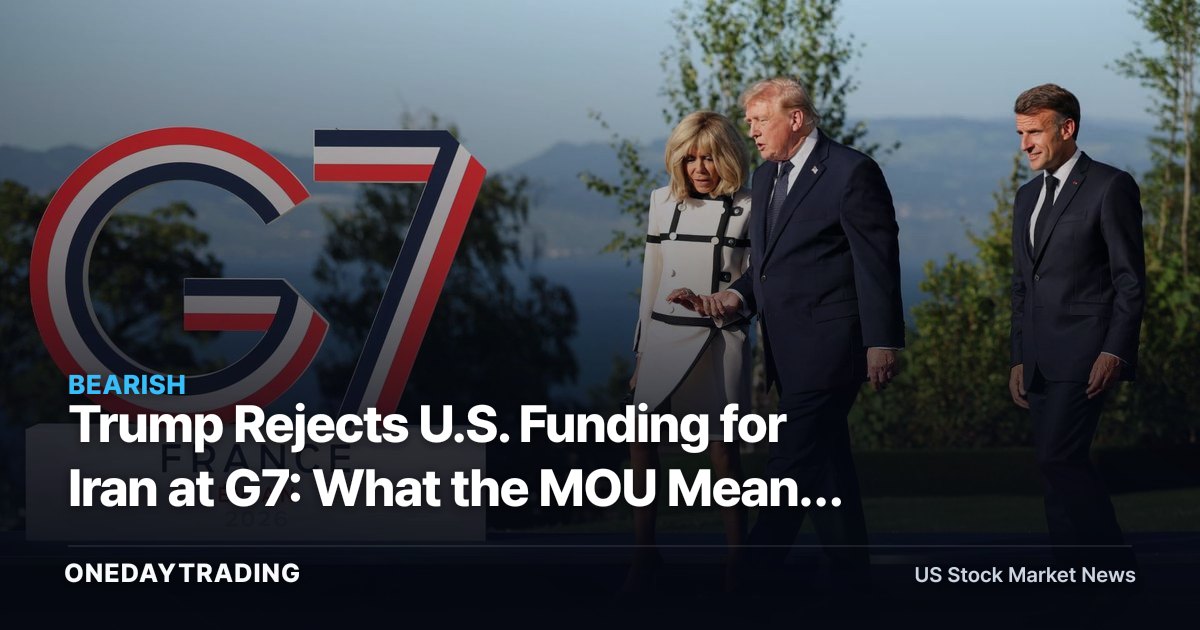
President Trump used the G7 summit to deny that Washington will channel any money into Iran, even as both sides confirmed a Memorandum of Understanding had been reached over the weekend. For markets, the signal is less about dollars and more about a possible easing of Middle East tension, which feeds straight into the geopolitical premium embedded in crude prices and energy equities.
The Full Story
The headline pairs two facts that pull in different directions. An MOU between Washington and Tehran implies a thaw, or at least a framework for dialogue, which historically deflates the fear premium that traders price into oil during periods of confrontation. Trump's explicit rejection of putting any money into Iran, delivered alongside allies at the G7, narrows the scope of that thaw and tempers expectations of a broader financial or sanctions-relief package.
Because the announcement carries no disclosed financial terms, scope, or timeline, the market reaction hinges on interpretation rather than hard numbers. Any framework that lowers the odds of direct conflict tends to compress crude's risk premium, while the absence of explicit sanctions relief limits how much additional Iranian barrels could realistically reach the market in the near term.
Structural Background
Iran sits among the larger producers within OPEC, so the path of its exports and the status of U.S. sanctions are recurring swing factors for global supply. De-escalation typically works through two channels: a lower probability of supply disruption in the Strait of Hormuz, and the longer-tail possibility of more Iranian crude returning to legal markets. Both are bearish for price when they gain credibility.
Stock & Sector Ripple
- ExxonMobil (XOM) and Chevron (CVX): upstream-heavy majors whose earnings leverage tracks the crude price; a fading risk premium pressures realized prices and the cash flows that fund buybacks and dividends.
- Oil services (SLB, HAL): activity and pricing follow producers' capex appetite, which softens if operators expect lower or more volatile crude.
- Defense names (LMT, RTX): a genuine diplomatic track marginally cools the conflict-driven demand narrative, though existing program backlogs blunt the effect.
- Airlines and consumer-facing transport: lower jet fuel and gasoline costs are a margin tailwind, the mirror image of the energy-sector drag.
Bull vs Bear Scenarios
The bear case for oil rests on the thaw holding and credibly raising the odds of more Iranian supply, dragging XOM and CVX with the crude curve. The counter-scenario is that an MOU with no money and no sanctions relief proves cosmetic; a breakdown, fresh enforcement, or any flare-up near key shipping lanes would snap the risk premium back and reward energy producers. The decisive unknown is the actual content of the agreement, which has not been published.
Investor Action Points
- Watch for the published terms of the MOU, specifically whether sanctions or oil-export language appears.
- Track the WTI and Brent curve in the days after the G7, since price action will reveal how traders weigh de-escalation versus skepticism.
- Map energy holdings by upstream exposure, where XOM and CVX are most price-sensitive.
- Monitor OPEC commentary and tanker-traffic data through the Strait of Hormuz as confirmation or contradiction of the diplomatic signal.
📊 Analysis
Signal Bearish
Why A reported U.S.-Iran MOU and a diplomatic G7 tone tend to compress oil's geopolitical risk premium, pressuring crude-leveraged energy producers like XOM and CVX.
Tickers$XOM$CVX$SLB$LMT$RTX
This article was independently written by OneDayTrading from public reporting. Read the original (CNBC)