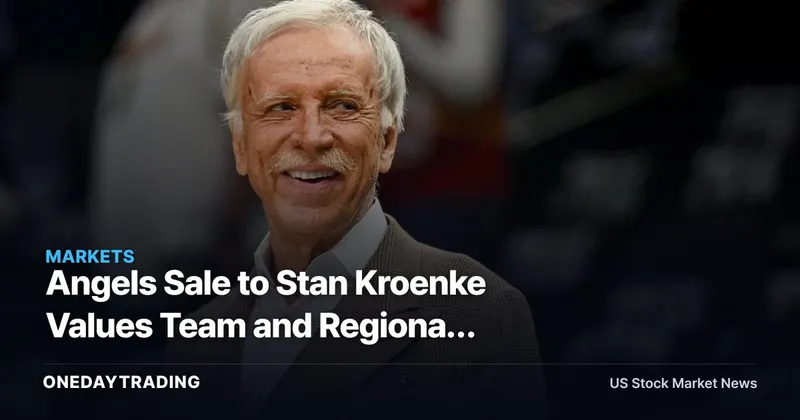
What does a $4 billion Angels deal mean for sports media valuations?
CNBC's report on Stan Kroenke and MLB's Angels is really a story about how investors price attention. The Angels are not just a baseball asset at $4 billion; the deal treats the regional network as part of the operating machine, which is where the recurring money lives. That matters for owners because ticket sales are cyclical, but local media rights can be monetized across seasons.
A regional sports network is the local television and distribution layer that carries game telecasts, and in this deal it is part of the value equation. For investors, the read-through is simple: scarce live inventory still pulls premium valuations when it is tied to a local audience. The counterpoint is equally clear. If distribution keeps fragmenting, a headline valuation can outrun the underlying cash flow that supports it.
By the numbers: $4 billion versus more than $26 billion
CNBC said the Angels and regional network were valued at $4 billion, while CNBC's most recent list of the world's most valuable sports empire put Kroenke Sports and Entertainment at more than $26 billion. Those figures frame the deal as a portfolio move, not a stretch bet. A buyer that already sits inside a more than $26 billion empire can absorb a $4 billion asset in a way that a standalone buyer cannot.
That also explains why sports franchises keep behaving like media assets with stadium economics attached. The price is not only about wins and losses; it is about how many fans a team can keep inside a monetizable distribution loop.
Winners & Losers
- MLB owners: a $4 billion valuation supports higher comp values for scarce teams with local rights leverage.
- Regional sports networks: the deal gives the model another valuation anchor if live games still drive audience retention.
- Public media owners such as FOXA, WBD and DIS: the read-through is mixed, because sports scarcity helps pricing power, but cord-cutting keeps pressuring the bundle.
- Rival bidders and prospective owners: the entry price rises when a team is priced with its media reach, not just its roster.
Risk Check
- The $4 billion tag only matters if the network economics can support it over time.
- Local sports audiences can fragment faster than buyers expect.
- Public media stocks can benefit from the scarcity narrative without fixing the structural decline in legacy distribution.
- Any valuation premium depends on whether live sports keeps commanding the same share of attention.
Bottom Line
CNBC's report says the market for sports assets still rewards control of live content and local distribution, and that is why the Angels deal lands above the usual baseball headline. The upside is clear: scarcity, fandom and media rights can justify premium pricing. The risk is just as clear: if the cash flow behind the network weakens, the valuation story gets ahead of the business.
FAQ
Why does a regional sports network matter in an MLB deal?
A regional sports network matters because it is the revenue bridge between the team and the viewer. CNBC's report ties the Angels and the network to a $4 billion valuation, which shows the market still pays for distribution, not just for the club on the field. If the network loses reach, the asset loses a key part of its price support.
What does a $4 billion valuation say about baseball franchises?
A $4 billion valuation says scarcity still trades well in live sports. CNBC's reporting on the Angels suggests investors are valuing the club as a bundled sports-media asset rather than as a pure operating team. That supports comparable values for other MLB owners with media leverage.
Do sports-media stocks benefit from this kind of deal?
The read-through is indirect, not automatic. Public names such as FOXA, WBD and DIS sit in the same sports-media ecosystem, so a premium deal can support sentiment around live rights and local distribution. The risk is that asset values can rise even as the underlying linear-TV economics keep weakening.
📊 Analysis
Signal Neutral
Why The deal supports sports-media asset valuations, but it is a private transaction with no direct public-market catalyst or disclosed operating numbers beyond the headline valuation.
This article was independently written by OneDayTrading from public reporting. Read the original (CNBC)