What Changes
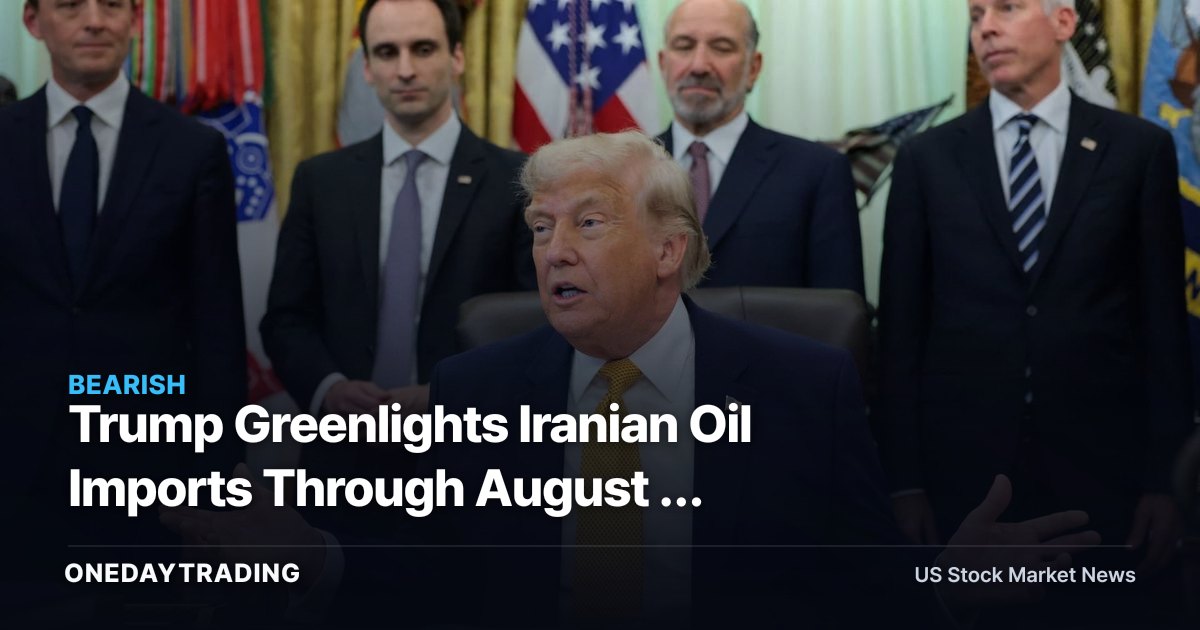
For years Iranian barrels were effectively locked out of the U.S. market under sanctions. A Treasury authorization that lets that crude and refined product enter through at least August reopens a channel that had been closed, and even a modest incremental flow shifts the supply narrative at a time when traders are already weighing OPEC policy and global demand.
The investor read-through runs through price. More available supply, or even the expectation of it, tends to cap crude and compress the margins of upstream producers whose earnings move almost one-for-one with the per-barrel price. Refiners sit on the other side of the trade: cheaper feedstock can widen crack spreads if product demand holds, so the same headline that pressures producers can quietly help downstream processors.
The political hedge matters too. By refusing to guarantee that Iran will not rebuild its military with oil revenue, the administration leaves the door open to reversing course, which injects headline risk in both directions and argues against treating the August window as a durable structural shift.
By the Numbers
The hard facts are narrow but specific: the authorization runs through at least August, and it covers both crude oil and refined products. No volume figure was disclosed, so the market impact hinges on how much actually ships rather than on the permission itself. Investors should anchor to the August date as the first concrete checkpoint for whether this becomes a recurring policy or a one-off.
Winners & Losers
- ExxonMobil (XOM), Chevron (CVX) — integrated majors with large upstream exposure; their cash flow leans on realized crude prices, so a softer supply backdrop trims the upside.
- ConocoPhillips (COP) — a pure-play producer with even higher price sensitivity than the integrateds, less cushioned by downstream and chemicals.
- Valero (VLO), Marathon Petroleum (MPC) — refiners that buy crude as feedstock; cheaper input can support crack spreads if gasoline and diesel demand stays firm.
- Energy sector broadly — sentiment-driven pressure on producers, partly offset by relief for fuel-intensive end users.
Risk Check
- No volume disclosed — if actual imports are token, the price effect may be negligible.
- The August window is short and explicitly conditional; a policy reversal could snap supply back out of the market.
- OPEC production decisions and global demand swings can easily dominate this marginal flow.
- Geopolitical escalation around Iran could spike risk premia and override the bearish supply read entirely.
Bottom Line
An authorization to import Iranian crude through August leans bearish for oil prices and the producers most levered to them, while offering refiners a potential feedstock tailwind — but with no disclosed volumes and an explicitly conditional time frame, the move is a sentiment signal to monitor rather than a confirmed shift in the supply balance.
📊 Analysis
Signal Bearish
Why Authorizing additional Iranian crude and product into the U.S. market is a supply-positive, price-negative signal for oil and the producers most levered to crude prices.
Tickers$XOM$CVX$COP$VLO$MPC
This article was independently written by OneDayTrading from public reporting. Read the original (CNBC)