Summary
The reopening of a sea lane through the Strait of Hormuz under a US-Iran agreement is the kind of headline that quietly drains the geopolitical premium baked into crude. For investors, the immediate read-through is downward pressure on oil prices and the producers most levered to them, with a murkier picture for tanker operators whose rates feed on disruption, not normalization.
The Full Story
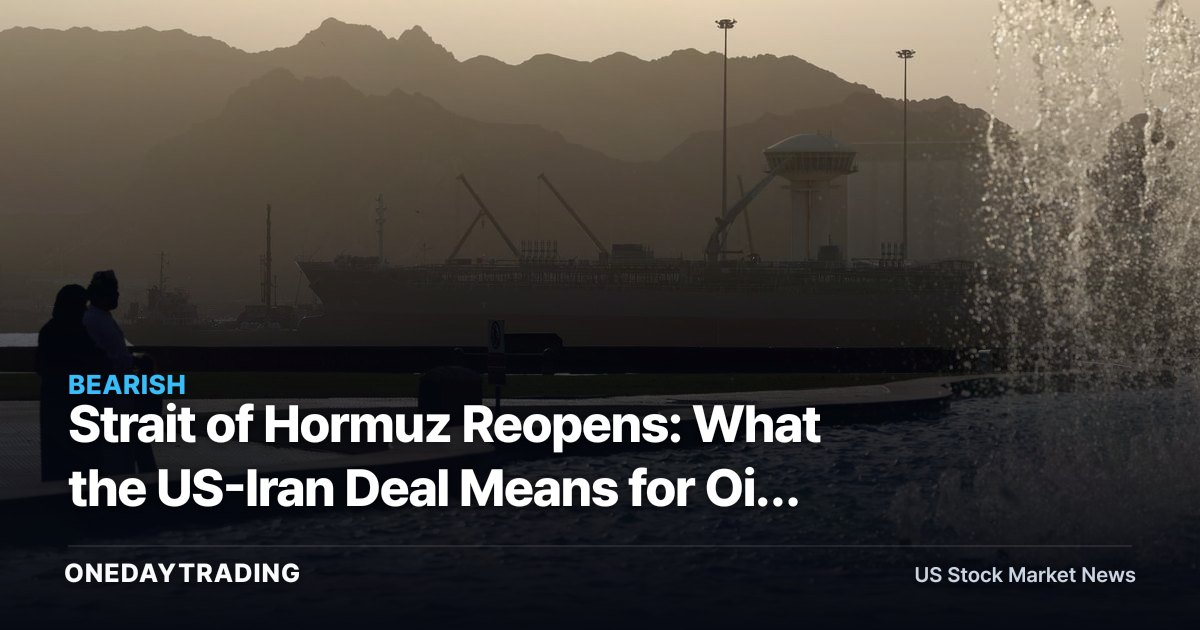
According to CNBC, oil tanker traffic through the Strait of Hormuz jumped after the United States and Iran implemented a deal to open the sea lane. The arrangement includes a toll-free period, and the open question now is how the chokepoint will be governed once that window closes.
The market significance is less about the volume of ships on any given day and more about risk perception. When a key waterway is contested, traders price in the possibility of closure or interference; oil carries a premium that has nothing to do with underlying barrels-per-day supply and demand. A credible mechanism that keeps tankers moving compresses that premium, and the compression tends to show up fastest in crude futures and in the equity of upstream producers whose margins swing directly with the spot price.
Structural Background
The Strait of Hormuz is the single most important maritime chokepoint for seaborne crude and LNG, the only outlet for Gulf barrels from Saudi Arabia, Iran, Iraq, Kuwait and the UAE into open water. Any signal that flows are secured removes a tail risk that has periodically spiked prices. The catch is durability: a toll-free period is temporary, and the governance question after it ends is precisely the variable that could reintroduce uncertainty later this year.
Stock and Sector Ripple
- ExxonMobil (XOM) and Chevron (CVX): integrated majors whose upstream earnings track crude prices; a fading risk premium trims the upside on realized prices even as refining margins can partly offset.
- Tanker operators (FRO, STNG): counterintuitively mixed; more transits lift utilization, but normalized routing shortens tonne-mile demand versus the long detours that supercharge rates during disruption.
- Airlines and transport: lower fuel cost risk is a tailwind for jet-fuel-heavy cost structures, a classic offset to the energy complex.
- US shale (smaller E and Ps): high-beta to spot crude, so a softer price deck pressures cash flow and buyback capacity faster than the diversified majors.
Bull vs Bear Scenarios
The bear case for oil is straightforward: flows are restored, the fear premium deflates, and crude drifts lower, weighing on producer multiples. The bull case for crude hinges on the governance gap; if the toll-free period lapses without a clear successor framework, the risk premium can snap back, and any sign of friction at the strait would reverse the move quickly. The key variable is not today traffic count but the post-deal arrangement.
Investor Action Points
- Track front-month WTI and Brent for whether the geopolitical premium is genuinely unwinding or just pausing.
- Watch for the end date of the toll-free period and any announced governance framework for the strait.
- On energy names, check the next earnings round for realized price assumptions and capital-return guidance under a softer deck.
- For tanker exposure, monitor day-rate prints, which reveal whether higher traffic offsets shorter routes.
📊 Analysis
Signal Bearish
Why Reopening a secured sea lane through Hormuz drains the geopolitical risk premium from crude, pressuring oil prices and the producers most levered to them.
This article was independently written by OneDayTrading from public reporting. Read the original (CNBC)