At a Glance
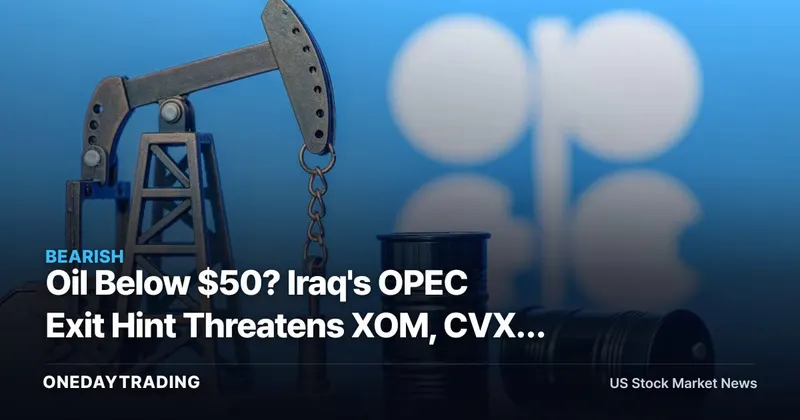
Iraq's suggestion that it could walk away from OPEC adds a fresh crack to the cartel's pricing discipline heading into 2026, and the scenario being floated is striking: crude dropping below $50 a barrel. For investors, the question is not whether oil is volatile, but who absorbs the pain when the world stops respecting production quotas.
Why It Matters Now
OPEC's leverage rests on members holding back barrels in unison. Iraq is the group's second-largest producer, so even a hint that it might exit signals that the incentive to defect is rising. When a major member breaks ranks, the rational move for everyone else is to pump and protect market share, which floods supply and drags prices down. A move toward sub-$50 crude would mark a regime shift from managed scarcity to open competition.
The pain is not evenly distributed. U.S. shale and offshore operators with higher per-barrel breakevens see margins compress fastest, while integrated majors with refining and trading arms can partly offset weaker upstream prices. On the other side, every business that burns fuel as a cost input — airlines, freight, chemicals — gets a tailwind. The same barrel that hurts a driller helps a logistics operator.
The channel to watch is capital discipline. Lower prices force producers to defend dividends and buybacks by cutting drilling budgets, which feeds back into oilfield-services demand and, eventually, future supply. That delayed feedback loop is exactly why an oversupplied market can overshoot to the downside before it self-corrects.
FAQ
- Why would Iraq leave OPEC? A member exits when quota compliance costs more in lost revenue than membership delivers in price support; the public hint itself signals that calculus is shifting.
- Does sub-$50 oil mean recession? Not necessarily — it can reflect abundant supply rather than weak demand, which lowers input costs across the economy even as energy producers suffer.
- Who wins from cheaper crude? Fuel-intensive sectors like airlines and shippers, plus consumers at the pump, gain purchasing power.
- Is the $50 figure a forecast? No — it is a downside scenario tied to OPEC discipline breaking, not a base case; cohesion could still hold.
Related Stocks & Sectors
- ExxonMobil (XOM) — integrated scale and downstream refining cushion upstream weakness, but lower prices still cap upstream cash flow.
- Chevron (CVX) — dividend commitment becomes harder to fund if crude stays low, putting buyback pace in focus.
- Occidental (OXY) — more upstream-weighted and leveraged, so its earnings swing harder with each dollar of crude.
- Oilfield services (SLB, HAL) — demand tracks producer capex, which gets cut first when prices fall.
- Airlines (DAL, UAL) — jet fuel is a top cost line, so cheaper crude directly widens margins.
What to Watch
- Any formal Iraqi statement on OPEC membership or unilateral output increases.
- The next OPEC and OPEC+ meeting and whether quota compliance holds across members.
- U.S. producer 2026 capex guidance on upcoming earnings calls as a tell on breakeven stress.
- The WTI price reaction at psychological levels near $60 and then $50.
Overall Outlook
The bear case for energy equities is straightforward: a defecting major member turns coordinated restraint into a market-share fight, and prices toward $50 would squeeze high-cost producers and services first. The counter-scenario is that an OPEC exit hint is a negotiating posture rather than a decision — cartels have absorbed dissent before, and remaining members could tighten quotas to defend prices. Demand surprises, geopolitical disruptions, or coordinated cuts could quickly reverse the supply narrative. The asymmetry to respect is that integrated majors and fuel consumers are positioned very differently from leveraged pure-play drillers, so the trade is less about oil direction and more about where on the value chain each company sits.
📊 Analysis
Signal Bearish
Why A potential Iraqi OPEC exit raises supply and lowers crude price expectations toward $50, pressuring oil producers' margins and cash returns.
Tickers$XOM$CVX$OXY$SLB$HAL$DAL
This article was independently written by OneDayTrading from public reporting. Read the original (MarketWatch)