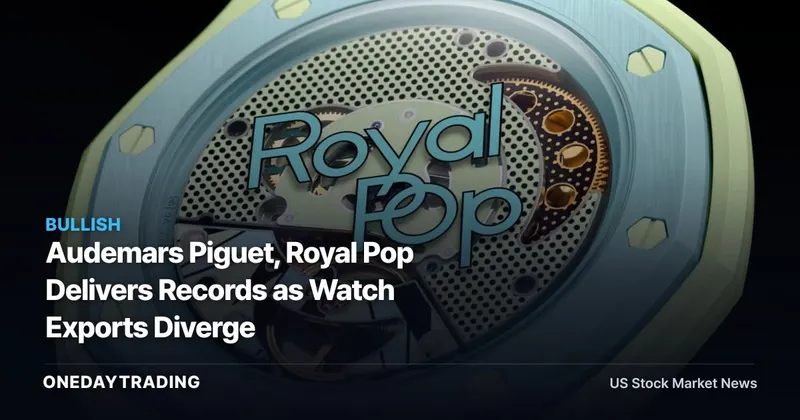
Audemars Piguet Turns Accessibility Into Demand
Audemars Piguet and Swatch launched Royal Pop in May, and Ilaria Resta says Audemars Piguet has recorded a record month every month since. For luxury investors, the important signal is not the collaboration’s undisclosed unit volume; it is the apparent transfer of attention from a $400 watch into engagement with a private, family-owned maker whose core products begin far higher up the price ladder.
Royal Pop is a line of brightly colored, lanyard-attached timepieces created by Audemars Piguet and Swatch. CNBC reported that the launch generated 20 billion social-media mentions and conversations for Audemars Piguet, while Swatch asked customers on Instagram not to rush to its stores. That combination of reach and reported monthly records makes the collaboration a potentially useful model for expanding an elite brand’s audience without relying on direct discounting of its principal collection.
Royal Pop Connects a $400 Product to a $30,000 Brand
The price architecture makes the experiment consequential. Royal Pop watches were priced at $400 apiece in May, while the Audemars Piguet Royal Oak starts at $30,000 and reaches over $200,000. Royal Pop therefore creates a low-cost point of contact with the brand, rather than making the Royal Oak itself more accessible.
That distinction matters because reach and scarcity perform different jobs. Royal Pop can introduce the name and mechanical-watch category to a wider audience; Audemars Piguet’s annual production of 53,000 watches preserves the limited supply of its main products. Preowned Audemars Piguet watches selling for 30% or more above retail price further indicates that scarcity remains economically relevant outside the collaboration.
Ilaria Resta described the response in operational terms: “Our website crashed. We have nonstop visits in our boutiques.” Those indicators show attention and traffic, not disclosed conversion or profitability. The strongest supported interpretation is that Royal Pop enlarged the top of the customer funnel while the company maintained the supply constraints surrounding its luxury watches.
Audemars Piguet Outgrows a Contracting Swiss-Watch Base
The collaboration arrived against a difficult industry backdrop. CNBC identified Swiss watches as a $50 billion industry and reported that global export volume has fallen by more than half since 2011. Industry sales declined 1.7% last year, according to Morgan Stanley and LuxeConsult.
The pressure is not evenly distributed. Of roughly 450 Swiss watch brands, Rolex, Patek Philippe, Audemars Piguet and Richard Mille represent about half of industry sales and 76% of industry profits, according to Morgan Stanley and LuxeConsult. Audemars Piguet’s scale is especially constrained: it produces 53,000 watches annually, compared with more than 1 million watches for Rolex.
Resta said Audemars Piguet achieved 10% organic sales growth in 2025 and said 2026 would surpass that record. Because the company does not publish revenue or profit totals, investors cannot translate that growth rate into absolute sales, earnings or margin contributions. Royal Pop unit sales and the monetary value of its donated proceeds are also unknown, so engagement should not be treated as a substitute for audited financial disclosure.
Tariffs Test the Economics Behind the Engagement
The demand signal faces a measurable policy headwind. The current tariff rate on Swiss goods is 12.5%, while Swiss-watch exports to the U.S. fell 19% in August even as worldwide Swiss-watch exports grew 9% that month, according to the Federation of the Swiss Watch Industry. The divergence makes the U.S. channel the clearest stress point in the available data.
Audemars Piguet chose not to pass tariff costs to customers, according to Resta. The company applied only small price increases to offset part of its higher material prices. That decision may protect the customer relationship and preserve pricing continuity, although absorbing costs also creates a margin risk that cannot be quantified without revenue and profit reporting.
Resta framed the trade-off directly: “What I'm after is not the yearly profit results.” Private, family ownership permits that long horizon, but it also leaves outside investors with fewer financial measures. The investment implication is therefore sectoral: brand engagement may remain strong while the economics of U.S. sales weaken under tariffs.
Where the Consumer Strategy Extends Beyond Sales
Audemars Piguet is donating all proceeds from Royal Pop to an initiative that trains and educates watchmakers. AP Labs serves the same educational direction, and no watches are sold there. These choices separate immediate product revenue from the broader objective of introducing people to watchmaking and supporting its skilled workforce.
The company is also creating a watch-repair and servicing center in Raleigh, North Carolina. A domestic service operation could deepen the post-purchase relationship with U.S. customers, though the opening date and investment cost have not been disclosed. It should therefore be evaluated as a planned service capability, not as a completed financial contribution.
Patek Philippe and Vacheron Constantin establish Audemars Piguet’s traditional high-luxury context, while the Swatch partnership supplies the accessible consumer interface. The tension is central to the strategy: wider awareness can replenish future interest, while excessive dilution could weaken the exclusivity that supports high prices. The evidence so far confirms engagement and reported records, not the long-term resolution of that trade-off.
Bull and Bear Cases for Swiss Luxury Watches
Bull case: Royal Pop’s 20 billion social-media mentions and conversations, repeated record months and Audemars Piguet’s 10% organic sales growth in 2025 support the view that broader access can stimulate interest without increasing the supply of core watches. Limited annual production and elevated preowned pricing provide evidence that scarcity remains intact.
Bear case: Swiss-watch sales declined 1.7% last year, global export volume is down by more than half since 2011, and August exports to the U.S. fell 19%. If attention does not progress into sustained demand for the main collection, the collaboration’s reach may coexist with industry contraction and tariff-related pressure on economics.
The decisive issue is conversion, not visibility. Audemars Piguet’s private status prevents direct public-equity exposure and withholds the revenue, profit and Royal Pop unit data needed to calculate returns from the campaign. Investors can still use the episode as evidence about luxury-brand demand, but not as a complete valuation case.
Investor Checkpoints After the Royal Pop Launch
- Monthly momentum: Check whether Audemars Piguet continues reporting record months after the initial Royal Pop attention fades.
- U.S. export direction: Compare the next Federation of the Swiss Watch Industry data with August’s 19% U.S. decline and 9% worldwide growth.
- Tariff policy: Monitor whether the current 12.5% tariff rate on Swiss goods changes; neither the timing nor the occurrence of a reduction is known.
- Pricing and scarcity: Track whether small price increases, annual production of 53,000 watches and preowned premiums of 30% or more continue to coexist.
Royal Pop has already demonstrated that a $400 collaboration can command global attention around a brand whose Royal Oak starts at $30,000. The next test is whether Audemars Piguet can preserve that bridge between access and exclusivity while U.S. exports, tariffs and undisclosed margins keep the financial outcome less visible than the consumer response.
📊 Analysis
Signal Bullish
Why Record monthly performance and broad engagement indicate stronger demand for Audemars Piguet, although tariffs and undisclosed financials limit the investment read-through.
This article was independently written by OneDayTrading from public reporting. Read the original (CNBC)