Summary
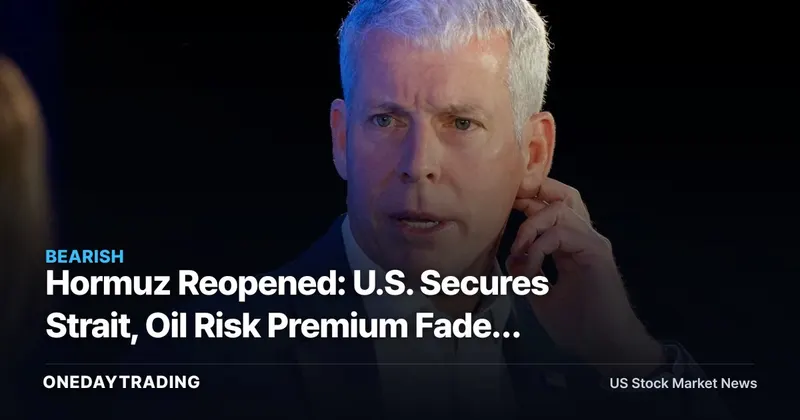
U.S. Energy Secretary Chris Wright said Washington has removed Iran's capacity to shut the Strait of Hormuz, pointing to 72 ships carrying 19 million barrels of oil that transited the chokepoint in the prior 24 hours. The headline matters less for supply math than for the risk premium baked into crude — a premium that tends to unwind fast when the market believes a chokepoint is secure.
The Full Story
The Strait of Hormuz is the single most important artery in global oil, and any credible threat to close it injects a fear premium into Brent and WTI regardless of physical barrels lost. Wright's claim that the route is functionally secured, backed by an observable 19-million-barrel, 72-ship flow in one day, signals normal throughput rather than disruption. For traders, that reframes the question from will barrels stop to how much fear was overpriced.
When a tail risk is taken off the table, the typical reaction is a drain of the geopolitical premium from front-month crude. That is a headwind for upstream producers whose earnings leverage to the oil price, and a tailwind for fuel buyers — refiners on the margin and airlines on the cost line. The direction of the next move depends on whether the market had been pricing meaningful Hormuz risk into recent crude strength.
Structural Background
Roughly a fifth of global seaborne oil moves through Hormuz, so the strait behaves as an option on Middle East escalation. Premiums spike on threats and bleed out on de-escalation signals. A government statement asserting the route is secured functions as a de-escalation marker, the kind of catalyst that historically compresses crude even without a change in OPEC output or inventories.
Stock & Sector Ripple
- ExxonMobil (XOM), Chevron (CVX), Occidental (OXY): Upstream-heavy earnings fall with the oil price; a fading risk premium pressures realized prices and cash flow leverage.
- Airlines (DAL, UAL, AAL): Jet fuel is a top operating cost; lower crude directly widens margins, making them relative winners on a Hormuz de-escalation.
- Tanker operators (FRO, STNG): Mixed — open, busy lanes support transit volume, but a calmer security backdrop can soften the elevated freight and war-risk rates that spike during scares.
- Refiners (VLO, MPC): Cheaper feedstock can aid crack economics if product prices hold, a partial offset to upstream weakness.
Bull vs Bear Scenarios
Bear (for crude/energy): If the premium drains, oil-linked producers see multiple and estimate compression while consumers of fuel benefit. Bull (for crude/energy): A single official statement does not change physical fundamentals; any fresh incident near the strait, an OPEC+ supply signal, or renewed tension can re-inflate the premium quickly. Headlines secure a strait until they don't — the key variable is durability, not the snapshot flow figure.
Investor Action Points
- Watch WTI and Brent front-month for premium compression in the days after the statement — the cleanest read on how much fear was priced in.
- Track weekly EIA inventories and any OPEC+ output commentary; fundamentals, not rhetoric, set the floor.
- Monitor tanker spot and war-risk insurance rates as a real-time gauge of whether the market trusts the security claim.
- For energy names, the next earnings calls and realized-price guidance show how producers model the crude path from here.
📊 Analysis
Signal Bearish
Why A secured Strait of Hormuz removes a geopolitical risk premium from crude, pressuring oil prices and oil-leveraged producers while helping fuel consumers.
Tickers$XOM$CVX$OXY$DAL$FRO
This article was independently written by OneDayTrading from public reporting. Read the original (CNBC)