Renfe and Iryo Face an Unresolved High-Speed Rail Failure
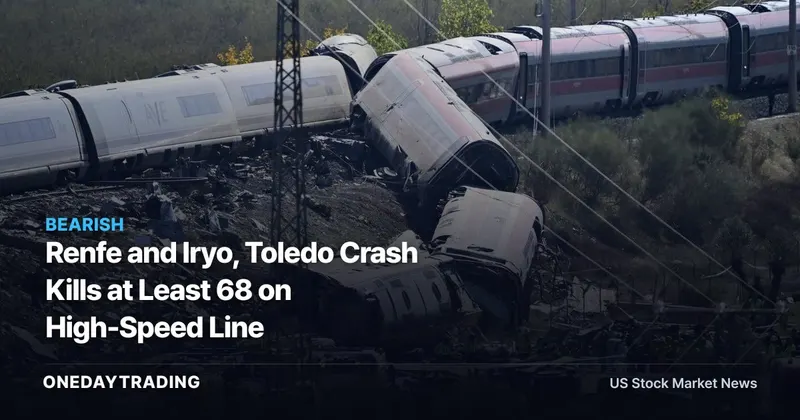
Renfe, Iryo and Spain’s high-speed rail system face scrutiny after two trains collided in Toledo on 2026-10-28, killing at least 68 people. For transportation investors, the central issue is not a measurable financial loss disclosed in the available facts; it is the unexplained operating sequence that allowed one train to restart and hit another at high speed.
A high-speed rail collision is an operating event in which the safety, control and movement systems intended to keep trains separated fail to prevent contact. The investor relevance lies in what Adif’s investigation establishes about that sequence, because the facts do not determine whether the failure arose from negligence, the safety system or another cause.
What Happened on the Madrid-to-Seville Line
CNBC reported that the two high-speed trains collided shortly before 9:15 a.m. local time, or 4:15 a.m. ET, on the Madrid-to-Seville line in Spain’s province of Toledo. Authorities said at least 68 people were killed in the collision.
Transport Minister Óscar Puente said a control-system failure near Urda stopped six trains. According to Puente, one train was then permitted to restart, travelled 25 km and struck a stopped train at high speed. He called the sequence “inexplicable.”
Óscar Puente also said 50 people were injured in the collision. Those confirmed details establish the immediate sequence and human toll, while leaving unanswered the decisive question: how the train received permission to resume its journey.
How the Death Toll Was Distributed Between Renfe and Iryo
Emiliano García-Page said 24 people died aboard the Renfe-operated train, with the remaining victims aboard the Iryo-operated train. CNBC’s account also cited reporting that more than 500 passengers were travelling on the two trains operated by Renfe and Iryo.
Iryo said its train was “struck from behind” by the Renfe train and described the cause as “still unknown.” That statement identifies the reported direction of impact, not why the collision occurred or who was responsible.
The Castilla-La Mancha government confirmed at least 68 deaths. The toll exceeded the 45 people killed in an earlier high-speed crash in southern Spain in January, making this the second deadly high-speed rail collision within the same year.
Why Adif’s Investigation Is the Critical Investor Checkpoint
Adif, Spain’s railway infrastructure manager, is investigating the sequence surrounding the accident. The investigation must separate what is already established—the control-system failure, the stopping of six trains, the restart of one train and its 25 km journey—from what remains unknown.
The missing link is authorization. The available facts do not explain how the train was permitted to restart, whether negligence occurred or whether the safety system itself failed. Those are distinct possibilities, and the evidence supplied does not support choosing among them.
That distinction matters for any sector assessment. A finding focused on a specific operating decision would frame the event differently from evidence of a broader safety-system failure. Neither outcome is confirmed, so assigning responsibility or estimating financial consequences would run ahead of Adif’s work.
Transportation-Sector Read-Through Without a False Stock Precision
- Renfe: One involved train was operated by Renfe, and Emiliano García-Page attributed 24 deaths to that train. The unresolved question is how it came to restart and travel 25 km before the collision.
- Iryo: The other train was operated by Iryo. Its account that the train was struck from behind clarifies the reported impact sequence while expressly leaving the cause unknown.
- Adif: As infrastructure manager and investigator, Adif is the institution positioned to establish the sequence of decisions and system behavior surrounding the crash.
- High-speed rail: Pedro Sanchez described the collision in the context of two terrible high-speed rail tragedies within the same year. The sector implication depends on whether the evidence identifies an isolated decision, negligence or a failure in the safety system.
No U.S.-listed company is directly established by the supplied facts, so attaching a U.S. ticker or claiming a specific share-price effect would be unsupported. The defensible market signal is directionally negative for the named operators and the transportation system involved, with the scale and duration of that effect impossible to quantify from the current record.
Political Pressure Around the Toledo Collision
Pedro Sanchez said he was “shocked” and stated that any negligence would come to light. He also said any failures in the safety system would be addressed “with the utmost firmness,” language that makes the investigation’s findings the next concrete point for assessing the official response.
Santiago Abascal, the leader of Vox, blamed Sanchez’s government in a statement describing renewed tragedy and anger over alleged neglect. That is a political accusation, not an established finding about the collision’s cause.
The dispute arrives before the Nov. 29 snap election called by Pedro Sanchez. The election is a defined political checkpoint, while responsibility for the crash remains an evidentiary question for the investigation.
What Investors Should Monitor Next
- The restart authorization: Any account of who or what allowed one train to resume travel after six trains had been stopped would address the central gap in the confirmed sequence.
- Adif’s findings: Evidence distinguishing an operating decision from a safety-system failure would define whether the implications remain narrow or extend across the high-speed rail system.
- Negligence evidence: Pedro Sanchez made negligence conditional rather than confirmed. Investors should keep that distinction intact until investigators establish responsibility.
- The official response: Any measures following findings of safety-system failures would indicate how firmly authorities act on the investigation, without predetermining what those findings will be.
The Live Risk After the Renfe-Iryo Crash
The narrow counter-scenario is that Adif identifies a specific, contained decision in the restart sequence rather than evidence of a wider safety-system problem. Such a finding could limit the breadth of the sector read-through, though it would not reduce the collision’s human toll.
The more consequential risk is evidence that the control failure and restart reflected weaknesses beyond a single decision. The available facts do not establish that outcome. Until Adif explains how one stopped train resumed travel and covered 25 km before impact, the investigation—not speculation about liability, costs or market pricing—remains the essential next trigger.
📊 Analysis
Signal Bearish
Why The fatal collision creates a negative read-through for the operators and Spain’s high-speed rail sector while the cause and any safety-system failures remain unresolved.
This article was independently written by OneDayTrading from public reporting. Read the original (CNBC)