Jamie Raskin’s Tariff Records Demand Puts Exemptions Under Scrutiny
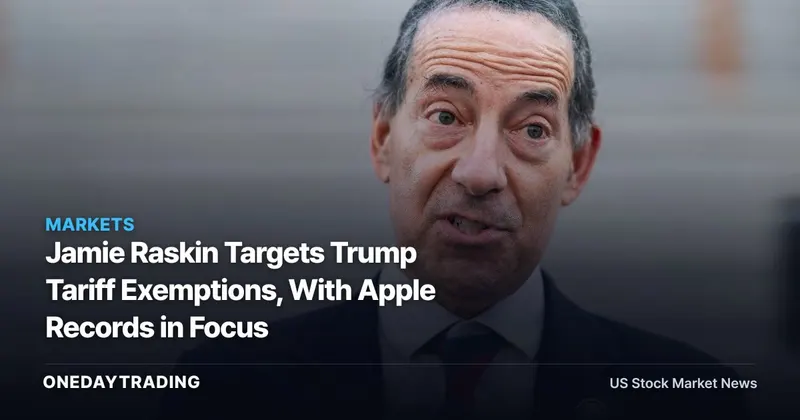
Jamie Raskin’s demand for tariff-related records from Donald Trump puts Apple, Brazilian meat and diamonds inside a policy review whose immediate investor relevance lies in exemption durability, not a proven change in company economics. CNBC reported on 2026-10-28 that Raskin requested multiple categories of records by Nov. 11 while alleging that gifts and political donations influenced import-tax exemptions.
The central investment issue is narrow but consequential: whether the documentary record supports the existing rationale for excluding particular goods from tariffs imposed across more than 80 countries in July. No supplied evidence establishes that a gift or donation caused an exemption, and no future legal, political, trade or market outcome is known.
What Jamie Raskin Requested From Trump
Raskin sent Trump a letter seeking communications involving the White House, the Office of the U.S. Trade Representative and private-sector representatives. The request covers records connected to tariff relief and names figures including Apple executive chairman Tim Cook and Rolex CEO Jean-Frederic Dufour.
Section 301 of the Trade Act of 1974 is the authority the U.S. used for the July tariffs. The Trump administration said those duties were designed to address foreign forced-labor practices; diamond jewelry and Chinese smartphones were exempt.
Raskin, acting from his House Judiciary Committee role, described the tariff system as a “tool for grift and self-enrichment.” He said the highlighted carve-outs “make little to no sense” under the administration’s stated criteria. Those statements are allegations, not established findings.
The White House and USTR did not immediately respond to CNBC’s requests for comment. Their positions therefore remain absent from the available record, as does any confirmation that Trump or the requested parties will produce the documents by Nov. 11.
Why the Section 301 Exemptions Matter to Investors
A tariff exemption changes which imported goods face an additional tax and which do not. For investors, the relevant transmission channel is exposure: an exemption can distinguish an uncovered product from products subject to the duties, while any review of that exemption can introduce policy uncertainty.
The available facts do not quantify revenue, costs, margins, prices or shipment volumes for Apple, JBS, Pilgrim’s Pride, Rolex or any diamond business. That prevents a defensible earnings estimate. It also means the correct market stance is neutral rather than a forced bullish or bearish call.
The consumer backdrop is more concrete. CNBC cited an estimate that the latest tariffs would cost American people an average of $820 per U.S. household this year, with the figure attributed in Raskin’s letter to the Tax Foundation. The estimate defines the affordability stake, although it does not allocate that cost among companies, goods or individual exemptions.
The Supreme Court struck down the “liberation day” duties in February. Critics described in the reporting argued that the July Section 301 tariffs served as a replacement; the Trump administration’s stated justification remained foreign forced-labor practices. That dispute makes the exemption criteria, and the records supporting their application, the analytical center of the story.
Brazilian Meat, Diamonds and Smartphones: The Evidence Cited
In Brazilian meat, Raskin pointed to a reported late-August Oval Office meeting between Trump and Joesley Batista, a co-owner of JBS. The next day, the U.S. announced that it would permit imports of up to 300,000 metric tons of product for ground beef. Pilgrim’s Pride, identified as JBS’s U.S. subsidiary, made a $5 million donation in 2024.
The letter also referenced Central Romana and its owner, José Francisco “Pepe” Fanjul. CNBC reported that Fanjul hosted a $50 million fundraiser in 2024 and that his family corporation made a $1 million donation that year. These facts establish timing and relationships, not that the contributions determined a tariff or forced-labor decision.
For diamonds, the Antwerp World Diamond Centre gave Trump a ring in June containing 321 natural diamonds and 75 other gemstones, marking the 250th birthday of the U.S. Raskin questioned the exemption because the U.S. Labor Department identifies precious stones as goods produced using forced or child labor. The available evidence does not establish that the ring caused the exemption.
For smartphones, Raskin focused on Tim Cook and Apple. Cook reportedly made a $1 million donation in 2025, while Apple donated $25 million. Chinese smartphones were exempt from the Section 301 tariffs, but the record supplied here does not prove that either contribution influenced USTR’s treatment of those products.
Apple and Pilgrim’s Pride Market Read-Through
- Apple: Chinese smartphones are exempt from the Section 301 tariffs, making the company the clearest listed equity connected to the records request through Tim Cook and the smartphone category. The facts provide no estimate of Apple’s financial benefit, no change to the exemption and no evidence that the cited donations caused it.
- Pilgrim’s Pride: The company is JBS’s U.S. subsidiary and made a $5 million donation in 2024. Its relevance comes from Raskin’s scrutiny of Brazilian meat exemptions, though the supplied record gives no company-specific import exposure or earnings effect.
- Luxury and diamonds: Rolex CEO Jean-Frederic Dufour appeared among the private-sector representatives in the requested communications, and diamond jewelry received an exemption. No public-company financial exposure or quantified market impact is established in the fact sheet.
Records and Policy Checkpoints for Investors
- Nov. 11: Check whether Trump or the requested parties provide the tariff-related records by Raskin’s requested deadline.
- White House response: A substantive answer could clarify the administration’s basis for the exemptions and its response to the allegations.
- USTR documentation: The key evidence would be communications explaining how forced-labor criteria were applied to Brazilian meat, diamond jewelry and Chinese smartphones.
- Exemption status: Monitor whether any covered category remains exempt, is reviewed or changes treatment. No such outcome is established by the current record.
The Investment Test After Nov. 11
The constructive scenario for exposed companies is continuity: the exemptions remain in place and the requested records reveal no basis for expecting different tariff treatment. That would preserve the known policy position for Chinese smartphones and diamond jewelry, without proving a particular earnings benefit.
The risk scenario begins with evidence that weakens the stated rationale for a carve-out or leads to further review. Investors would then need company-specific data on imports, pricing and costs before translating a policy change into financial estimates. None of those metrics appears in the available facts.
Raskin wrote that the cited exemptions “only scratch the surface” of what he alleged was corruption. For markets, rhetoric is not the decisive variable. The next usable evidence is whether records arrive by Nov. 11, what the White House and USTR say, and whether the exemption list itself changes.
Market data check: Apple Inc.
Apple Inc. last traded near $345.73 (-0.39%). Our composite signal — blending price momentum and news flow — reads 🟡 neutral. Price momentum scores 55/100.
Data as of publication. Price via market feeds; for reference only, not investment advice.
📊 Analysis
Signal Neutral
Why The records demand raises policy scrutiny around exempt industries, while the facts establish neither causation nor a measurable directional impact on listed companies.
This article was independently written by OneDayTrading from public reporting. Read the original (CNBC)