At a Glance
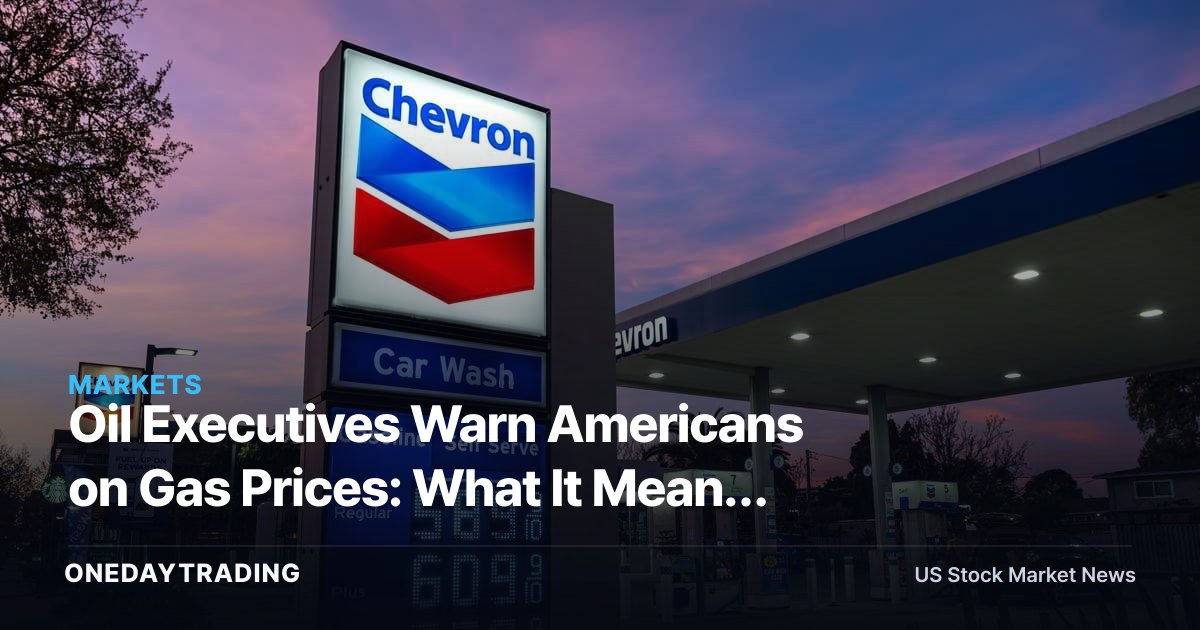
Senior oil industry executives have delivered a direct, no-spin message to American consumers about where gasoline prices are headed and the realities of crude production economics. For investors, the framing matters as much as the prices themselves, because it signals how producers are thinking about supply discipline, capital spending and shareholder returns.
Why It Matters Now
Gasoline prices sit at the intersection of consumer sentiment, inflation expectations and energy company profitability. When executives speak bluntly rather than offering optimistic reassurance, it often reflects a view that pump prices are tied to structural factors — refining capacity, global crude benchmarks and demand — rather than something producers can simply switch on or off. That candor can reset investor expectations about future cash flows.
For the equity market, the energy sector has been a swing factor in recent years, rewarding companies that prioritize free cash flow, dividends and buybacks over aggressive volume growth. A message emphasizing discipline over a race to lower prices is broadly consistent with the capital-return strategy that has drawn income-focused investors to oil majors. At the same time, persistently elevated gas prices feed into headline inflation, which connects energy back to the rate path and the wider market.
FAQ
- What is the core message? That gasoline prices are shaped by broad market and cost realities, not easily dictated by individual producers.
- Why should investors care? It frames how oil companies plan production and capital returns, which drives earnings and dividends.
- Does this signal higher or lower prices? The tone leans toward managing expectations rather than promising relief at the pump.
- How does it affect consumers? It suggests limited near-term help on gas costs, keeping energy a live inflation input.
Related Stocks & Sectors
- ExxonMobil (XOM) — a bellwether integrated major whose strategy reflects industry-wide capital discipline.
- Chevron (CVX) — dividend-focused major closely tied to crude and refining margins.
- ConocoPhillips (COP) — a large independent producer sensitive to production and price signaling.
- Occidental (OXY) — leveraged to US shale economics and crude price trends.
- Energy sector broadly — refiners and producers all respond to consumer demand and benchmark moves.
What to Watch
- Whether executives reaffirm capital discipline or hint at production growth.
- WTI and Brent crude benchmarks for direction on margins.
- Refining capacity and seasonal demand trends affecting pump prices.
- How gasoline costs feed into upcoming inflation readings.
Overall Outlook
The bull case for energy rests on disciplined producers generating strong free cash flow and returning it to shareholders, supported by steady demand. The risks are real: blunt messaging on prices can dampen consumer goodwill, invite political scrutiny, and remind investors that crude is cyclical and externally driven. With limited detail beyond the executives tone, the prudent read is to treat this as a sentiment signal rather than a fundamental shift.
📊 Analysis
Signal Neutral
Why The message reframes how gas prices are set without confirming a clear price direction or earnings catalyst, leaving energy stocks broadly unaffected near term.
This article was independently written by OneDayTrading from public reporting. Read the original (Yahoo Finance)