What the Netanyahu Stalemate Means for Investors
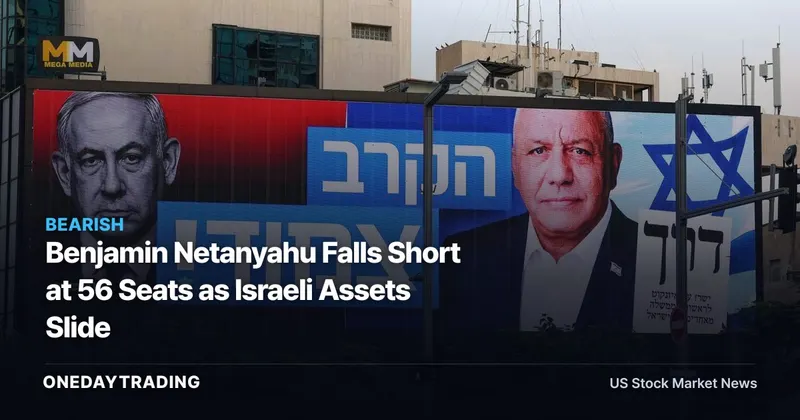
Benjamin Netanyahu’s bloc reached 56 seats in partial results on Wednesday, CNBC reported, as Israel’s national election produced no clear winner and Israeli assets declined. Gadi Eisenkot’s opposition bloc stood at 48 seats, also short of control. The immediate investor issue is not simply which bloc leads: it is whether any Knesset member can assemble the 61-seat majority needed to form a government.
A coalition is an alliance of parties formed to command a governing majority in the 120-seat Knesset. Because outright majorities are rare, the president typically asks the Knesset member best placed to reach 61 seats to form a government. The current count does not establish who will receive that opportunity first or whether the initial effort will succeed.
The market reaction says that investors demanded lower prices for Israeli equities, the shekel and government bonds while the governing arithmetic remained unsettled. That interpretation has limits: the supplied evidence establishes simultaneous political uncertainty and asset declines, not a definitive cause for every move. The tape has priced an inconclusive partial count; it has not resolved the coalition, its policies or the duration of negotiations.
Seat Arithmetic Behind the Israel Election
With over 66% of ballots counted, CNBC reported 56 seats for Benjamin Netanyahu’s bloc and 48 seats for Gadi Eisenkot’s bloc. Arab-led parties, aligned with neither camp, were projected to hold 16 seats. Their projected representation could therefore matter to coalition formation, though whether they will participate in or support a government is unknown.
Ra’am leader Mansour Abbas said “our vote will change the government,” while Joint List faction chairman Ahmad Tibi had previously described a plan to prevent Netanyahu from remaining in power, according to the Jerusalem Post. Those positions identify political leverage without proving a coalition agreement. Neither Netanyahu nor Eisenkot has said he would embrace the Arab-led parties.
Avigdor Liberman adds another constraint. His Yisrael Beytenu party was projected to receive seven to nine seats, and he refused during the campaign to rely on Arab parties. That stance could narrow Eisenkot’s available path even if the opposition bloc remains competitive, because reaching 61 seats depends on which parties are willing to cooperate, not merely on adding every non-Netanyahu seat together.
Shekel, Tel Aviv 35 and Bond-Market Signals
The Israeli shekel fell 1% against the U.S. dollar on Wednesday, and the Tel Aviv 35 stock index traded 2.7% lower, according to CNBC. These were broad market-level moves rather than evidence about the revenue, costs or valuation of any individual U.S.-listed company. No supported company-specific equity conclusion can be drawn from the supplied facts.
Israeli government bonds weakened at the same time. The 2-year government bond yield rose 6 basis points, the benchmark 10-year yield increased 4 basis points and the 30-year yield added 2 basis points on Wednesday. Bond prices move inversely to yields, so the increases show selling pressure across short, benchmark and longer maturities.
The curve’s largest stated move occurred in the 2-year maturity. Investors should avoid assigning a policy forecast to that pattern because the facts provide no inflation, fiscal, central-bank or issuance data. What can be said is narrower: pressure appeared across the curve, with the short maturity recording the biggest reported yield increase.
Turnout Raised the Stakes, Not the Certainty
The Central Elections Committee reported turnout of around 77.7% of eligible voters, the highest participation in a Knesset election in 27 years. High turnout gives the result political weight, but it does not simplify coalition formation. The decisive threshold remains 61 seats, and neither principal bloc reached it in the partial count.
This was Israel’s first national election since the Hamas attack on Oct. 7, 2023. Gadi Eisenkot said the initial exit polls showed “a complete lack of confidence in Netanyahu and his October 7 government.” Exit polls are not the official result, and the later partial count placed his bloc behind Netanyahu’s, making the final publication the more important checkpoint for investors.
Benjamin Netanyahu has dominated Israeli politics since 2009 and faces an International Criminal Court arrest warrant over the Gaza campaign, which he has rejected. P.R. Kumaraswamy of Jawaharlal Nehru University cautioned that “It is too early to write him off.” The record of five elections between 2019 and 2022 shows that repeated voting is a possible institutional outcome when coalition efforts fail, though another election is not established here.
Coalition Paths and Their Market Limits
- Netanyahu path: His bloc’s 56 seats in the partial results leave it below 61. The open question is whether Benjamin Netanyahu can attract enough support outside his current bloc.
- Eisenkot path: His bloc’s 48 seats leave a wider numerical gap. Arab-led parties were projected at 16 seats, while Avigdor Liberman’s refusal to rely on them complicates any simple coalition calculation.
- Arab-party leverage: Ra’am and the Joint List could influence which candidate can demonstrate majority support. Their participation in, or external support for, a government has not been confirmed.
- Policy continuity: Michael Feller, chief strategist at Geopolitical Strategy, said policies concerning Iran, Palestine and security may otherwise remain the same. That view is analysis, not a confirmed description of the next government.
Risks the Market Has Not Resolved
- Count risk: More than 66% of ballots had been counted in the partial results, leaving the final official allocation unknown until the results scheduled for Nov. 4.
- Mandate risk: It is not known which Knesset member the president will ask first to attempt forming a government.
- Negotiation risk: Amin Saikal of the S. Rajaratnam School of International Studies expected Netanyahu to fight for political survival, while the length of coalition talks remains unknown.
- Market-interpretation risk: The shekel, equities and bonds moved in the same negative direction, though the available facts do not establish how much uncertainty is already reflected in their prices.
Nov. 4 Is the Next Test for Israeli Assets
The bearish market signal is clear: the shekel lost 1%, the Tel Aviv 35 traded 2.7% lower and yields rose across Israel’s government bond curve as neither major bloc secured 61 seats. The constructive counter-scenario is a final count and coalition arrangement that establishes a workable majority. The adverse scenario is an extended process in which party constraints prevent either side from assembling one.
Nov. 4 is the next defined checkpoint. Investors should compare the official seat allocation with the partial 56-seat Netanyahu bloc, 48-seat Eisenkot bloc and 16-seat projection for Arab-led parties, then watch who receives the first mandate and which parties offer support. Those developments—not declarations based on exit polls—will determine whether the market’s uncertainty premium can narrow or needs to persist.
📊 Analysis
Signal Bearish
Why The shekel, Tel Aviv 35 stock index and Israeli government bonds all weakened as partial election results left both leading blocs short of a governing majority.
This article was independently written by OneDayTrading from public reporting. Read the original (CNBC)