Summary
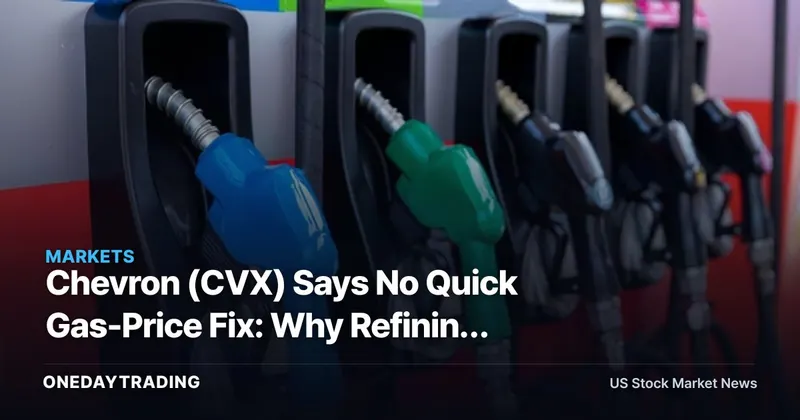
A Chevron executive told investors there is no quick fix to lowering U.S. gasoline prices, rejecting the premise behind Trump administration pressure for fast pump relief. The read-through is structural, not political: pump prices are set by crude input costs and a refining system that cannot be willed lower on a political timetable. That rigidity is, on balance, supportive of integrated-oil and refining margins.
The Full Story
The comment matters because it draws a line between rhetoric and the physical economy. A president can jawbone, release barrels from reserves, or ease permitting, but none of those levers reroute a barrel from wellhead to pump overnight. Crude must be produced, transported, refined into finished gasoline, and distributed — a chain measured in weeks and quarters, not news cycles.
For Chevron, the message is also a defense of capital discipline. Producers have spent the last several years prioritizing free cash flow and shareholder returns over volume growth. Telling Washington that prices will not fall on command is, implicitly, telling shareholders the company will not flood the market to score a political point. That is the posture that has kept upstream returns firm even when crude softens.
Structural Background
The deeper constraint is refining. The U.S. has not added meaningful net new refining capacity in decades, and closures have tightened the system. When demand runs hot or a refinery goes down, gasoline cracks widen fast and ease slowly — a cost curve that policy cannot short-circuit. Seasonal blend changes and maintenance turnarounds add further rigidity that no executive order removes.
Stock & Sector Ripple
- Chevron (CVX) — The subject. Integrated model means firm refining margins and steady upstream cash flow both benefit when prices stay sticky rather than collapsing on political pressure.
- ExxonMobil (XOM) — Same integrated logic; downstream and chemicals exposure means it gains from a refining system that stays tight.
- Marathon Petroleum (MPC), Valero (VLO), Phillips 66 (PSX) — Pure refiners are the most direct beneficiaries of wide, slow-to-narrow gasoline cracks.
- Macro/Fed channel — Sticky gasoline keeps a floor under headline inflation, a variable for rate-cut timing that reaches far beyond energy names.
Bull vs Bear Scenarios
Bull case: structurally tight refining and disciplined upstream capex keep margins elevated, rewarding free-cash-flow and buyback-driven energy equities. Bear case: crude itself rolls over on weak global demand or rising OPEC supply, and even a tight refining system cannot hold pump prices up — compressing both upstream realizations and downstream cracks. The swing variable is global crude, which no single executive controls.
Investor Action Points
- Watch gasoline crack spreads and refinery utilization rates as the real-time gauge of pump-price direction.
- Track CVX and XOM free cash flow and buyback pace at the next quarterly print for evidence capital discipline is holding.
- Monitor any policy moves — reserve releases, permitting, export rules — and gauge whether the market treats them as durable or symbolic.
- Read headline CPI energy components for the inflation feedback loop into rate expectations.
Market data check: CVX
CVX last traded near $171.06 (-0.69%). Our composite signal — blending price momentum and news flow — reads 🟡 neutral. Price momentum scores 44/100.
Data as of publication. Price via market feeds; for reference only, not investment advice.
📊 Analysis
Signal Neutral
Why The story is policy-versus-structure commentary with no earnings or guidance catalyst; firm prices modestly support margins but there is no clear directional trigger for the stock.
Tickers$CVX$XOM$MPC$VLO$PSX
This article was independently written by OneDayTrading from public reporting. Read the original (Seeking Alpha)