Summary
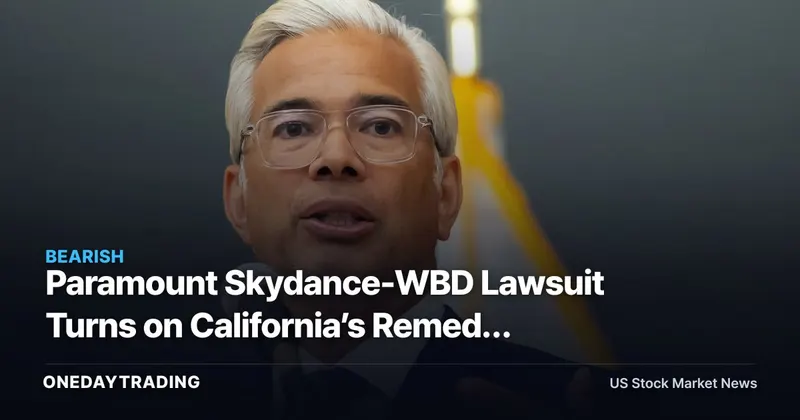
Paramount Skydance and Warner Bros. Discovery are not facing a headline antitrust objection; they are facing a remedy test after California Attorney General Rob Bonta told CNBC on Aug. 20 that settling the states’ lawsuit would require robust structural remedies.
The investor read-through is direct: Paramount Skydance PSKY and Warner Bros. Discovery WBD must prove that a merger settlement can change market structure enough for state attorneys general, not merely promise better conduct after closing.
The Full Story
Structural remedies are antitrust fixes that alter ownership, assets, or business lines, while behavioral remedies usually require a company to follow rules after a deal closes.
California Attorney General Rob Bonta told CNBC that any settlement of the states’ antitrust case to block the Paramount Skydance-Warner Bros. Discovery merger would require robust structural remedies, per CNBC’s Aug. 20 reporting.
That wording matters for merger-arbitrage investors because structural remedies usually strike closer to the income statement than compliance promises. If Paramount Skydance PSKY must divest assets or reshape the combined media footprint, the deal thesis shifts from scale economics to what scale is left after concessions.
Warner Bros. Discovery WBD sits on the other side of the same uncertainty. WBD holders benefit if the transaction clears, but the California AG’s CNBC comments signal that settlement value depends on the quality and cost of remedies, not just whether talks continue.
Structural Background
The states’ antitrust case is designed to block the Paramount Skydance-Warner Bros. Discovery merger, according to CNBC’s description of the dispute. The legal pressure point is competition in media, where studios, streaming platforms, cable networks, advertising inventory, sports rights, and distribution leverage can reinforce one another.
For media investors, the distinction is practical. A conduct promise can preserve headline synergies; a structural fix can remove revenue pools, reduce bargaining power, or complicate integration plans against competitors such as Netflix NFLX, Disney DIS, and Comcast CMCSA.
Stock & Sector Ripple
- Paramount Skydance PSKY: California’s remedy demand adds execution risk because any required asset sale or operating separation would change the economics of the proposed combination.
- Warner Bros. Discovery WBD: WBD remains the target company most exposed to deal certainty, because settlement terms determine whether the merger path improves or the antitrust case keeps blocking closing.
- Netflix NFLX: Netflix is a competitive reference point because a constrained Paramount-WBD combination would face less freedom to bulk up in streaming and studio economics.
- Disney DIS: Disney’s media portfolio makes the antitrust debate relevant to sector valuation, because regulators are scrutinizing how content ownership and distribution power combine.
- Comcast CMCSA: Comcast’s NBCUniversal assets sit in the same media ecosystem, so tougher structural-remedy standards can affect how investors price future consolidation.
Bull vs Bear Scenarios
The bull case is procedural: if Paramount Skydance PSKY and Warner Bros. Discovery WBD offer remedies that California and the other states accept, the market can refocus on the strategic logic of combining media assets.
The bear case is economic: if robust structural remedies mean divestitures or forced separation of valuable assets, the merger can still move forward while delivering less operating leverage than investors expected. The weakest outcome for both stocks is a prolonged lawsuit that preserves deal uncertainty without clarifying the remedy bill.
Investor Action Points
- Track the next CNBC or court-reported statement from California Attorney General Rob Bonta on whether robust structural remedies means asset sales, operating restrictions, or both.
- Watch Paramount Skydance PSKY disclosures for any language that separates structural remedies from behavioral commitments.
- Watch Warner Bros. Discovery WBD trading around legal updates, because WBD is the cleaner barometer of merger-close confidence.
- Compare media-sector multiples for Netflix NFLX, Disney DIS, and Comcast CMCSA if regulators raise the bar for large media mergers.
FAQ
Why is California challenging the Paramount Skydance-WBD merger?
California Attorney General Rob Bonta is part of the states’ antitrust case to block the Paramount Skydance-Warner Bros. Discovery merger, according to CNBC’s Aug. 20 description. The case targets whether the proposed media combination would harm competition.
What are structural remedies in an antitrust merger case?
Structural remedies are merger fixes that change company structure, asset ownership, or business lines. In the Paramount Skydance PSKY and Warner Bros. Discovery WBD case, Rob Bonta told CNBC that settlement would require robust structural remedies.
What does the Paramount-WBD lawsuit mean for PSKY and WBD stock?
The Paramount-WBD lawsuit raises deal-risk for Paramount Skydance PSKY because structural remedies can reduce the economics of a media merger. The lawsuit raises certainty risk for Warner Bros. Discovery WBD because target-stock value depends on whether the transaction can clear the states’ challenge.
Market data check: PSKY
PSKY last traded near $10.24 (-3.44%). Our composite signal — blending price momentum and news flow — reads 🟡 neutral. Price momentum scores 22/100 (soft).
Data as of publication. Price via market feeds; for reference only, not investment advice.
📊 Analysis
Signal Bearish
Why California’s demand for robust structural remedies increases merger execution risk and could reduce the economic value of the Paramount Skydance-WBD combination.
Tickers$PSKY$WBD$NFLX$DIS$CMCSA
This article was independently written by OneDayTrading from public reporting. Read the original (CNBC)