Summary
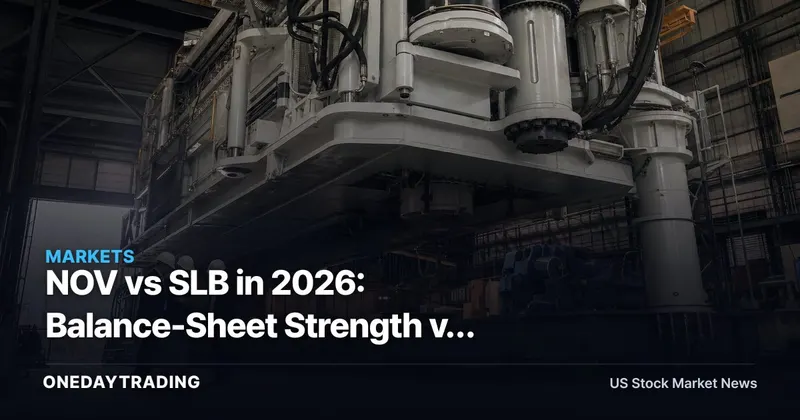
NOV enters 2026 leaning on a conservative balance sheet — a current ratio of roughly 2.4x and low debt — while SLB counters with global scale and technology breadth. For energy investors, the real question is not who sells more equipment, but whose capital structure survives a flatter spending cycle and whose end-markets keep funding it.
The Full Story
Oilfield-services equities live and die on operator capital budgets, and those budgets have stopped racing higher. In that environment, a current ratio near 2.4x is not an accounting footnote — it tells you NOV can fund working capital, honor supplier terms, and ride out a slow quarter without leaning on credit markets. Low leverage compounds the point: less interest expense skimming margins, more room to buy back stock or step into a downturn rather than retrench.
SLB sits at the other end of the trade-off. Its pitch is reach — a footprint across drilling, completions, production systems and digital that captures spend wherever it lands, and pricing power on differentiated technology that a hardware-weighted peer cannot easily match. Scale converts even a stable rig count into recurring service revenue, but it also ties results more tightly to international and offshore activity, where project timing swings hard.
Structural Background
This is a classic capital-cycle face-off. NOV's revenue skews to equipment and capital goods — rig technology, components, big-ticket orders that arrive in lumps and lean on backlog. SLB's mix tilts toward repeatable service and production work that tracks the installed base. When operators spend cautiously, the service annuity tends to prove stickier than the equipment order book, but a balance sheet built for stress is the hedge against exactly that lumpiness.
Stock & Sector Ripple
- NOV — Conservative financing (2.4x current ratio, low debt) is the defensive case; the risk is heavier exposure to discretionary equipment and rig-technology orders that soften first when budgets tighten.
- SLB — Scale and technology breadth support pricing and recurring service revenue, but greater international and offshore weighting raises sensitivity to project deferrals and commodity swings.
- Oilfield-services peers — Halliburton (HAL) and Baker Hughes (BKR) move on the same operator-capex signal; relative positioning hinges on North America versus international mix.
- Upstream operators — Producers such as ExxonMobil (XOM) and Chevron (CVX) sit upstream of this spend; their budget discipline sets the ceiling on services demand.
Bull vs Bear Scenarios
Bull: If spending holds and offshore and international projects sanction on schedule, SLB's annuity grows while NOV's clean balance sheet lets it return cash and gain share on weaker rivals. Bear: A softer commodity tape pressures operator budgets; equipment orders stall first, exposing NOV's cyclicality, while SLB's international weighting amplifies project-timing risk. Valuation is the swing factor — paying up for scale only works if activity cooperates.
Investor Action Points
- Track each company's book-to-bill and backlog in the next quarterly report to gauge order momentum versus the recurring-service base.
- Watch operator capex guidance from majors and the global rig count as the leading signal for both names.
- For NOV, monitor whether the low-debt, high-liquidity profile converts into buybacks or counter-cyclical investment.
- For SLB, weigh international and offshore project timing against the multiple you are paying for scale.
Market data check: NOV
NOV last traded near $18.66 (-1.48%). Our composite signal — blending price momentum and news flow — reads 🟡 neutral. Price momentum scores 38/100 (soft).
Data as of publication. Price via market feeds; for reference only, not investment advice.
📊 Analysis
Signal Neutral
Why A head-to-head valuation comparison frames a trade-off between NOV's balance-sheet strength and SLB's scale rather than delivering a clear directional catalyst for either stock.
Tickers$NOV$SLB$HAL$BKR$XOM$CVX
This article was independently written by OneDayTrading from public reporting. Read the original (NASDAQ)