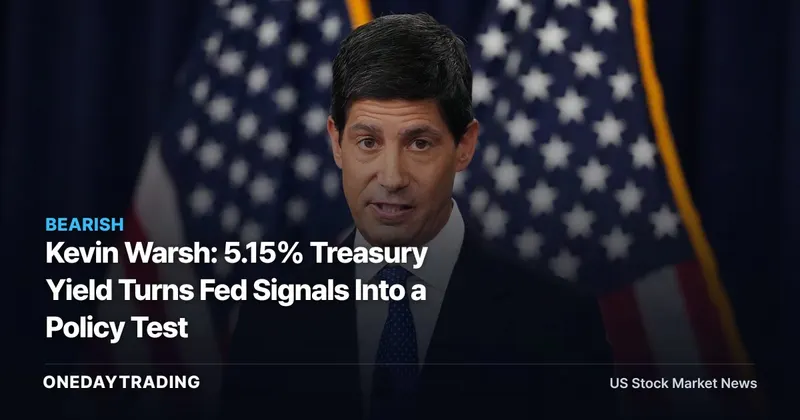
Kevin Warsh Faces a Treasury-Market Policy Test
Kevin Warsh faces a harder Federal Reserve policy trade-off as rising Treasury yields collide with inflation above the central bank’s 2% goal and market expectations for additional interest-rate increases. CNBC Markets reported on 2026-09-24 that Treasury yields continued rising Thursday, while traders increased the odds of an October rate hike after the Federal Reserve raised rates by a quarter percentage point last week.
For investors, the sharpest signal is not simply that yields are higher. It is that the market and Federal Reserve officials may disagree over how much tightening is required, even as Warsh has emphasized financial-market signals as an input into policy. That disagreement leaves the next decision exposed to repricing whichever course policymakers choose.
The policy dilemma is the risk that additional tightening restrains the expansion while insufficient tightening fails to restore price stability. The article does not establish which outcome will prevail, and it does not state the Federal Reserve’s next decision.
The 5.15% Yield Is the Starting Point, Not the Answer
CNBC Markets reported that the 10-year Treasury yield was around 5.15% on Thursday. The same report said the 30-year Treasury bond yield had reached its highest level since 2004, showing that the pressure extended beyond expectations for the next policy move.
The market’s implied path also shifted. Traders raised the probability of a possible October increase and anticipated a possible third rate increase late this year or early in 2027. That outlook marked a departure from the Federal Reserve’s June projection, which contemplated a rate increase followed by no further increase before eventual cuts.
Those expectations remain market pricing, not a Federal Reserve commitment. The source supplies neither exact dates for the possible October and year-end decisions nor an exact future path for policy rates or Treasury yields. The distinction matters because expectations can move before policymakers act.
RSM’s 5.5% Scenario Defines the Economic Risk
RSM modeled a scenario in which a 5.5% 10-year Treasury yield would reduce growth to 1.5%, raise unemployment to 4.7% and leave core inflation at 2.4%. That combination frames the central difficulty: weaker growth and higher unemployment would not necessarily return core inflation to the Federal Reserve’s 2% goal under the modeled assumptions.
The scenario is not a forecast that CNBC Markets said would occur. It is a conditional result showing why a higher-yield environment could complicate the policy calculation rather than resolve it. Investors therefore need to separate the observed 5.15% yield on Thursday from RSM’s modeled 5.5% yield.
Joseph Brusuelas said his view after the September meeting had been that the Federal Reserve would deliver three rate hikes. After considering RSM’s work, he argued that restoring price stability might require five or six hikes rather than two or three.
Brusuelas described the period of looking through the initial supply shock as finished and said policy should lean toward restoring price stability. His assessment represents a more forceful tightening case, while the modeled growth and unemployment results show the economic cost embedded in that case.
Federal Reserve Voices Do Not Confirm the Market’s Full Path
John Williams called another increase by the end of the year “reasonable,” while stressing that policymakers should continue watching economic data rather than lock themselves into a preset course. His position supports the possibility of further tightening without validating every increase reflected in market expectations.
Anna Paulson also indicated that more policy tightening was likely, describing potential moves as “modest.” Her characterization does not align clearly with a long sequence of increases, leaving a gap between support for additional action and the scale of tightening proposed by Brusuelas.
Krishna Guha of Evercore ISI called market expectations “too aggressive.” He identified a communication problem as well as a policy problem: weak guidance could leave the Federal Reserve choosing between an undesirable increase and disappointing markets, with either decision capable of producing a substantial change in market rates.
That tension is especially important because the central bank has moved away from the forward-guidance approach associated with the period beginning in 2008. Without a predefined path, each decision carries more information about policymakers’ reaction to inflation, yields and economic data.
What Warsh’s Market-Led Framework Changes
Kevin Warsh took the Federal Reserve chair job in May and has emphasized listening to market signals. Jonathan Pingle of UBS wrote that Warsh’s framework appeared less grounded in detailed economic measurement and more influenced by market narratives than prior Federal Reserve leadership.
This approach creates a feedback problem within the facts reported. Markets anticipate tighter policy, Treasury yields rise, and those market movements become signals considered by a chair who gives financial conditions substantial weight. The source establishes the interaction, though it does not specify how Warsh will translate any particular yield level into a policy vote.
Andrew Hollenhorst of Citigroup offered a different reading of the yield increase. He argued that the move reflected real yields as investors priced higher policy rates, rather than expectations that an overly accommodative Federal Reserve would allow inflation to remain above target.
Beth Hammack also enters the debate through Pingle’s assessment that Warsh’s views appeared closely aligned with hers. The significance is not a confirmed voting outcome; it is evidence that observers saw the chair’s stance as consistent with a more restrictive policy position.
Implications for Rates and Equity Investors
- Treasury rates: The immediate reference point is the 10-year Treasury yield near 5.15% on Thursday. A move toward RSM’s modeled 5.5% scenario would make the model’s growth, unemployment and inflation combination more relevant, without proving that those results will occur.
- Federal Reserve expectations: An October increase is a market probability rather than a stated decision. Investors should distinguish that pricing from the more cautious language used by John Williams and Anna Paulson.
- Policy credibility: The Federal Reserve must weigh the risk of excessive tightening against the risk that insufficient action weakens confidence in its commitment to the 2% inflation goal.
- Equities: The supplied evidence contains no company earnings, valuations or sector-level performance. It therefore does not support naming specific stock beneficiaries or casualties from the yield move.
Signals That Could Change the Rates Thesis
- The October decision: Check whether the Federal Reserve delivers the increase traders increasingly anticipated or departs from that pricing.
- Guidance from officials: Watch whether John Williams’s data-dependent stance and Anna Paulson’s expectation of “modest” tightening develop into a clearer policy path.
- The 10-year Treasury yield: Compare the observed level with the 5.5% assumption in RSM’s scenario rather than treating the model as a forecast.
- The possible later increase: Assess whether expectations for a third rate increase late this year or early in 2027 persist as policymakers evaluate growth, unemployment and core inflation.
The Next Move Depends on Which Signal the Fed Trusts
The restrictive case rests on inflation remaining above the Federal Reserve’s 2% goal, rising Treasury yields and the market’s expectation of further increases. Brusuelas’s argument strengthens that case by suggesting that two or three hikes may be insufficient and that five or six may be required to restore price stability.
The countercase comes from the economic strain in RSM’s modeled scenario and the view from Guha that market expectations are too aggressive. Hollenhorst’s interpretation also matters because it frames rising yields as a response to higher expected policy rates, not proof that the Federal Reserve has lost control of inflation expectations.
The decisive checkpoint is the interaction between the next policy choice, official guidance and the 10-year Treasury yield. If Warsh continues to treat markets as a policy input, the question is whether Treasury pricing clarifies the appropriate path or amplifies the uncertainty the Federal Reserve is trying to manage.
📊 Analysis
Signal Bearish
Why Rising Treasury yields and expectations for further Federal Reserve tightening create a difficult trade-off between restoring price stability and preserving economic growth.
This article was independently written by OneDayTrading from public reporting. Read the original (CNBC Markets)