Cengage’s Graduate Survey Signals a Narrower U.S. Hiring Funnel
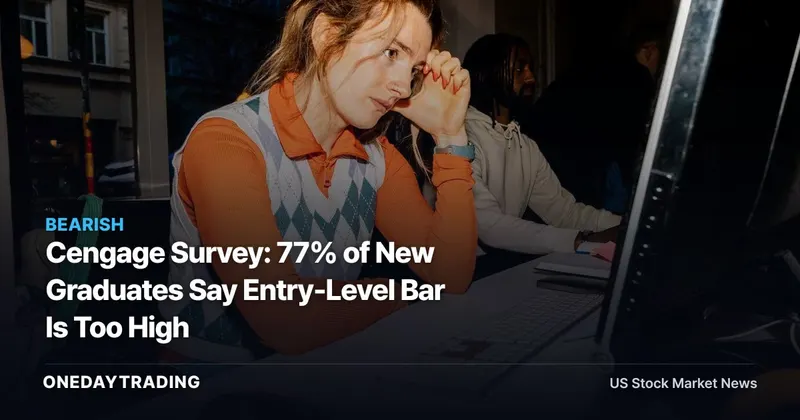
Cengage found that 77% of recent graduates in 2026 believed businesses demanded too much experience for entry-level jobs, a labor-market warning published by CNBC on 2026-09-28. For investors, the relevant signal is not one unsuccessful job search; it is the combination of stricter screening, scarce junior openings and weaker hiring across financial services, tech, information and media, and professional services.
The entry-level hiring gap is the mismatch between employers’ experience requirements and the opportunities available to graduates seeking their first full-time role. It can make headline hiring demand look more accessible than it is because an advertised junior position may still exclude candidates without prior workplace experience.
That distinction matters when assessing the U.S. economy. A labor market can remain competitive overall while its first rung becomes harder to reach, limiting how readily education converts into full-time employment and making employers more selective about candidates who need training.
Rachel Grandis Illustrates the Experience Paradox
Rachel Grandis graduated from Elon University with a strategic communications degree in May 2026 and had not secured a full-time job offer. Her experience captures the central contradiction: employers can describe a role as entry level while favoring applicants who already have a stronger employment record.
“No job is willing to give you that first experience to have on your resume,” Grandis told CNBC. Her case does not establish why any application failed. The available evidence does not identify the employers or openings involved, determine whether AI-assisted applicant tracking systems rejected her because she was a 2026 graduate, or state how many full-time offers she ultimately received.
Those limits are important. One graduate’s outcome cannot prove a marketwide screening mechanism. The broader survey and hiring data carry the analytical weight; Grandis provides a concrete example of the obstacle the respondents described.
Cengage Finds Experience Requirements Colliding With Opportunity
According to CNBC, the Cengage report found that 75% of recent graduates in 2026 believed there were too few genuinely entry-level opportunities. The report drew on U.S. surveys conducted from April to August 2026 of 931 full-time hiring managers, 759 post-secondary instructors and 1,100 recent graduates, with an approximate margin of error of ±3 percentage points.
Michael Hansen, CEO of the education tech company Cengage, said employers had raised the bar. The report also found that 72% of employers in 2026 said the pace of workforce change made it difficult for colleges and universities to keep workforce-readiness programs current.
The pressure is visible in applicant behavior. Cengage reported that 53% of recent graduates in 2026 had avoided certain entry-level jobs because they felt underqualified, compared with 48% in 2025. When candidates self-select out before applying, demanding job descriptions can constrict the applicant funnel without employers formally closing a position.
About 1 in 3 recent graduates in 2026 said a lack of prior work experience removed them from consideration for opportunities. Respondents assigned prior experience a 24% weight as a factor in getting a job, compared with 14% for holding a degree, reinforcing the perception that credentials alone no longer clear the screening threshold.
Handshake and LinkedIn Show Weakness Beyond Survey Sentiment
Handshake, an early-career jobs site, recorded only a 1% increase in postings from July 2025 through June 2026 versus the same period in 2024 to 2025. Employers had posted 2 times as many full-time jobs for the Class of 2022 as for the Class of 2026, indicating that the opportunity set facing the later graduating class was materially smaller.
LinkedIn data supplied a broader labor-demand check. U.S. entry-level hiring and the national hiring rate each registered a roughly 6.5% decline in August 2026 from August 2025. The matching declines mean the weakness was not confined to junior roles, though the lower base of early-career opportunities can still make the impact more acute for applicants without established work histories.
The sector detail is more severe. LinkedIn found that hiring in financial services, tech, information and media, and professional services had declined 33 to 43% since June 2021. These are industries that employ entry-level talent, so their reduced hiring narrows important pathways from education into professional work.
The Investor Read-Through Is Macro, Not Stock Specific
- Financial services: A 33 to 43% hiring decline across the group of industries identified by LinkedIn signals tighter labor demand in a sector that recruits graduate talent. The evidence does not separate financial services from the other named industries, so it cannot support a company-level earnings conclusion.
- Tech: Reduced hiring can indicate greater selectivity and less willingness to absorb candidates who require training. The facts do not identify particular technology companies, spending plans or profit effects.
- Information and media: A smaller entry-level funnel may intensify competition for communications roles such as those sought by Rachel Grandis. No specific employer or listed stock is tied to her applications.
- Professional services: Experience-heavy screening can constrain graduate recruitment even when openings exist. The available figures establish hiring weakness, not its cause or its eventual revenue impact.
The market implication is therefore bearish at the labor-demand level and neutral on individual securities. Lower hiring can restrain payroll growth, while greater selectivity may reduce training demands for employers; the fact sheet supplies no wage, cost, revenue or margin data with which to determine the net corporate effect.
Education Value and Responsibility Are Also Being Repriced
Cengage found that 37% of recent graduates in 2026 believed their education was worth its cost, down from 68% in 2022. That change does not measure institutional revenue or enrollment, though it does show a substantial deterioration in graduates’ assessment of the education-to-employment bargain.
Responsibility remains fragmented. In 2026, students assigned businesses 17% of the responsibility for workforce readiness, instructors assigned them 11%, and employers assigned them 19%. Hansen argued that employers must help create the internships, apprenticeships and training opportunities needed to meet higher expectations.
Recruiting professional Bonnie Dilber offered the tougher counterpoint: employers with broad candidate choice are less likely to consider applicants stretching into a role. Together, the views frame the unresolved issue. Employers may participate more actively in developing junior talent, or they may continue selecting candidates who already meet elevated requirements.
What Investors Should Check Next
- Early-career postings: Track whether the next Handshake comparison moves beyond the nearly flat 1% increase recorded from July 2025 through June 2026 against the preceding comparable period.
- Hiring breadth: Compare future LinkedIn entry-level hiring with the national hiring rate. A divergence would show whether new graduates are improving or weakening relative to the wider labor market.
- Sector participation: Watch whether hiring in financial services, tech, information and media, and professional services begins to recover from the reported 33 to 43% decline since June 2021.
- Employer requirements: Look for evidence that businesses reduce experience demands or expand training access. The current record does not establish that either change will occur.
The Next Signal Must Come From Actual Hiring
The constructive scenario is a reopening of the entry-level funnel: more postings, broader consideration of candidates and greater employer participation in creating relevant experience. That would address the mismatch identified by Cengage and reduce the share of graduates who decline to apply because they feel underqualified.
The risk is that selectivity persists while postings remain nearly flat and hiring in graduate-heavy industries stays depressed. In that case, the key market signal will not be another account of applicant frustration on TikTok or an editorial note from CNBC Select; it will be whether Handshake postings and LinkedIn hiring data show that employers are again adding genuine entry-level capacity.
📊 Analysis
Signal Bearish
Why Weak entry-level hiring, nearly flat job postings and sharply lower hiring in graduate-heavy industries point to restrained labor demand, though the evidence does not establish a stock-specific impact.
This article was independently written by OneDayTrading from public reporting. Read the original (CNBC)