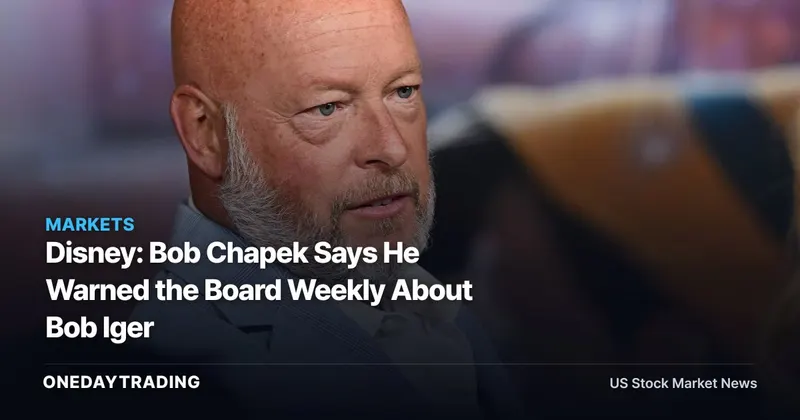
Disney Investors Get a Governance Account, Not an Operating Update
Disney investors received a new account of its former leadership conflict on 2026-09-28, when Bob Chapek told CNBC that he had raised concerns with the company’s board weekly about then-Executive Chairman Bob Iger. The disclosure sharpens the governance questions around Chapek’s tenure, although it supplies no operating figures, financial outcomes or formal explanation from the board.
The Chapek-Iger power struggle refers to the reported division of authority after Chapek became chief executive while Iger remained at Disney to oversee content initiatives including Disney+. For shareholders, the distinction matters: this is evidence about leadership friction and oversight, not evidence that revenue, costs or the company’s competitive position changed.
That makes the immediate investment read-through neutral. The account may affect how investors assess Disney’s past succession process, while the supplied record offers no basis for estimating an impact on the income statement, balance sheet or valuation.
Bob Chapek’s Timeline Concentrates the Succession Question
Bob Chapek took the helm in 2020, shortly before the Covid pandemic shuttered theaters and amusement parks, after previously leading Disney’s theme park and experiences division. Iger stayed with the company to handle content initiatives such as Disney+, leaving both executives in consequential roles during the transition.
CNBC reported that Bob Chapek was removed in late 2022, less than three years after taking the CEO post, and replaced by Bob Iger. Put differently, Chapek’s authority ended almost three years after he was named CEO, while the executive whose conduct he says he questioned returned to the top job.
According to Chapek, reports of Iger criticizing him reached him “two, three” times in the same week with recurring talking points. He told CNBC that this prompted the judgment, “I’ve got a problem,” and said he then brought concerns to Disney’s board weekly.
Chapek also recounted being told that Iger would be gone in two years and that the situation was acceptable. That recollection is central because it describes the response Chapek says he received; the evidence does not identify who delivered it or establish that it represented a formal board decision.
Bob Iger ultimately remained in the returned CEO role until March 2026. That sequence does not prove why the leadership transition unfolded as it did, though it explains why Chapek’s claims focus investor attention on the board’s handling of overlapping authority.
What Chapek’s Claims Establish—and What They Do Not
- Frequency of escalation: Bob Chapek says he alerted Disney’s board weekly during his CEO tenure. CNBC’s account does not provide documentary evidence of those communications, so the frequency remains Chapek’s attributed claim.
- Nature of the dispute: Chapek portrays Bob Iger as working against him rather than serving as a steward of the new chief executive’s role. The supplied evidence contains no response from Iger to that allegation.
- Board accountability: The account places the board at the center of the succession dispute because Chapek says he repeatedly escalated his concerns. No board members are named, and the board’s formal reasons for removing him are not stated.
- Financial significance: The facts describe governance, authority and succession. They include no Disney earnings, guidance, subscriber figures, theme-park results or other financial measures from which to calculate a stock effect.
Chapek discussed the episode after remaining publicly quiet about his firing for nearly four years, according to CNBC. He presented his version through an interview on Squawk Box and the memoir Behind the Castle Walls: My Thirty Years at the Happiest Place on Earth.
The memoir title’s “Thirty” years supplies personal context for his account, not corroboration of the allegations. Investors therefore have a detailed narrative from one participant, alongside clearly defined gaps in the public evidence provided here.
Disney Stock Checkpoints After the Chapek-Iger Account
For Disney stock, the next useful evidence would address governance rather than near-term operations. A response from Bob Iger could clarify which factual assertions he disputes, while records supporting the claimed weekly complaints could establish whether and how the board received them.
- Corroboration: Look for documentary support for Chapek’s stated weekly communications with the board. The present account confirms that he made the claim, not that independent records validate it.
- Board explanation: A formal account of the late 2022 removal would help separate the alleged power struggle from the board’s actual reasons for replacing Chapek.
- Iger’s position: The supplied report includes no response from Bob Iger. Any direct reply would add the second principal participant’s account to a record currently centered on Chapek.
- Investment linkage: A directional case for DIS would require evidence connecting the governance episode to Disney’s operations or financial performance. None is included in the available facts.
The balanced view is narrow. Chapek’s allegations raise a legitimate question about whether Disney’s leadership structure gave its new CEO clear authority while the former CEO retained responsibility for content initiatives. The counterweight is equally important: this record offers one executive’s account without documentary proof, named board participants, the board’s formal rationale or Iger’s response.
The House of Mouse is therefore the only directly affected listed company supported by the evidence, and DIS is the relevant symbol. The live question is not whether Chapek’s story proves a financial outcome; it is whether later corroboration turns a disputed leadership narrative into evidence investors can connect to board oversight and executive succession.
📊 Analysis
Signal Neutral
Why Chapek’s account raises governance questions, though the available evidence provides no financial results or formal board explanation supporting a directional stock impact.
This article was independently written by OneDayTrading from public reporting. Read the original (CNBC)