Key Takeaways
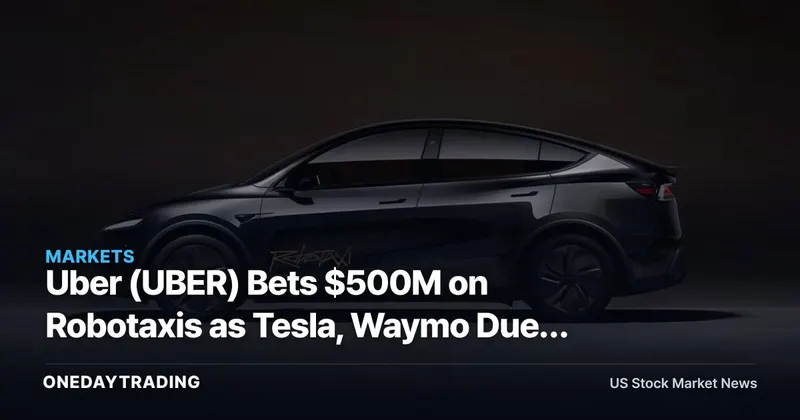
The most aggressive spender in the robotaxi race builds no vehicles at all. Uber is committing $500 million checks to secure autonomous-vehicle supply, betting that owning the demand layer matters more than owning the hardware. The strategy is capital-light versus Tesla and Waymo, but it leaves Uber dependent on partners that increasingly have the option to bypass it.
What Happened
While Tesla and Alphabet-owned Waymo fight to prove their self-driving technology on public roads, Uber is taking a different route: deploying large investments, reportedly in $500 million increments, to lock in access to robotaxi fleets it will dispatch through its own app. The pitch is simple — Uber already aggregates millions of riders, so it can monetize autonomous miles without absorbing the cost of manufacturing cars or developing full self-driving stacks.
The tension is that Waymo, the perceived technology leader, is positioned to scale its own rider app and could leave Uber behind rather than feed it demand. That turns Uber's partnership model into a strategic question: is it the indispensable distribution channel for autonomy, or a middleman that mature operators eventually disintermediate?
Background and Context
Uber exited in-house self-driving development years ago, choosing a marketplace role over a capital-intensive technology race. That kept its balance sheet lighter than Tesla's and Waymo's, both of which carry the heavy fixed costs of vehicles, sensors and engineering. The current checks signal that the asset-light thesis still requires real cash to guarantee a seat at the table.
Market and Stock Impact
- Uber (UBER): Core subject. The $500M outlays test the asset-light narrative — upside if Uber becomes the default demand aggregator for many fleets, downside if leaders like Waymo build direct-to-consumer apps and squeeze Uber's take rate.
- Tesla (TSLA): Robotaxi ambitions are central to its valuation premium; it controls vehicle production and software but must prove unsupervised autonomy at scale, a far costlier path than Uber's.
- Alphabet (GOOGL): Owns Waymo, the technical front-runner. The optionality to bypass Uber and own the rider relationship is a competitive lever that pressures Uber's negotiating power.
- Lyft (LYFT): As the rival aggregator, it faces the same disintermediation risk and the same need to strike its own autonomy supply deals.
Investor Checkpoints
- Watch whether new robotaxi partnerships route demand through Uber or through operators' own apps — that determines who captures the rider relationship.
- Track Uber's take rate and capital commitments in upcoming quarterly results to see if these checks dilute the asset-light margin story.
- Monitor Waymo's city expansion and whether it launches a standalone consumer app, the clearest signal of disintermediation.
- For Tesla, gauge progress and geographic scope of any unsupervised robotaxi service against its production-scale advantage.
Outlook
The bull case for Uber is that autonomy still needs distribution, and paying upfront secures a structural toll on millions of future driverless trips without manufacturing risk. The counter-scenario is concrete: if the strongest technology owner controls both the cars and the app, Uber's checks buy access that erodes as partners scale. The deciding variable is leverage — whether riders default to Uber's marketplace or to the fleet operators directly.
Market data check: UBER
UBER last traded near $73.85 (+6.00%). Our composite signal — blending price momentum and news flow — reads 🟡 neutral. Price momentum scores 95/100 (firm).
Data as of publication. Price via market feeds; for reference only, not investment advice.
📊 Analysis
Signal Neutral
Why Uber's $500M robotaxi bet is strategically significant but cuts both ways — it secures supply yet exposes disintermediation risk from stronger technology owners, with no clear directional resolution.
Tickers$UBER$TSLA$GOOGL$LYFT
This article was independently written by OneDayTrading from public reporting. Read the original (MarketWatch)