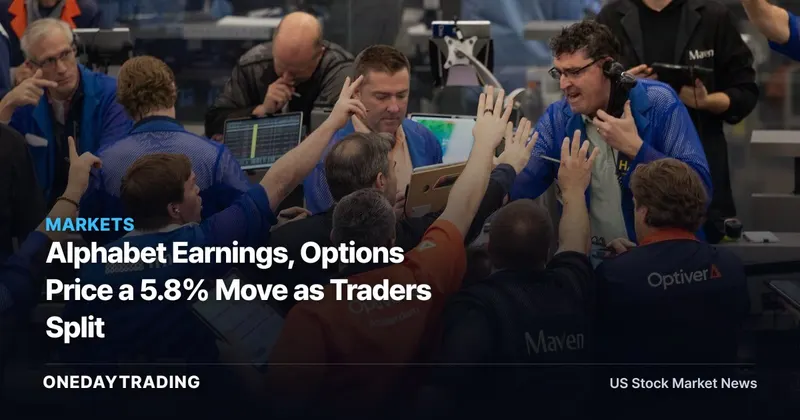
Alphabet’s Earnings Setup at a Glance
Alphabet and Microsoft were set to report earnings after the close, with Alphabet options pricing a 5.8% post-report move and traders expressing sharply different views on its direction. CNBC’s Oct. 28 reporting shows an unusually wide gap between the magnitude embedded in Alphabet options and the company’s 2.6% eight-quarter median move.
The sharp read is not simply that volatility was elevated. The options market paired substantial call demand with a bearish put structure, indicating agreement that the report could matter and disagreement over where the shares might go. That makes the quality and time horizon of each trade more informative than aggregate call volume alone.
Why Alphabet’s Implied Move Stands Out
An implied move is the stock swing reflected in options prices around an event; it describes magnitude, not a forecast of direction. Cboe LiveVol showed market-makers pricing a 5.8% move for Alphabet after its report, compared with a swing of under 5% for Microsoft.
The contrast with each company’s own record is equally important. Alphabet’s 5.8% implied move was more than double its 2.7% two-year average reaction, while Microsoft’s expected swing was below its 6% two-year average. The options market was therefore assigning more event risk to Alphabet even though both technology companies faced the same after-the-close reporting window.
Recent Alphabet reactions help explain why traders were paying for a wider range of outcomes without determining which outcome would occur. The shares fell 7% after the last quarter’s report and rallied 10% after the report before that. Those opposite moves support a high-uncertainty reading, not a directional conclusion.
The stock’s starting point also differed from Microsoft’s. Alphabet was 20% below its closing high reached in May, leaving its options setup centered on whether weakness would reverse or extend. This is the key tension: the tape had already priced a large move, while the sign of that move remained contested.
Bullish Alphabet Trades Targeted More Than a Relief Move
Just before noon, a trader bought 2271 Alphabet 350/365 call spreads for about $4.4 per spread. The structure targeted a near-term move toward $365, equivalent to a 13% rise from the referenced price.
A call spread combines a purchased call with a sold call at a higher strike, limiting both the cost and the maximum payoff. In this case, the 350/365 strikes framed a defined upside zone. The position expressed a stronger directional view than the nearly 6% post-earnings move reflected in current options prices.
Broader flow leaned toward calls as well. Cboe recorded 435,000 Alphabet options traded Tuesday, including 312,00 calls; almost 102,000 call trades were likely buyer-initiated, compared with 54,000 likely initiated by sellers, with the remainder near the mid-price.
SpotGamma identified another concentrated expression of upside demand at the $360 strike for January expiry. Its data indicated that what appeared to be a single trader bought around $18.5 million of Alphabet calls through 8 transactions of 2,850 contracts each. The concentration strengthens the evidence for bullish positioning, though neither trade reveals the trader’s identity, full portfolio, or ultimate profitability.
The Bearish Put Trade Carried a Different Clock
A separate trader established a bearish 3x1 put diagonal into Alphabet’s report. The position collected $1.9 million by selling 9,000 puts at the $290 strike expiring Nov. 20 for $4.15 per contract, while buying 3,000 puts at the $300 strike expiring Jan. 15, 2027 for $2.15 per contract.
The total debit was $2.5 million. A put diagonal uses options with different strikes and expirations, so its result depends on direction, timing and the behavior of volatility rather than on direction alone. Here, the short-dated puts could benefit from expiring worthless, leaving the longer-dated $300 puts positioned for a later decline.
The trade was structured around Alphabet moving 9% lower through mid January. It therefore does not directly cancel the bullish call-spread signal: the positions operate across different expirations and may reflect different paths. Alphabet could move around the earnings event without resolving which longer-horizon view ultimately works.
The precise year of the Nov. 20 expiration and the exact date represented by mid January were not specified. That limitation matters when comparing the put diagonal’s intended path with the Jan. 15, 2027 expiration of the purchased puts.
What Put-to-Call Ratios Say—and Do Not Say
- Calls remained more numerous: Barchart data showed that Alphabet and Microsoft maintained put-to-call ratios below 1 over the past year, meaning call activity exceeded put activity on that measure.
- Alphabet protection had increased: its current put-to-call ratio stood at 0.72, the highest since August, even as Tuesday’s call flow supplied a more positive counter-signal.
- Microsoft showed the same directional shift: its ratio was 0.59, up from 0.43 in June, as the Nasdaq 100 Index pulled back.
- Volume is not conviction by itself: the ratio identifies the balance between puts and calls, while strike selection, expiration and whether trades were initiated by buyers or sellers determine the actual exposure.
Alphabet and Microsoft: Related Market Read-Throughs
- Alphabet: the stock carried the larger implied post-report move, the concentrated January call demand and the opposing 3x1 put diagonal. Its options market was pricing dispersion between plausible outcomes rather than a clean consensus.
- Microsoft: options implied a swing of under 5% after its report, below its 6% two-year average. That smaller range distinguished its event setup from Alphabet’s without establishing whether Microsoft would rise or fall.
- Nasdaq 100 Index: the index’s pullback accompanied a gradual increase in put positioning for both companies, according to Barchart. The supplied evidence does not establish the index’s move after the reports.
What the Earnings Reports Needed to Resolve
- Actual versus implied movement: compare Alphabet’s post-report stock move with the 5.8% priced by Cboe LiveVol and Microsoft’s move with the under-5% swing embedded in its options.
- The bullish strike path: check whether Alphabet approaches the 350/365 call-spread range in the near term and whether demand remains concentrated at the $360 January strike.
- The diagonal’s timing: observe whether the sold $290 puts expire worthless on Nov. 20 and whether the purchased $300 puts retain relevance through Jan. 15, 2027.
- Positioning after the event: track whether Alphabet’s 0.72 and Microsoft’s 0.59 put-to-call ratios continue rising or reverse once the earnings uncertainty has passed.
The Market Priced Volatility, Not an Earnings Verdict
The bullish case rested on visible call demand: the 350/365 spread sought a 13% near-term rise, and SpotGamma’s January data showed $18.5 million of buying at the $360 strike. The countercase was explicit as well, with the 3x1 put diagonal preserving exposure to a 9% decline through mid January.
That combination supports a neutral directional assessment before the releases. The companies’ earnings results, their actual post-report stock moves and the profitability of the disclosed positions were not available in the supplied evidence. The decisive test is whether realized movement exceeds what options had already priced—and which strike and expiration capture it.
Market data check: Alphabet Inc.
Alphabet Inc. last traded near $326.03 (+1.70%). Our composite signal — blending price momentum and news flow — reads 🟡 neutral. Price momentum scores 64/100 (firm).
Data as of publication. Price via market feeds; for reference only, not investment advice.
📊 Analysis
Signal Neutral
Why Heavy call buying signals upside demand, while the bearish put structure and elevated implied move show that traders remain divided on Alphabet’s direction.
This article was independently written by OneDayTrading from public reporting. Read the original (CNBC)