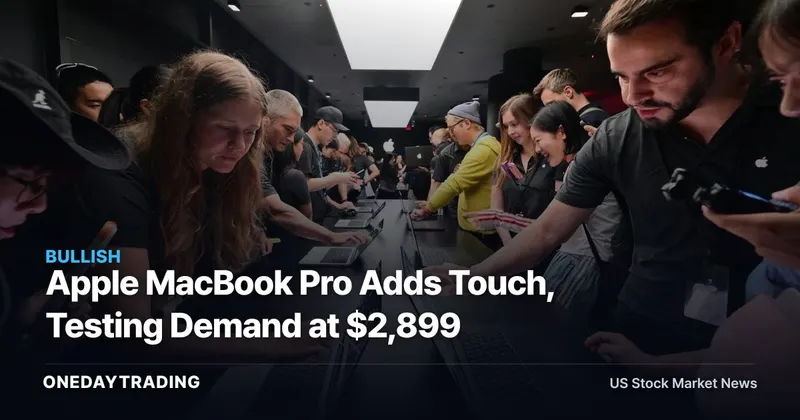
Apple’s Touchscreen MacBook Pro Raises the Stakes for Mac Hardware
Apple announced its first touchscreen laptop on Oct. 28, 2026, giving investors a new test of whether a substantial interface change can support premium Mac demand. CNBC reported that the MacBook Pro with ProLED XDR Display will go on sale Nov. 6, with the 14-inch version starting at $2,899 and the 16-inch version at $3,399.
The investment case rests less on touch as a feature than on whether Apple can use touch, OLED technology and its own silicon to make the Mac more valuable to professional users and software developers. The launch is directionally positive for Apple because it broadens the Mac proposition, while its high entry prices, a contracting PC market and unknown customer demand make the revenue outcome impossible to establish from the announcement alone.
What Apple Actually Changed
The MacBook Pro with ProLED XDR Display is Apple’s first Mac laptop designed for direct touch input. It runs MacOS, uses an OLED display and is powered by Apple’s M5 Pro or Max chips; the machine also carries a glowing Apple logo on its lid.
That combination matters because Apple has retained the Mac’s operating system rather than redefining the product as an iPad. Touch therefore becomes another input method inside the existing Mac platform. John Ternus made the reversal explicit: “Yes, for the very first time, we are bringing touch to the Mac,” he said in remarks reported by CNBC.
The pricing makes this a demanding commercial test. Apple’s 14-inch model starts at $2,899, while its 16-inch model costs at least $3,399, according to CNBC. Those prices can support substantial revenue per unit, though the fact sheet provides neither expected unit volume nor evidence that buyers will pay specifically for touch.
Why the Mac Strategy Matters to Apple
Apple reported $10.35 billion in Mac sales in its most recent quarter, equal to just under 10% of total revenue, according to CNBC. The Mac is therefore meaningful without being the company’s dominant revenue source, making a successful product expansion useful while limiting what this launch alone can change across the wider business.
The strategic channel extends beyond hardware buyers. Apple teamed up with Meta to announce that large, nearly frontier models can run on clusters of Macs linked by high-speed cabling. That relationship places the Mac in a local and clustered computing discussion that also includes developers deciding whether to use services from Anthropic or OpenAI.
Macs run on Apple’s chips rather than Intel’s, giving the company control over both the computer platform and the silicon inside it. Johny Srouji and John Ternus were associated with that transition. For investors, the relevant mechanism is integration: a touch interface can add value only if MacOS, the display and Apple’s processors work together well enough to change how users interact with professional applications.
Touch Reverses a Longstanding Apple Position
The announcement reverses years of resistance inside Apple. Craig Federighi explained the company’s objection to touchscreen laptops in 2018, while John Ternus discussed Apple’s separation of Mac and touch-oriented input with The Wall Street Journal’s Joanna Stern in 2021.
The reversal does not prove that touchscreen demand has become broad. IDC data indicate that only 17% of notebook PCs shipped globally this year will have touchscreens. Ryan Reith described the core issue as software and interface design rather than hardware, saying, “This is really a user interface and software thing.”
That distinction sets the hurdle for the product. A touchscreen alone is unlikely to establish differentiation if buyers treat it as an optional feature. A MacOS experience that makes touch useful to developers and professional workflows could create a stronger reason to choose the machine; as Reith put it, “It’s one more thing that can draw the developers in.”
Apple Faces a Weak PC Demand Backdrop
The launch arrives against declining industry volumes. Overall laptop shipments are expected to fall 11% this year, while IDC estimated that total PC shipments dropped 20% year over year in the third quarter. Apple did not escape that pressure: IDC estimated that Apple shipments fell 11% during the third quarter.
These figures sharpen the pricing risk. A premium product can generate more revenue per sale, yet a high starting price can narrow the addressable buyer pool when industry shipments are falling. The fact sheet does not establish whether the touchscreen model will attract new Mac customers, accelerate upgrades or mainly shift purchases within Apple’s existing lineup.
Other supplied pricing points reinforce the importance of buyer response. Mac Minis received a $300 increase in August, and the iPad Mini starts at $699, which is $100 above its predecessor. Those figures do not reveal the economics of the new MacBook Pro, though they show that investors should separate higher listed prices from demonstrated shipment growth.
Stock and Hardware-Sector Read-Through
- Apple: The direct opportunity is additional Mac revenue from a premium laptop combining touch, OLED technology, MacOS and M5 Pro or Max chips. The direct risk is that higher prices meet weak demand in a market where Apple shipments fell 11% during the third quarter, according to IDC.
- Hardware sector: IDC’s estimate that touchscreen notebooks represent only 17% of global notebook PC shipments this year suggests touch is not yet a universal purchase requirement. Apple’s launch can test whether tighter hardware-software integration changes that role at the premium end, but the sheet provides no future sector shipment or market-share outcome.
- Developer ecosystem: The Meta collaboration shows one route through which Mac hardware can serve developers running large models on connected machines. The touchscreen launch adds another interface layer, though no supplied figure links either initiative to developer adoption or sales.
Bull and Bear Cases for AAPL
Bull case: Apple has paired its first touch-enabled Mac with OLED technology, its own M5 Pro or Max chips and MacOS rather than presenting touch as a standalone specification. If that integrated experience proves useful, the company could give professional users and developers a clearer reason to choose a high-priced MacBook Pro.
Bear case: The market evidence does not show that touch drives notebook purchases. Only 17% of notebook PCs shipped globally this year will include touchscreens, according to IDC, and both overall PC volumes and Apple shipments declined in the third quarter. Prices of $2,899 and $3,399 raise the burden on the product to demonstrate value through actual demand.
The balanced reading is a positive product catalyst with limited near-term evidence. Exact sales volume, release markets, regional availability, full display specifications, customer demand and future market-share outcomes are all unknown, so the announcement supports a thesis to test rather than a completed earnings argument.
Investor Checkpoints After the Nov. 6 Launch
- Sales evidence: After the Nov. 6 release, look for disclosed demand or shipment information that separates touchscreen MacBook Pro performance from the broader Mac category.
- Mac revenue: Compare the next reported Mac sales figure with the most recent quarter’s $10.35 billion, while avoiding the assumption that any change came solely from the new laptop.
- Shipment direction: Track whether subsequent IDC estimates improve from Apple’s 11% third-quarter decline and the industry’s 20% year-over-year contraction in total PC shipments.
- Developer response: Look for evidence that touch in MacOS or Mac clusters used for large models expands developer activity; the current fact set confirms the product and Meta relationship, not adoption or financial returns.
Market data check: Apple Inc.
Apple Inc. last traded near $344.4 (-0.78%). Our composite signal — blending price momentum and news flow — reads 🟡 neutral. Price momentum scores 52/100.
Data as of publication. Price via market feeds; for reference only, not investment advice.
📊 Analysis
Signal Bullish
Why The touchscreen MacBook Pro expands Apple’s premium hardware proposition and developer appeal, though high prices and falling shipments limit conviction.
This article was independently written by OneDayTrading from public reporting. Read the original (CNBC)