Kash Patel’s Absence Puts Contractor Access Under Scrutiny
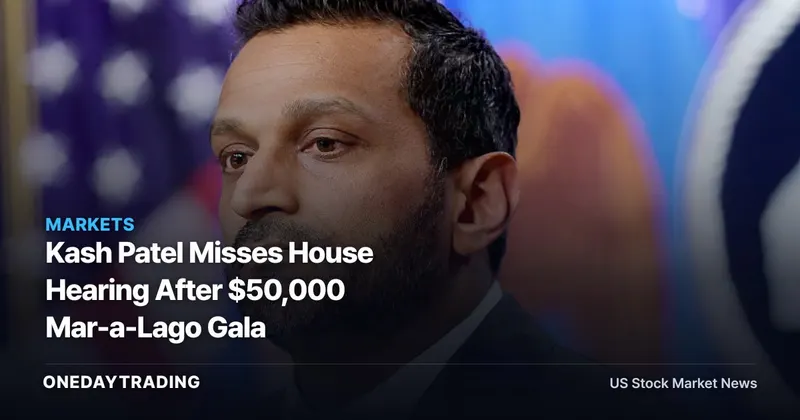
Kash Patel missed the House Homeland Security Committee’s annual threat assessment hearing on Wednesday after attending the Big Blue Bash at Mar-a-Lago the previous night. For investors, the relevant issue is not the gala alone; it is whether paid access involving officials and federal contractors produces additional oversight, disclosure demands or procurement scrutiny.
CNBC reported the episode in an article dated 2026-11-18. The FBI confirmed that Patel, Markwayne Mullin and Attorney General Todd Blanche attended the event, while Patel sent his deputy to the hearing. The known facts support a governance-risk analysis, not a conclusion that any sponsor received favorable treatment.
The Big Blue Bash was a charitable fundraiser benefiting the Federal Law Enforcement Officers Foundation. Its access structure ranged from general admission costing nearly $5,000 to a $25,000 VIP all-access pass and a $50,000-per-person package covering a private roundtable and resort stay. Corporate sponsorship packages reached $1 million.
The Timing Behind Kash Patel’s Missed Hearing
Flight records reviewed by CNBC showed that a Justice Department aircraft associated with Patel’s travel left West Palm Beach at 7:51 a.m. ET on Wednesday and landed at Joint Base Andrews at 10:20 a.m. ET, 20 minutes after the hearing began. Who was aboard the aircraft is unknown, and the available evidence does not establish that the flight was connected to the gala.
Patel’s nonappearance drew criticism from committee Chairman Andrew Garbarino and Bennie Thompson. Their objections matter to investors only through a potential transmission channel: congressional concern can increase questions directed at agencies, officials and contractors. The fact sheet provides no resulting investigation, procurement change or financial penalty, so that channel remains conditional.
FBI spokesperson Benjamin Williamson said, “The event is approved by Ethics, following all guidelines and regulations.” That statement establishes the FBI’s position on the event. It does not answer which officials joined private meetings, which companies purchased the highest-priced packages or whether the $1 million sponsorship package was sold.
Motorola Solutions and the Federal-Contract Exposure
Motorola Solutions was the Big Blue Bash’s top named sponsor, making it the clearest corporate focus in the disclosure. CNBC’s analysis put Motorola Solutions’ net contract obligations from the Justice and Homeland Security departments at approximately $237.1 million in fiscal 2026. The amount identifies substantial government exposure, though it does not demonstrate that gala participation affected an award.
Motorola Solutions’ September figures included a $139.6 million Bureau of Prisons radio contract, a $25.8 million Customs and Border Protection award and a nearly $18 million Secret Service contract option. The company also reported roughly $1.69 million in federal lobbying expenses this year through September.
The company said it supported the Big Blue Bash and stated, “We did not participate in private briefings.” That denial narrows the known interaction but leaves the size of its sponsorship undisclosed. For an equity reader, the missing variable is not whether federal contracts exist—the figures confirm that they do—but whether oversight creates any change in procurement treatment, disclosure burden or contract execution.
Other Sponsors and the Procurement Link
Vierra Group and Teya Diversified Services sponsored a Department of Homeland Security presentation featuring Mullin and Homan, while LEO Technologies was listed as a Big Blue Bash sponsor. These relationships connect the event to companies serving government agencies, but the fact sheet does not identify which sponsors bought the most expensive access.
Federal contracting records showed that Teya Diversified Services received three Customs and Border Protection contracts in September worth approximately $23.3 million combined. The awards comprised $9.1 million for work at 12 ports, $7.9 million for nine ports and $6.4 million for 10 ports.
Those awards provide the commercial context for scrutiny, not evidence of causation. The article expressly states that there is no evidence sponsorships influenced federal contracts or secured preferential treatment. Some unanswered questions may affect perceptions of process integrity, but they cannot be converted into a revenue forecast or adverse-contract assumption from the supplied record.
The $1 Million Package and the Disclosure Gap
The event’s $1 million sponsorship package exceeded the Federal Law Enforcement Officers Foundation’s $725,476 in 2024 revenue. No purchase of that package has been confirmed, and the available information does not show how much money ultimately reached the nonprofit beneficiary.
Another missing figure is what Mar-a-Lago was paid. The only supplied comparison is that a Republican fundraiser at Mar-a-Lago cost about $318,000 in 2023. That comparison frames the scale of a possible venue payment, but it cannot establish the Big Blue Bash’s cost or the allocation of its proceeds.
The central analytical tension is therefore unusually precise: the access prices and government-contract amounts are documented, while the identities behind the costliest packages and the flow of event proceeds are not. Investors should treat that as a disclosure issue until additional records establish a financial or procurement consequence.
Neutral Case Versus a Higher-Risk Scenario
Neutral case: The ethics approval cited by Benjamin Williamson stands, Motorola Solutions’ statement that it avoided private briefings is not contradicted, and no evidence emerges connecting sponsorship to contract decisions. Under that scenario, the event remains a political and governance controversy without a supported directional effect on contractor revenue.
Higher-risk scenario: Additional disclosure identifies sponsors in private meetings or produces new questions about agency procurement and official travel. That could intensify oversight of companies with federal business, especially where contract awards and event sponsorship overlap in public discussion. The fact sheet does not establish that this scenario has occurred.
The balance of evidence supports a neutral market assessment. Contract exposure is concrete, while the mechanism required for a bullish or bearish stock conclusion—preferential access, altered awards, contract disruption or a measurable cost—is absent.
Investor Checkpoints After the Big Blue Bash
- Check whether officials or organizers disclose who attended private meetings and which companies purchased the highest-priced sponsorship packages.
- Track whether Motorola Solutions provides additional detail on its sponsorship amount or its interactions at the event.
- Look for congressional or agency disclosures that connect the hearing controversy to procurement review, contract administration or travel oversight.
- Verify any accounting of what Mar-a-Lago received and how much of the event’s proceeds reached the Federal Law Enforcement Officers Foundation.
Until one of those checkpoints produces new evidence, the investable facts remain bounded: Kash Patel missed the hearing, named contractors sponsored the gala, and substantial federal contract amounts were already on record. The next meaningful signal is documented follow-through, not the access price by itself.
📊 Analysis
Signal Neutral
Why The episode raises governance and contracting-scrutiny risk, but the available evidence establishes neither preferential treatment nor a measurable financial impact.
This article was independently written by OneDayTrading from public reporting. Read the original (CNBC)