Summary
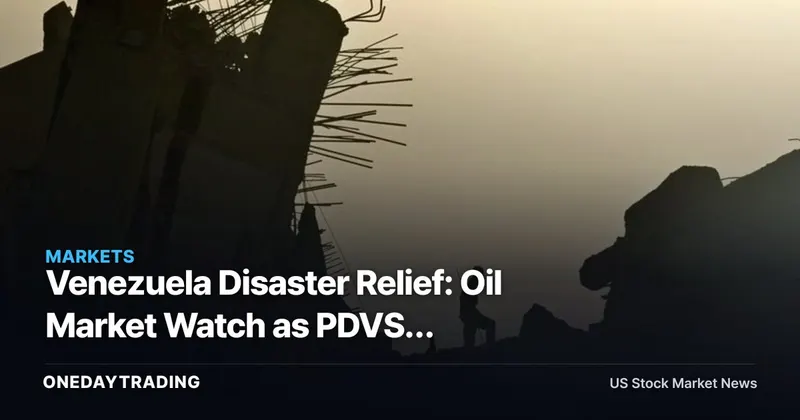
Venezuela's latest humanitarian emergency — a search-and-rescue operation drawing foreign teams amid mounting local frustration — lands against a backdrop of chronically impaired oil infrastructure, where any additional operational disruption carries non-trivial implications for global supply balances. Venezuela's crude output has been hobbled for years by U.S. sanctions, underinvestment, and PDVSA mismanagement; a major domestic crisis adds another layer of uncertainty to an already fragile production base. For energy investors, the watchpoint is less the immediate event and more whether instability compounds an already difficult operating environment for the few companies still holding Venezuelan exposure.
The Full Story
International rescue teams joined Venezuelan authorities in a large search operation as community frustration grew over the pace and scale of the official response. The details of the specific incident were not disclosed in full, but the mobilization of foreign resources signals a significant casualty event. Venezuela's civil infrastructure — including oil facilities, pipelines, and refineries — has deteriorated sharply over the past decade under sanctions pressure and capital starvation, meaning any large-scale physical disruption in the country risks compounding existing production shortfalls.
Venezuela holds some of the world's largest proven crude reserves, yet output has collapsed from roughly 3 million barrels per day in the early 2000s to well under 1 million bpd in recent years. PDVSA's operating reliability is already at the margin; incremental operational shocks, even unrelated to the oil sector directly, can ripple through a workforce and logistics network with almost no redundancy built in. Whether this event directly touches energy infrastructure remains unclear — but the pattern of Venezuela-related news moving oil prices on supply-disruption speculation is well established.
Structural Background
The Trump-era maximum-pressure sanctions and subsequent Biden-era partial relief created an unstable policy environment for Venezuelan crude, with Chevron holding a narrow but active carve-out license to lift oil. Any escalation of domestic instability risks triggering U.S. policy reviews of that license, tightening supply from a marginal but real producer. OPEC+ has already been managing a complex quota balancing act; losing even 100,000–200,000 bpd of Venezuelan volume in a low-inventory environment would register on WTI and Brent prompt spreads.
Stock & Sector Ripple
- CVX (Chevron) — The only major U.S. integrated oil company with active Venezuelan operations under its OFAC license; domestic instability raises both operational risk and license-renewal uncertainty.
- XOM (ExxonMobil) — Broader OPEC supply disruption risk supports WTI; Exxon as a large U.S. E&P benefits from any sustained crude price lift.
- OXY (Occidental Petroleum) — High oil-price leverage given its cost structure; upside in a supply-disruption scenario, but also most exposed to price volatility.
- HAL / SLB (Halliburton / SLB) — Oilfield services firms with emerging-market exposure; Venezuelan instability is a long-standing drag on any recovery of their legacy contracts in the country.
Bull vs Bear Scenarios
Bull: If the disaster directly impairs Venezuelan production or triggers a U.S. policy review of Chevron's license, even a modest reduction in OPEC+ effective supply — against a backdrop where global inventories remain below the five-year average — could push WTI toward the upper end of its recent range, lifting all U.S. E&P names. Chevron's Venezuela optionality, already undervalued by most sell-side models, becomes a cleaner long if instability ultimately pushes toward political transition and a sanctions reset.
Bear: The event may carry no direct energy-infrastructure impact, in which case any oil-price reaction fades quickly. More importantly, Venezuela's chronic dysfunction is already well-priced into global supply models — incremental bad news there rarely moves the needle in a market more focused on Saudi production decisions and U.S. shale rig counts. Chevron investors face binary headline risk with limited near-term upside from Venezuelan operations regardless of domestic conditions.
Investor Action Points
- Monitor PDVSA operational reports and any U.S. Treasury OFAC statement on Chevron's Venezuela license in the coming days — that is the direct policy trigger to watch.
- Track EIA weekly crude inventory data; a Venezuela supply reduction only matters if U.S. storage is already tight, so the inventory print sets the amplification context.
- Watch WTI prompt-month versus six-month spread (backwardation depth) as a real-time signal of whether the market is pricing physical tightness or dismissing the event.
- For Chevron specifically, the Q2 earnings call — and any management commentary on Venezuela volumes — will be the definitive checkpoint on operational status.
📊 Analysis
Signal Neutral
Why The story is a humanitarian rescue operation with no confirmed direct impact on oil infrastructure; market implications remain speculative and contingent on unconfirmed details.
Tickers$CVX$XOM$OXY$HAL$SLB
This article was independently written by OneDayTrading from public reporting. Read the original (Investing.com)