What Changes
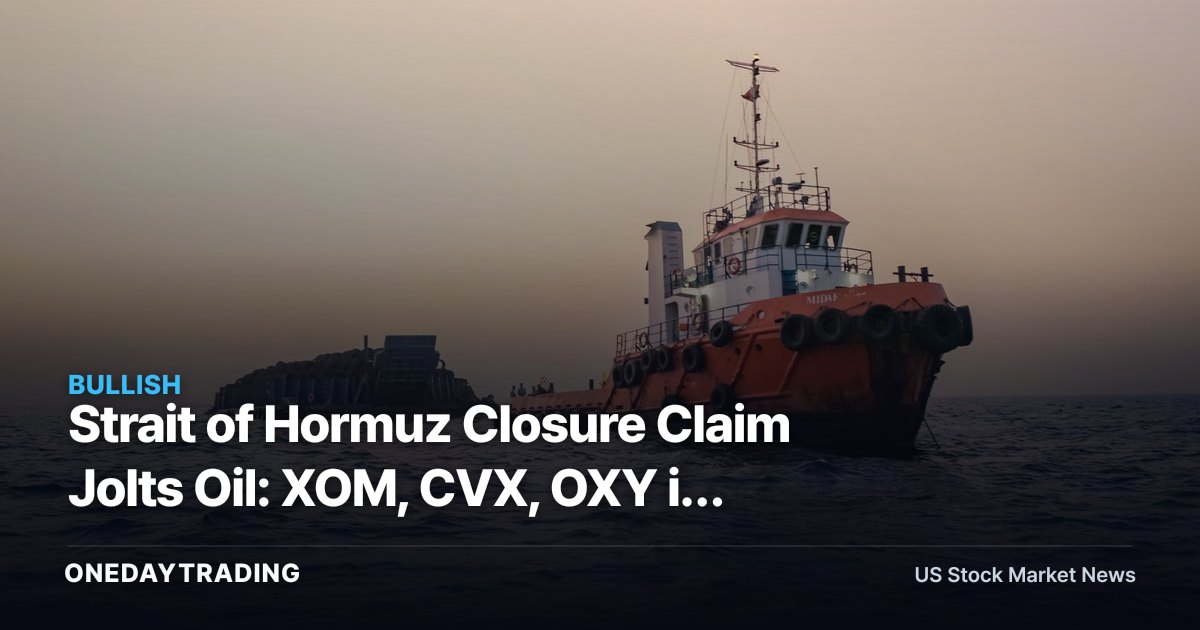
The market reaction here hinges less on the words and more on the flows. A declared closure of Hormuz is the single most powerful supply shock the energy market can price, because roughly a fifth of the world's seaborne oil and a large share of global LNG move through that narrow lane between Iran and Oman. When a closure is announced, crude futures and energy equities tend to gap up first and ask questions later.
But the detail that matters for positioning is the contradiction: even as Tehran calls the strait closed, the same trackers watching the water report Iranian tankers continuing to transit. That divergence suggests the announcement is functioning more as a political and pricing lever than as an enforced blockade. For investors, the practical question is whether transit data confirms a real interruption, or whether ships keep moving and the risk premium fades.
This is a textbook geopolitical risk-premium event rather than a confirmed loss of barrels. Integrated oil majors and exploration-and-production names benefit from higher realized crude prices on every barrel they already produce outside the conflict zone, which is why their leverage to a Hormuz scare is immediate and largely cost-free.
By the Numbers
The concrete signals are two: Iran's renewed declaration that the waterway is closed, and the stall in broader shipping traffic it has triggered. Set against that, the counter-signal is equally concrete — Iranian tankers are still recorded sailing through. With no reported figure for halted volumes, the price move is being driven by probability and fear, not by a verified barrel count, which is exactly the kind of premium that can unwind quickly if flows normalize.
Winners & Losers
- ExxonMobil (XOM), Chevron (CVX), Occidental (OXY) — higher crude prices lift realized margins on existing production; these are the most direct equity beneficiaries of a Hormuz risk premium.
- Tanker and shipping operators — a genuine disruption reroutes cargoes and spikes freight rates, a tailwind for crude-carrier owners even as transit risk rises.
- Refiners and airlines — pressured, since higher crude raises feedstock and jet-fuel costs they cannot instantly pass through, squeezing margins.
- Energy-heavy ETFs and oilfield services — ride the same crude tailwind, with services leveraged to any sustained move in activity and spending.
Risk Check
- The closure may be rhetorical: if tankers keep transiting, the risk premium can deflate as fast as it appeared.
- A spike built on fear rather than verified lost barrels is fragile and prone to sharp reversals on any de-escalation headline.
- Sustained high oil feeds inflation and complicates rate-cut expectations, a drag on broad equities beyond energy.
- Energy names already pricing geopolitical risk carry valuation downside if crude round-trips lower.
Bottom Line
A declared Hormuz closure is a real catalyst for crude and energy equities like XOM, CVX and OXY, but the continued transit of Iranian tankers is the tell that this may be a premium without a confirmed supply loss — track verified vessel flows and any official volume figures before treating the move as structural rather than a headline spike.
📊 Analysis
Signal Bullish
Why A declared Strait of Hormuz closure is a direct supply-shock catalyst that lifts crude prices and the oil majors leveraged to them, even as actual flows remain uncertain.
This article was independently written by OneDayTrading from public reporting. Read the original (CNBC)