At a Glance
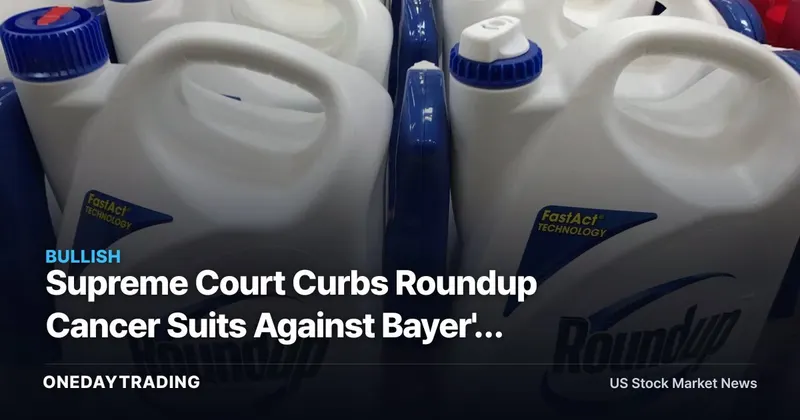
The U.S. Supreme Court has acted to limit cancer lawsuits tied to Roundup, the glyphosate-based weedkiller owned by Bayer through its Monsanto unit. For investors, the headline question is narrow but material: how much of Bayer's litigation overhang does this actually remove, and how durable is the relief.
Why It Matters Now
Glyphosate is the most widely used herbicide in agriculture, so Roundup is not a fringe product line but a core agricultural-chemicals franchise. The investment problem has never been demand for the product; it has been the open-ended legal liability attached to claims linking glyphosate to cancer. That tail risk is what has weighed on Bayer's valuation and capital-allocation flexibility since the Monsanto acquisition.
A ruling that constrains how and where these suits can proceed attacks the problem at its source. If plaintiffs face a higher bar or fewer venues, the expected value of future settlements falls and the range of outcomes narrows. Markets dislike unquantifiable liabilities more than large-but-bounded ones, so even a partial cap on legal exposure can re-rate the equity by shrinking the discount investors apply for uncertainty.
The channel here is preemption-style logic: if federal pesticide regulation is treated as the governing standard, state-law failure-to-warn claims lose footing. That would not erase existing cases, but it changes the trajectory of new filings and the leverage plaintiffs hold in negotiations.
FAQ
- Does this end Roundup litigation? No. It limits a category of suits; pending cases and prior settlements are not undone.
- Why does a legal ruling move the stock? Bayer's discount has reflected unbounded liability fear; a cap reduces the uncertainty premium.
- Is Roundup still being sold? Glyphosate remains the most common agricultural herbicide, so the revenue base is intact.
- How do U.S. investors access Bayer? Through the BAYRY ADR rather than a direct U.S. listing.
Related Stocks & Sectors
- Bayer (BAYRY) — direct beneficiary; reduced legal tail supports its crop-science earnings power and balance-sheet flexibility.
- Corteva (CTVA) — agrochemical peer; precedent on pesticide liability shapes the whole sector's risk profile.
- FMC Corp (FMC) — crop-protection maker exposed to the same product-liability and regulatory dynamics.
- Deere (DE) — farm-economy proxy; herbicide availability and cost feed into row-crop input decisions.
What to Watch
- Bayer's next litigation-provision update and any change to its booked legal reserves.
- Whether new Roundup filings slow in the quarters after the ruling.
- Management commentary on whether a separation or restructuring of the crop unit becomes more likely.
- Read-through commentary from agrochemical peers on regulatory-preemption risk.
Overall Outlook
The bull case is straightforward: a ceiling on a previously open-ended liability can release value trapped by uncertainty, and the underlying glyphosate franchise still sells into the largest herbicide market in agriculture. The risk is over-reading a single ruling — existing claims, future regulatory scrutiny of glyphosate, and the possibility that lower courts interpret the limits narrowly all keep the overhang from disappearing entirely. The clearest tell will be in Bayer's own reserve math, not in the headline.
Market data check: BAYRY
BAYRY last traded near $13.02 (+15.73%). Our composite signal — blending price momentum and news flow — reads 🟡 neutral. Price momentum scores 95/100 (firm).
Data as of publication. Price via market feeds; for reference only, not investment advice.
📊 Analysis
Signal Bullish
Why Limiting Roundup cancer suits reduces Bayer's open-ended litigation liability, the key overhang on the stock.
Tickers$BAYRY$CTVA$FMC$DE
This article was independently written by OneDayTrading from public reporting. Read the original (CNBC)