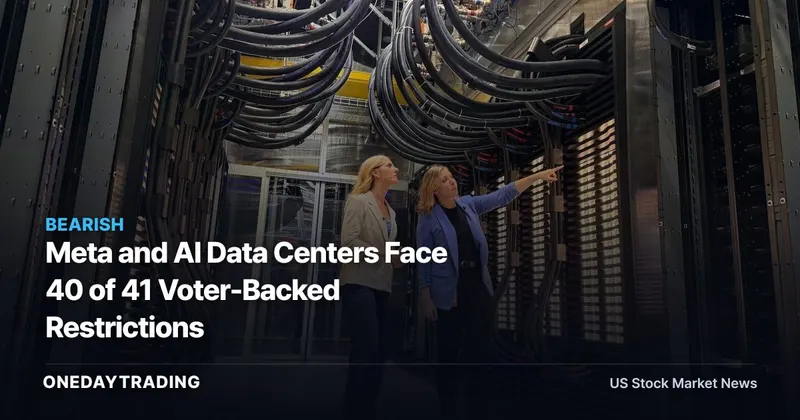
Meta and AI Data Centers Meet a Voter Constraint
Meta, Google, Amazon and SpaceX now face a clearer resource constraint around AI infrastructure: voters this week passed 40 of 41 proposed ballot measures restricting some planned data centers, CNBC reported. The investor read-through is bearish for the buildout at the margin, because local water and power questions may become conditions that projects must address rather than secondary engineering details. Whether the measures alter any specific facility’s construction or operation remains unknown.
AI data centers are facilities built around dense computing hardware whose heat must be removed through internal server cooling and an external process that releases that heat into the surrounding environment. More than 2,000 new facilities are planned, according to CNBC, putting the ballot results against a large prospective construction pipeline rather than an isolated project.
The Cooling Problem Starts Outside the Chip
Large 1-gigawatt AI data centers associated with Meta, Google, Amazon and SpaceX can consume up to 10 million gallons of water per day, University of California, Riverside researcher Shaolei Ren told CNBC. The figure is an upper-end statement about large facilities, not a site-level reading for every project. Hardware, location and cooling design can all change the requirement.
The internal loop is only part of the system. Dense GPUs generate enough heat to require liquid cooling, and water is 3,000 times more efficient at cooling them, according to Equinix sustainability head Christopher Wellise. Nvidia and Advanced Micro Devices therefore sit inside a physical infrastructure chain in which greater computing density must be paired with a workable method for rejecting heat.
The distinction matters because a closed-loop system can recirculate internal coolant while the facility still needs water or power to move heat into the ambient environment. The two primary external methods are dry cooling and evaporative cooling. Dry cooling uses less water and can require more power in hot conditions; evaporative cooling uses little power while losing water through evaporation on the hottest days.
Hybrid designs attempt to manage that exchange. This is not a simple choice between liquid cooling and no liquid cooling: the relevant investor question is how each site balances water availability, power demand and peak-temperature performance. Wellise’s assessment was direct: “There’s no sort of silver bullet.”
Meta’s Indiana Allocation Shows the Disclosure Gap
Meta is building a 1GW data center in Lebanon, Indiana, and says its closed-loop system will use zero water for a majority of the year. Its law firm says the site’s water allocation could reach up to 8 million gallons per day by 2031. Meta characterizes that amount as a maximum expected only during the hottest conditions and says it is currently projected for “only a few days per year.”
Those statements can coexist, because annual operating patterns and peak-day allocations measure different things. They do not reveal the site’s exact consumption. For investors, the missing metric is a site-level series that separates routine use from peak demand and identifies how often the maximum is approached.
Equinix illustrates the same reporting limitation at company scale. Equinix operations consumed 1.2 billion gallons of water in 2025, up 10% from a year prior, while the company does not disclose consumption for individual data centers. That prevents a direct comparison between specific cooling designs, locations and customer configurations.
At an Equinix colocation facility, customers rent space while the operator supplies power, network connections, interconnectivity and cooling. Alembic owns the eight Nvidia Grace Blackwell racks observed at one such facility. This arrangement divides ownership of computing hardware from responsibility for much of the supporting infrastructure, making facility-level data important when assessing where resource exposure sits.
Water Infrastructure Is Becoming Part of AI Capital Spending
Meta spent $100 million on a water and wastewater system near its Kuna, Idaho data center. That spending shows how water infrastructure can become part of enabling an AI campus, not merely a utility line item. Microsoft and Amazon are also among the companies building treatment facilities near some projects, although the available facts do not quantify their spending or resulting supply.
Outside Memphis, Elon Musk pledged $80 million for a recycling plant intended to turn treated municipal wastewater into cooling water for SpaceX’s Colossus data centers. Colossus 1 came online in 2024, while construction on the treatment plant was put on hold in April of this year. The amount of water that plant would supply is unknown.
Colossus 1 has an allocation of up to 1.28 million gallons per day and had not reached that level, according to Memphis Light, Gas and Water. Actual daily consumption has not been disclosed. The distinction between an allocation and measured use is essential: allocation describes potential access, while consumption establishes the operating burden.
Chip-Level Efficiency Offers a Counterweight
The bearish policy signal has a technical counter-scenario. If processors and memory produce less heat, facilities may need less cooling before operators choose between dry and evaporative systems. DeepX says its AI processor runs up to 100°F cooler than competitors, and Hyundai Motor will use the chip in robotics offerings.
SK Hynix told CNBC in July that its iHBM technology can reduce thermal resistance by 30%. Thermal resistance describes how strongly a material or component impedes heat flow; reducing it could make heat easier to move away from memory. The available evidence does not quantify resulting facility-level water or power savings, so the claim should be treated as a component metric rather than proof of lower total resource use.
For Nvidia and Advanced Micro Devices, the policy exposure is indirect but relevant. Their rack-scale AI systems rely on liquid cooling, placing GPU deployment inside the broader water-and-power debate. The facts provided do not establish changes to orders, shipments or demand, so ballot restrictions should not be translated into a measured semiconductor revenue effect.
What Investors Should Check at the Next Disclosures
- Site-level reporting: Check whether Equinix or other operators move beyond companywide water totals and disclose consumption by facility, cooling method or peak condition.
- Meta’s operating range: Compare any disclosed routine usage at the Indiana site with its allocation of up to 8 million gallons per day by 2031, while tracking whether peak use remains limited to a few days per year as projected.
- Memphis recycling capacity: Look for a construction update and a quantified water contribution from the planned recycling plant before treating the $80 million pledge as available supply for the Colossus data centers.
- Technical translation: Watch for evidence connecting DeepX’s temperature claim or SK Hynix’s 30% thermal-resistance reduction to lower cooling demand at the facility level.
The Investment Balance After the Ballot Measures
The bear case is that 40 of 41 successful measures turn resource access into a more visible constraint for a planned pipeline of more than 2,000 facilities. Meta, Google, Amazon and SpaceX must operate within a debate where peak allocations can reach millions of gallons per day, while incomplete site-level reporting makes comparisons difficult.
The countercase rests on engineering and infrastructure. Closed-loop liquid systems recirculate water internally, hybrid cooling can balance water and power, treatment plants can expand reuse, and lower-heat chips may reduce the thermal load. None of those approaches removes the external heat-rejection trade-off documented by Equinix.
The decisive evidence will come from project-specific disclosures: actual daily consumption, peak-day frequency, treatment-plant supply and any changes to construction or operation under the new restrictions. Until those figures emerge, the ballot result is a credible constraint on AI infrastructure expansion, not proof that any named project has been canceled or that GPU demand has changed.
Market data check: Meta Platforms, Inc.
Meta Platforms, Inc. last traded near $635 (+0.79%). Our composite signal — blending price momentum and news flow — reads 🟡 neutral. Price momentum scores 56/100.
Data as of publication. Price via market feeds; for reference only, not investment advice.
📊 Analysis
Signal Bearish
Why Voter-backed restrictions and unresolved site-level resource disclosures could add constraints and uncertainty to planned AI data-center development.
Tickers$META$GOOGL$AMZN$EQIX$NVDA$AMD
This article was independently written by OneDayTrading from public reporting. Read the original (CNBC)