At a Glance: Mark Wiseman’s Tariff Warning
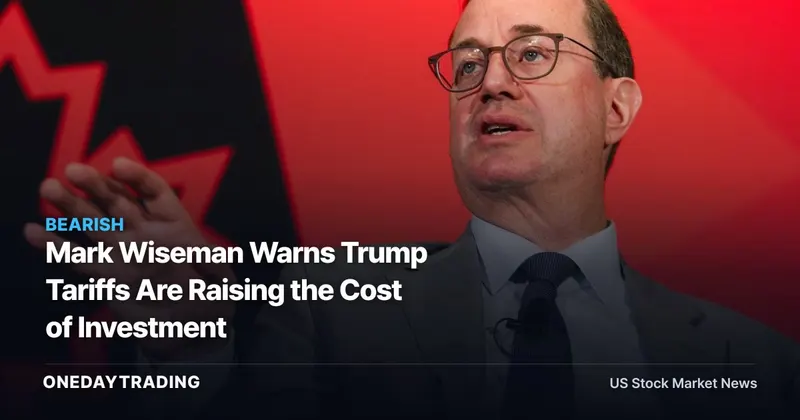
Mark Wiseman warned on 2026-11-11 that tariffs are raising investment costs and discouraging business expansion during renewed U.S.-Canada trade negotiations. For investors, the central risk is broader than the customs bill: uncertain trade rules can make long-lived spending on plants, equipment and research harder to approve.
CNBC reported that the U.S. and Canada exchanged roughly $570 billion in goods during the first nine months of 2026. That scale makes the dispute relevant to the macro outlook even though the available evidence does not identify individual U.S.-listed companies or quantify the investment being deferred.
Why Donald Trump’s Tariffs Matter for Capital Spending
A tariff is a duty charged on an imported product; its economic effect depends on which participant ultimately absorbs the added cost. The immediate issue for businesses is therefore not only the tariff rate, but also whether the cost can be passed through and whether the applicable rules will remain stable long enough to support an investment decision.
Wiseman expressed the capital-cycle problem directly: “Uncertainty increases your cost of capital.” His argument is that greater certainty makes businesses more likely to commit money to expansion. When the future cost of imported inputs or market access is unclear, the expected return on a long-duration project becomes harder to judge, which may raise the threshold required for approval.
That mechanism does not prove that aggregate investment has already fallen by a particular amount. The source provides no estimate of the investment allegedly discouraged by tariffs. The defensible investor conclusion is narrower: the policy environment creates a headwind to planning, while the size of the resulting spending restraint remains unknown.
The Import-Cost Channel Is Already Material
CNBC reported that U.S. customs duties on imports from Canada reached $10 billion in 2025, compared with $400 million in 2024. Those figures measure duties rather than lost investment, corporate-margin pressure or final consumer costs, so they establish the expansion of the customs burden without settling who ultimately bears it.
The clearest evidence on incidence comes from an October study. CNBC said the research found that nearly 90% of tariff costs were passed on to U.S. importers, while about a quarter of tariff increases eventually reached consumer goods prices. This separates the first-round burden from the later retail effect: importers encounter most of the tariff cost initially, and part of the increase can then move into consumer prices.
U.S. consumer prices rose 0.4% in October, according to the same reporting. That figure does not by itself isolate tariffs as the cause of the monthly increase. It does show why investors must evaluate the trade dispute alongside inflation: further consumer price pressures were expected in 2027, although the source does not quantify them.
The Core Debate in the U.S.-Canada Negotiations
- Protection versus cost: Donald Trump imposed duties of up to 50% on certain Canadian products and defended tariffs as protection for U.S. manufacturers and workers. Canada responded with retaliatory measures targeting U.S. exports.
- Certainty versus leverage: Wiseman called for the removal of tariffs imposed under Sections 232 and 338 of U.S. trade law. His case rests on predictable investment conditions; the opposing policy logic treats tariffs as negotiating and protective instruments.
- Negotiation scope: The governments resumed talks after negotiations collapsed in August, with tariffs on Canadian steel and automobiles at the center of the discussions. The source gives no timetable or expected form of a settlement.
- Trade integration: Wiseman said the two countries have maintained comprehensive free trade since 1988. The current dispute therefore tests the terms governing an established commercial relationship rather than a new trading channel.
Industrial and Consumer Read-Through
The most direct sector exposure in the supplied evidence lies in steel and automobiles because those products are an explicit focus of the negotiations. The transmission mechanism is physical and financial: duties can alter the landed cost of an imported product, while shifting rules can complicate capital commitments tied to cross-border production and sales.
Consumer-facing businesses face a different pressure point. If part of a tariff increase reaches consumer goods prices, companies must decide how much cost to absorb and how much to reflect in pricing. The fact sheet supplies no company-level revenue mix, margin, guidance or pricing data, so assigning the effect to particular stocks would overstate the evidence.
The balance is not uniformly negative. A negotiated reduction in steel and automobile tariffs could improve planning certainty and lessen the customs burden. Continued duties or another breakdown in talks would preserve the uncertainty Wiseman identified, leaving businesses to evaluate projects without clarity on future trade costs.
A Wider Business Demand for Stable Rules
The concern was not limited to the Canadian representative. Jens Hanefeld argued that businesses can adapt to tariffs but struggle with an ever-changing regulatory environment. His point reinforces the distinction between a known cost and an unstable one: a fixed rule can be modeled, while repeated changes can force companies to revise assumptions and delay commitments.
Aurélien Lechevallier urged greater cooperation on AI and energy instead of continued trade disputes, saying, “Businesses are eager to do more business.” That statement signals demand for commercial engagement, not proof that investment will accelerate. Actual expansion still depends on the policy certainty at the center of Wiseman’s warning.
Mark Carney identified the Trump administration as Canada’s principal negotiating partner. BlackRock is relevant only as Wiseman’s former affiliation, and the fact sheet establishes no corporate role for it in the dispute. Joe Biden appears solely in the political context supplied with the story; the evidence does not support a company-specific or market-performance comparison tied to his presidency.
What Investors Should Monitor Next
- Steel and automobile terms: Watch whether resumed negotiations produce a reduction or removal of the tariffs under discussion. No conclusion date is provided.
- Sections 232 and 338: A change in the duties Wiseman identified would be the clearest policy test of his call for greater certainty.
- Importer cost absorption: Future evidence should show whether U.S. importers continue to bear most tariff costs or pass a larger portion into consumer goods prices.
- Consumer prices in 2027: Track whether the expected additional price pressure becomes measurable and whether it can be separated from other influences on inflation.
Overall Outlook for U.S.-Canada Trade Risk
The near-term macro signal is bearish: a larger customs burden, importer exposure and uncertain trade rules can weigh on investment decisions and add pressure to prices. The available record supports a risk assessment, not a forecast of a specific decline in capital spending, corporate earnings or equity valuations.
The constructive scenario is a negotiated easing of tariffs on Canadian steel and automobiles, accompanied by clearer rules for long-term business planning. The adverse scenario is prolonged uncertainty alongside duties of up to 50% on certain Canadian products and continuing retaliation against U.S. exports.
The decisive checkpoint is policy, not rhetoric. Investors need evidence that the resumed negotiations change tariff terms, followed by data showing whether importer costs, consumer-price transmission and business investment conditions improve. Until those signals arrive, the $570 billion goods relationship remains economically significant and exposed to an outcome the source does not yet define.
📊 Analysis
Signal Bearish
Why Higher import costs and policy uncertainty could restrain business investment while adding pressure to U.S. consumer prices.
This article was independently written by OneDayTrading from public reporting. Read the original (CNBC)