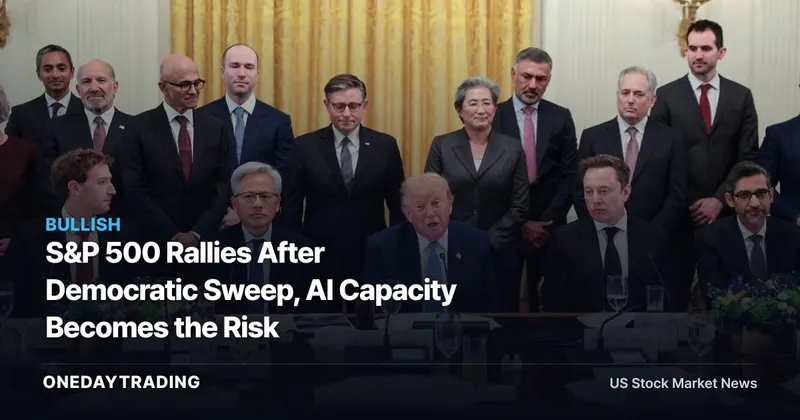
S&P 500 Rally Meets an AI Infrastructure Test
The S&P 500 rose 1.6% Wednesday after Democrats won a sweeping midterm victory, putting Big Tech, AI infrastructure and data-center policy at the center of the investor debate. The Dow Jones Industrial Average climbed 1,569 points, or 3%, while the Nasdaq Composite advanced 1.4%, according to CNBC.
The sharp read is that the market rally and the political reaction are not expressing the same judgment. Equity indexes moved higher as billionaire donors debated election spending and prominent investors warned that tighter limits on data-center construction could restrain the physical capacity behind AI expansion.
What the Democratic Midterm Sweep Means for Markets
A sweeping midterm victory means Democrats prevailed broadly in the election, although the available reporting provides neither certified nationwide vote totals nor seat counts. That distinction matters: the result is confirmed, while the precise scale of the institutional change cannot be measured from the supplied evidence.
The tape delivered an unambiguous first response. CNBC reported that the Dow Jones Industrial Average gained 1,569 points, or 3%, Wednesday; the S&P 500 rose 1.6%, and the Nasdaq Composite added 1.4%. Those moves establish direction and magnitude for the session, not the market’s reason for assigning higher prices or the durability of the rally.
Big Tech stocks added more than $750 billion in market value at one point Wednesday, CNBC reported, even as smaller, debt-dependent data-center operators fell. The phrase “at one point” is essential because the reporting does not provide a final closing market-value gain.
Elon Musk, Richard Branson and the Donor Reckoning
Political spending became a second market-facing fault line. Elon Musk, CEO of Tesla and SpaceX, was the election’s largest individual donor, and his preferred Republicans lost the Texas Senate and governor races. CNBC reported that Musk contributed $224 million in the state during the 2026 election cycle, part of $474 million in nationwide political giving during the same period.
Richard Branson, founder of Virgin Group, criticized the scale of election influence and called for campaign-finance reform. “I have felt embarrassed by the billions that tech entrepreneurs and hedge fund managers have spent,” Branson said in remarks attributed by CNBC.
Reid Hoffman, a co-founder of LinkedIn, also criticized Musk’s spending while defending his own contributions to Democrats. “We should get money out of politics,” Hoffman said. Alex Soros celebrated the outcome after $103 million in contributions to Democratic political efforts during the 2026 election cycle, according to CNBC, declaring: “The world changed yesterday.”
The investor takeaway is narrower than the political rhetoric. The disclosed amounts show that large donors committed substantial capital and received divergent electoral outcomes. They do not establish how campaign-finance rules will change, or whether political spending will affect the earnings of Tesla, SpaceX, Virgin Group or LinkedIn.
Gina Hinojosa Puts Data-Center Capacity in Focus
The most direct industry issue emerged in Texas, where Gina Hinojosa defeated Greg Abbott in the governor race. Hinojosa proposed a moratorium on new data-center construction until stronger safeguards are established. A proposal is not an achieved construction halt, so the investable question is whether it advances into an enforceable restriction.
A data center is the physical infrastructure that houses the computing systems used to develop and operate AI services. Limits on new construction could constrain additional capacity, while leaving the economics of existing facilities dependent on the eventual scope, timing and implementation of policy.
Bill Ackman, founder of Pershing Square, framed slower AI development as a threat to technological progress. “Practically speaking, we can’t slow down,” he said. Chamath Palihapitiya focused on the infrastructure channel: “And the only way to sink the AI trade is to sink the data centers.” These are investor warnings, not established outcomes.
Brad Gerstner, CEO of Altimeter Capital, projected that 10 to 15 gigawatts of expected AI data-center capacity would not come online in 2027. Dan Ives estimated Wednesday that 10% of planned U.S. data centers would no longer proceed. The source does not establish that either projected reduction will occur, so neither estimate should be treated as completed capacity cancellation.
AMD and the Split Inside the AI Trade
Lisa Su, CEO of AMD, acknowledged resistance to AI expansion and urged technology companies to show local communities the benefits of data centers. “At the end of the day, what we need to do is ensure that everybody wins from AI,” Su told CNBC.
For AMD, the policy mechanism runs through infrastructure rather than a reported company result. Data centers provide the physical setting for AI computing, so restrictions on additional construction may limit where incremental systems can be deployed. The evidence supplies no AMD orders, shipments, revenue guidance or stock move, preventing a company-specific earnings conclusion.
Wednesday’s market split offers a more defensible sector signal. Big Tech stocks surged while smaller, debt-dependent data-center operators declined. That divergence suggests investors distinguished between established technology businesses and operators whose expansion depends more heavily on new construction and debt, though the fact sheet does not identify individual companies within either group.
A slower buildout could make existing facilities more valuable and reduce the spending burden on technology giants. The counterweight is capacity: fewer new facilities could also narrow the physical base available for AI expansion. Which effect dominates cannot be established from one session, and the future impact of the election on AI development remains unknown.
Bull and Bear Paths After Wednesday’s Rally
Bull case: The confirmed market response was positive across the Dow Jones Industrial Average, S&P 500 and Nasdaq Composite. If proposed restrictions do not become binding or leave expected capacity largely intact, the session’s preference for Big Tech over smaller, debt-dependent operators could persist without a major reduction in AI infrastructure.
Bear case: If the proposed Texas moratorium becomes enforceable and similar resistance constrains construction, expected capacity may fail to arrive. That would put the warnings from Bill Ackman, Chamath Palihapitiya, Brad Gerstner and Dan Ives closer to the operating reality of the AI trade.
Neither path is confirmed. Nationwide seat totals are absent, projected data-center reductions remain estimates, and no final closing figure is supplied for the Big Tech market-value increase. Investors therefore have a strong price signal from Wednesday, paired with incomplete evidence about the policy channel that could shape future AI capacity.
Investor Checkpoints for the S&P 500 and AI Infrastructure
- Track implementation, not slogans: Check whether Gina Hinojosa’s proposed data-center moratorium advances and what safeguards would govern new construction.
- Test capacity estimates: Compare subsequent project decisions with Brad Gerstner’s projection of 10 to 15 gigawatts in 2027 and Dan Ives’s Wednesday estimate covering 10% of planned U.S. data centers.
- Watch market breadth: Observe whether the Dow Jones Industrial Average, S&P 500 and Nasdaq Composite continue moving together or whether the split between Big Tech and smaller, debt-dependent data-center operators widens.
- Demand operating evidence: At AMD’s next company update, focus on any disclosed orders, shipments or guidance that clarify whether resistance to data-center expansion is affecting the business.
The next decisive signal will come from policy action and company disclosures, not donor commentary. Wednesday priced a broad equity rally; it did not settle how much AI capacity will be built, where it will be located or whether the election will change the pace of development.
📊 Analysis
Signal Bullish
Why All three named equity indexes rose Wednesday, although proposed data-center restrictions create an unresolved risk for AI infrastructure.
This article was independently written by OneDayTrading from public reporting. Read the original (CNBC)