Summary
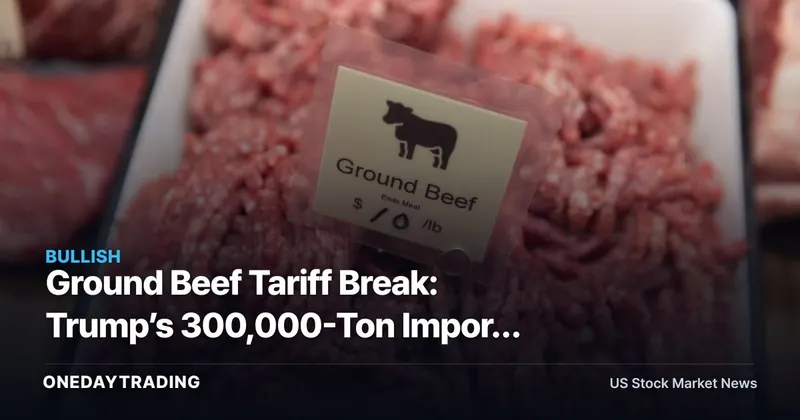
Ground beef tariffs are the pressure valve President Trump chose for 2026 beef inflation: the planned duty-free import allowance of 300,000 metric tons targets a consumer staple whose price has risen because the U.S. cattle herd has shrunk, per CNBC’s reporting.
The read-through for investors is clearest in food retail, restaurants and packaged-protein margins: cheaper incremental supply can ease input costs, but the benefit depends on whether imported ground beef lowers wholesale pricing enough to matter at the checkout counter.
The Full Story
President Trump will allow 300,000 metric tons of ground beef to enter the U.S. without tariffs, according to CNBC, after U.S. beef prices climbed in 2026 because the domestic cattle herd contracted.
Ground beef is a high-frequency grocery item, meaning consumers see the price often and quickly translate the increase into broader food-inflation anxiety. A tariff waiver is not a rebuild of the cattle herd; the policy adds imported supply to a market where domestic production capacity is constrained by fewer animals.
For equity investors, the mechanism matters more than the headline. Food sellers benefit only if the 300,000 metric tons land at a cost low enough to reduce procurement expense, and only if companies keep part of that relief rather than passing all of it through to consumers.
Structural Background
Beef inflation in 2026 is a supply problem, per CNBC’s reporting: the U.S. cattle herd reduction left fewer animals available for beef production, lifting prices before policy entered the equation.
A tariff-free import quota is a trade channel, not a production fix. The U.S. beef market still depends on herd rebuilding, slaughter availability and retailer pricing decisions, while the 300,000 metric tons becomes the measurable policy shock investors can track.
Stock & Sector Ripple
- Tyson Foods (TSN): Tyson Foods has direct protein exposure, so cheaper imported ground beef can ease raw-material pressure, while extra imported supply can also challenge pricing power in beef.
- Walmart (WMT): Walmart sells high-volume groceries, and lower ground beef costs can help traffic-sensitive food pricing if wholesale relief reaches shelves.
- Kroger (KR): Kroger’s grocery margin depends on the gap between procurement cost and shelf price, making beef inflation relief relevant to basket economics.
- McDonald’s (MCD): McDonald’s beef input costs connect directly to burger margins, though the company’s benefit depends on contract timing and supplier pass-through.
- Chipotle Mexican Grill (CMG): Chipotle has menu exposure to beef proteins, so any easing in U.S. beef costs can support restaurant cost of goods if sustained.
Bull vs Bear Scenarios
The bull case is narrow but real: 300,000 metric tons of tariff-free ground beef increases available supply and gives food retailers and restaurants a chance to protect margins without raising prices further.
The bear case is that import relief treats the symptom, not the herd shortage. If U.S. cattle supply remains tight, tariff-free ground beef can soften one product category while broader beef costs stay elevated across cuts and contracts.
Investor Action Points
- Track whether U.S. grocery chains cite beef cost relief in the next earnings cycle.
- Watch restaurant commentary on beef procurement, contract timing and menu pricing.
- Compare ground beef shelf prices with broader beef-price trends in 2026.
- Monitor whether the 300,000 metric tons changes wholesale pricing or only slows further increases.
FAQ
Why are U.S. beef prices high in 2026?
U.S. beef prices rose in 2026 because the nation’s cattle herd declined, according to CNBC. Fewer cattle reduce domestic beef supply, which raises pressure on wholesale and retail beef prices.
What does Trump’s 300,000-ton ground beef tariff move mean?
President Trump’s policy allows 300,000 metric tons of ground beef to enter the U.S. without tariffs, per CNBC. The policy aims to add supply to a tight beef market without waiting for the domestic cattle herd to recover.
Which stocks are affected by lower ground beef import tariffs?
Tyson Foods (TSN), Walmart (WMT), Kroger (KR), McDonald’s (MCD) and Chipotle Mexican Grill (CMG) have business models tied to beef costs or grocery food pricing. The equity impact depends on whether the tariff-free imports reduce procurement costs and how much companies pass through to consumers.
Market data check: TSN
TSN last traded near $57.62 (-1.34%). Our composite signal — blending price momentum and news flow — reads 🟡 neutral. Price momentum scores 39/100 (soft).
Data as of publication. Price via market feeds; for reference only, not investment advice.
📊 Analysis
Signal Bullish
Why The tariff-free 300,000-metric-ton ground beef import allowance is a potential cost relief catalyst for food retailers and restaurants, though domestic cattle supply remains the key constraint.
Tickers$TSN$WMT$KR$MCD$CMG
This article was independently written by OneDayTrading from public reporting. Read the original (CNBC)