Summary
A diplomatic deal with Iran has arrived just as the U.S. Strategic Petroleum Reserve sank to its lowest level since 1983, with oil executives flagging rapidly depleting global inventories after war-driven supply disruption. The signal that matters for investors is not the headline price move but the loss of spare buffer: when government stockpiles and commercial inventories thin at the same time, the market becomes more sensitive to the next shock, which favors producers with low-cost barrels and reserve leverage.
The Full Story
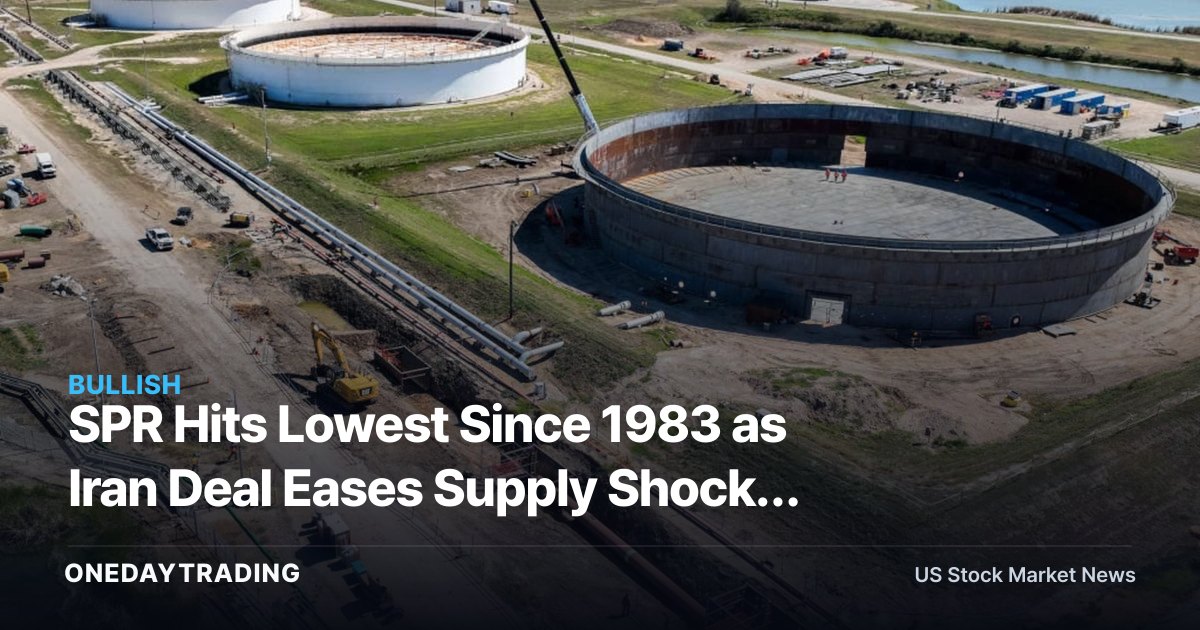
The reserve, the federal emergency cushion built after the 1970s oil shocks, has been drawn down to a depth not seen in more than four decades. That erosion happened against a backdrop of supply interruption tied to the Iran conflict, which pulled barrels out of the global system faster than they were replaced and pushed industry leaders to warn that worldwide inventories are running lean.
The Iran deal changes the near-term risk picture by reopening a path for disrupted supply to return, which removes some of the war premium that had been embedded in crude. But the timing cuts both ways. With the SPR offering far less ability to absorb a future disruption, the policy emphasis is likely to shift from releasing barrels to refilling them, a structural source of incremental demand that competes directly with refiners and commercial buyers for crude.
Structural Background
The SPR was designed as a counter-cyclical tool: release into shortages, refill into gluts. Years of heavy drawdowns have inverted that flexibility. A reserve at 1983 levels means Washington has limited room to dampen the next price spike, so the market must price geopolitical risk with thinner safety margins. For upstream producers, that backdrop tends to support a higher floor under crude even when a specific conflict de-escalates.
Stock & Sector Ripple
- ExxonMobil (XOM) — A diversified major with large low-cost upstream output benefits from a structurally tighter inventory regime; sustained crude underpins upstream cash flow even as the war premium fades.
- Chevron (CVX) — Similar leverage to realized crude prices through its production base; a market with little spare buffer rewards reserve depth and reliable volumes.
- ConocoPhillips (COP) — A pure-play exploration and production name with high sensitivity to crude realizations, making it a sharper expression of the inventory-tightness thesis than integrated peers.
- Refiners (e.g. VLO) — Face the opposite pressure: any government move to refill the SPR adds competition for crude feedstock and can squeeze input costs and margins.
- Energy sector broadly — Thin inventories plus reduced policy buffer raise the option value of energy as a hedge against the next supply disruption.
Bull vs Bear Scenarios
The bullish case rests on a tight physical market: depleted SPR, lean global inventories, and eventual refill demand keep a firm floor under crude and producer cash flows. The bearish counter is that the Iran deal restores meaningful supply just as global demand growth disappoints, which would unwind the war premium and pressure prices regardless of how low the reserve sits. A weaker macro backdrop or faster-than-expected barrel returns is the key variable that could overwhelm the inventory story.
Investor Action Points
- Watch official weekly U.S. crude and SPR inventory data for whether stockpiles stabilize or keep falling.
- Track any government announcement on SPR refill plans, the timing and pace are the swing factor for crude demand.
- Compare upstream-heavy names (COP, XOM, CVX) against refiners, since refill competition cuts the two groups in opposite directions.
- Monitor the next earnings cycle for energy producers, focusing on realized crude prices and capital-return guidance rather than headline output.
📊 Analysis
Signal Bullish
Why A historically depleted SPR plus lean global inventories and eventual refill demand support a firmer crude floor that benefits low-cost oil producers, even as the Iran deal trims the war premium.
This article was independently written by OneDayTrading from public reporting. Read the original (CNBC)