What Changes
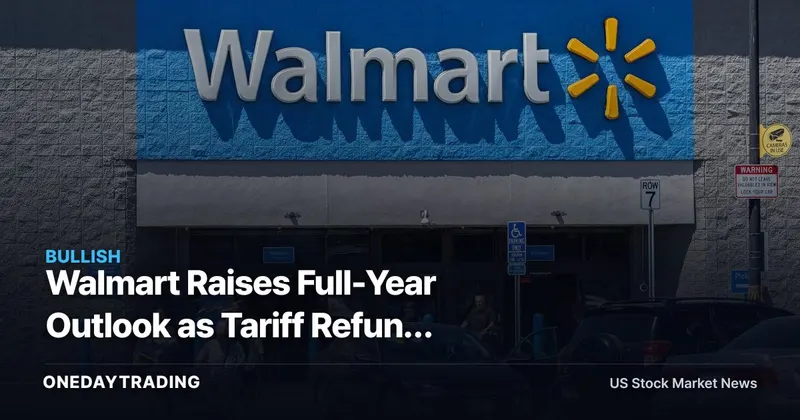
Walmart’s signal is straightforward: the consumer has not disappeared, but value is absorbing a larger share of the wallet. A higher full-year outlook says management sees enough durability beyond fiscal second quarter to underwrite better guidance, while the tariff refund gives it room to defend price without immediately asking the income statement to carry the full burden.
That is Olivia Bennett territory: shopper behavior first, balance sheet second. If Walmart uses the refund to hold prices down, the direct benefit is traffic and basket relevance. The indirect benefit is competitive pressure. Rivals with thinner scale, weaker sourcing leverage or less room to absorb tariff friction have to choose between matching price and protecting margin.
The market should not treat the refund as recurring earnings power. It is a funding bridge. The investment question is whether low prices convert into sustained customer retention, especially in a K-shaped economy where higher-income shoppers may still spend while lower-income households remain price sensitive.
By the Numbers
The supplied report gives three concrete markers: Walmart reported fiscal second-quarter earnings on Thursday, raised its full-year outlook, and said a large tariff refund would be used to keep prices low. It does not provide the refund amount, comparable sales, margins, earnings per share or revenue figures, so the clean read is directional rather than model-ready.
The timing matters. Fiscal second-quarter results arrive as investors are using big-box retail as a consumer stress test. A guidance raise is more durable than a quarterly surprise because it forces management to commit to the second-half demand, cost and pricing assumptions embedded in the outlook.
Winners & Losers
- Walmart: The clearest beneficiary. Price investment can support traffic, defend grocery share and reinforce the company’s value positioning.
- Mass retail peers: The pressure point is relative pricing. If Walmart widens the value gap, competitors may need promotions to protect volume.
- Dollar and discount retail: A sharper Walmart price message can pull trips from lower-income shoppers who compare essentials closely.
- Consumer staples suppliers: Lower shelf prices can help unit volume, but Walmart’s scale may also keep pressure on vendor negotiations.
Risk Check
- The tariff refund is not the same as repeatable operating leverage; investors should not capitalize it like recurring margin expansion.
- If low prices lift traffic but baskets weaken, revenue quality may look better than household spending power actually is.
- A K-shaped economy cuts both ways: value retailers gain trade-down demand, but the same consumer stress can cap discretionary categories.
- The next checkpoint is Walmart’s detailed guidance language after fiscal second quarter, especially any comments on pricing, traffic and second-half consumer demand.
Bottom Line
Walmart’s outlook raise is bullish for the stock because it pairs demand resilience with a concrete price-funding lever. The risk is valuation quality: a tariff refund can buy time and traffic, but the durable upside depends on whether those shoppers stay after the one-time support fades.
Market data check: WMT
WMT last traded near $106.01 (-7.25%). Our composite signal — blending price momentum and news flow — reads 🟡 neutral. Price momentum scores 5/100 (soft).
Data as of publication. Price via market feeds; for reference only, not investment advice.
📊 Analysis
Signal Bullish
Why Walmart raised its full-year outlook and plans to use a tariff refund to reinforce low prices, a positive catalyst for traffic and competitive positioning.
This article was independently written by OneDayTrading from public reporting. Read the original (CNBC)