Summary
A reported framework for a U.S.-Iran peace deal shifts the market's attention from supply disruption fears toward the prospect of de-escalation in the Middle East. The cleanest first-order effect runs through crude oil: a lower geopolitical risk premium and the eventual possibility of restored Iranian barrels. That reframes the trade for energy producers, defense contractors, and oil-sensitive consumers of fuel.
The Full Story
The Trump administration and Iran have agreed on a framework for a peace deal, with markets now waiting on the actual text before pricing the details. The gap between a framework and a signed, enforceable agreement is where the trading risk lives — frameworks set intent, but sanctions relief, inspection regimes, and timelines determine how many physical barrels and how much risk premium actually change hands.
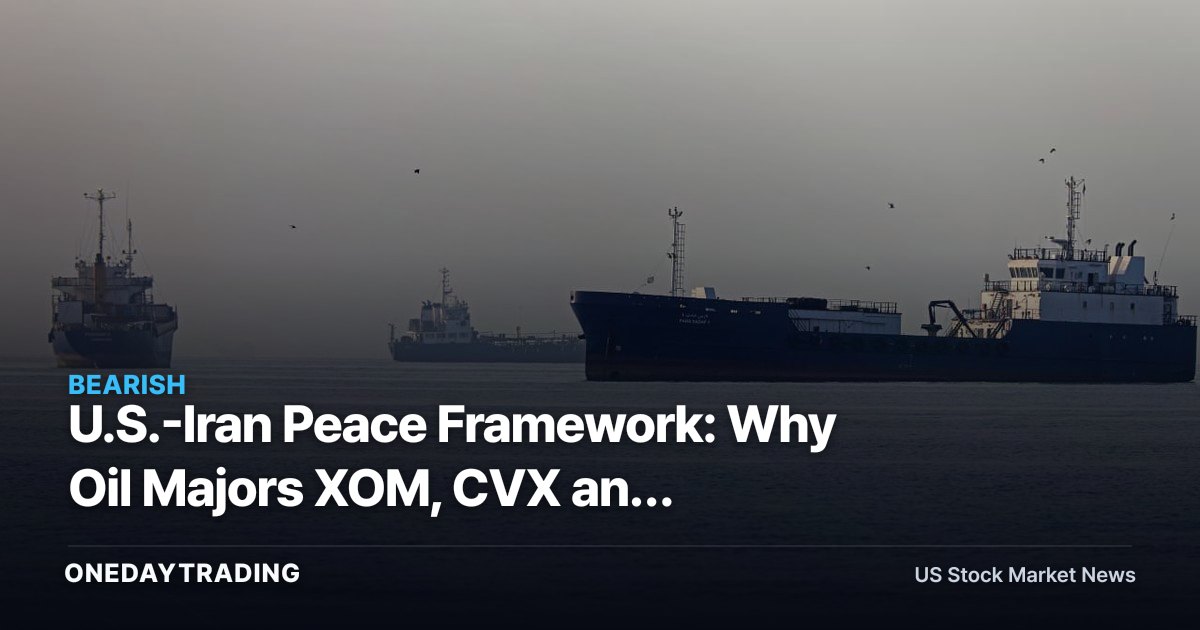
For oil, the channel is straightforward. Middle East conflict has historically embedded a premium into crude to compensate for the tail risk of a supply shock through the Strait of Hormuz, the chokepoint for a large share of seaborne crude. A credible de-escalation removes some of that premium even before a single extra barrel ships. If the eventual text includes sanctions relief, Iranian export volumes could climb over subsequent quarters, adding supply into a market where OPEC+ already manages spare capacity.
The flip side: a framework is not a deal. If the published text stalls, gets diluted, or collapses, the premium snaps back quickly, and the same names that sold off would re-rate higher.
Structural Background
Oil is the transmission mechanism that links this geopolitical event to equity sectors. Integrated majors and exploration-and-production names earn on the price of the barrel; refiners and airlines pay for it. Defense contractors, meanwhile, carry an implicit premium tied to elevated conflict risk and the order flow that accompanies it. A peace framework leans against all three of those setups at once, which is why a single headline can ripple across unrelated-looking tickers.
Stock & Sector Ripple
- Exxon Mobil (XOM), Chevron (CVX): Upstream earnings track crude prices directly; a falling geopolitical premium and the prospect of returning Iranian supply pressure realized selling prices and forward cash-flow assumptions.
- Occidental (OXY): A higher-beta, leverage-sensitive producer that tends to amplify crude moves in both directions.
- Defense — Lockheed Martin (LMT), RTX (RTX): De-escalation trims the conflict-risk narrative that supports sentiment, though multi-year backlogs cushion near-term fundamentals.
- Airlines — Delta (DAL), United (UAL): Jet fuel is a top operating cost; softer crude is a direct margin tailwind for carriers.
Bull vs Bear Scenarios
Bear case for energy: the text confirms a path to sanctions relief, Iranian barrels return, and crude grinds lower, compressing producer margins while handing refiners and airlines a cost break. Bull case for energy: the framework fails to convert into a binding agreement, OPEC+ keeps a tight grip on supply, or implementation drags — leaving the risk premium intact and rewarding the producers that sold off. The key variable is the actual treaty text and its sanctions and verification terms, not the framework headline.
Investor Action Points
- Watch for the release of the framework text — the sanctions-relief language and timeline are the real catalysts, not the announcement.
- Track front-month WTI and Brent; a sustained break lower validates the de-escalation trade, a sharp reversal signals the deal is faltering.
- Listen for OPEC+ commentary on production policy, which can offset or amplify any Iranian supply return.
- Check energy and airline names into their next earnings for management's crude-price assumptions and hedging posture.
📊 Analysis
Signal Bearish
Why A U.S.-Iran peace framework reduces oil's geopolitical risk premium and raises the prospect of returning Iranian supply, pressuring energy producers and defense names.
Tickers$XOM$CVX$OXY$LMT$DAL$RTX
This article was independently written by OneDayTrading from public reporting. Read the original (MarketWatch)