Summary
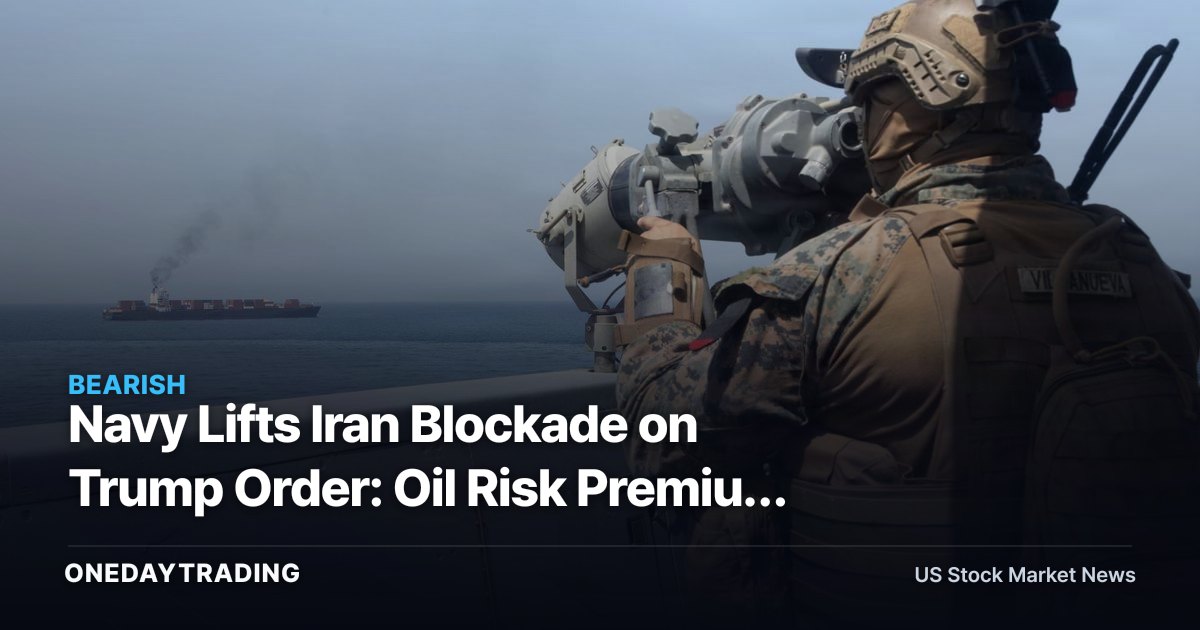
The U.S. Navy lifted its blockade of Iran's ports and coastal areas on Thursday at President Donald Trump's direction, a de-escalation that removes a fresh geopolitical premium from crude prices. For investors, the immediate read-through runs through energy, defense, airlines and tanker shipping, because the news changes the perceived odds of a supply disruption in the Strait of Hormuz corridor.
The Full Story
A naval blockade of Iranian ports is, in market terms, a supply-side threat: it raises the risk that Iranian barrels and Gulf transit flows get interrupted, which pushes traders to bid crude higher as insurance. Ending that blockade does the opposite. It signals Washington is dialing down direct confrontation, and that lowers the probability traders had been assigning to a worst-case Hormuz scenario.
The order coming directly from the President matters for how durable the move looks. A blockade imposed and then lifted by executive direction can, in principle, be reinstated just as quickly, so any premium that comes out of oil now is conditional on the diplomatic posture holding. That is the core tension: the physical risk has eased, but the policy switch remains in one person's hands.
Structural Background
Roughly a fifth of global seaborne oil moves through the Strait of Hormuz, so any U.S.-Iran flashpoint near Iranian ports tends to inject a premium of several dollars per barrel into Brent and WTI almost reflexively. When that flashpoint cools, the premium bleeds out and crude tends to drift back toward whatever the underlying supply-demand balance justifies, which has been shaped more by OPEC+ policy and global demand than by headlines.
Stock & Sector Ripple
- Oil majors (XOM, CVX): A lower geopolitical premium pressures crude, and integrated producers see upstream realizations track the oil price; a softer barrel trims the cash-flow tailwind these names had from elevated prices.
- Defense primes (LMT, RTX): De-escalation cools the near-term threat narrative that supports munitions and missile-defense demand expectations; sentiment, not contracts, moves first.
- Airlines (DAL, AAL): Jet fuel is a top operating cost, so easing crude is a margin positive for carriers that cannot fully hedge or pass through fuel.
- Tanker and shipping names: Reduced Hormuz disruption risk can lower war-risk insurance and spot tanker rates that spike on conflict fear, a mixed signal for crude-tanker operators.
Bull vs Bear Scenarios
Bull case for risk assets: A genuine thaw caps oil, eases inflation worries tied to energy, and supports consumer-facing and transport sectors. Bear case: Because the blockade was lifted by direct order, it can be reversed on the next provocation, so the de-escalation may prove fragile and the oil premium could snap back; energy bulls may also argue OPEC+ supply discipline limits how far crude actually falls.
Investor Action Points
- Watch front-month WTI and Brent for whether the geopolitical premium actually compresses or holds — a non-reaction signals the market already discounted it.
- Track follow-on U.S.-Iran headlines; a reinstated posture would reverse the trade fastest in oil and defense.
- For energy exposure, weigh spot oil moves against OPEC+ output policy and inventory data rather than the headline alone.
- For airlines, check whether fuel-cost relief shows up in the next quarterly cost guidance before assuming margin upside.
📊 Analysis
Signal Bearish
Why Ending the blockade removes a supply-disruption risk premium from crude, pressuring oil prices and the energy producers most levered to them.
Tickers$XOM$CVX$LMT$DAL$RTX
This article was independently written by OneDayTrading from public reporting. Read the original (CNBC)