Key Takeaways
A diplomatic thaw between Washington and Tehran lands first on the geopolitical risk premium embedded in crude oil prices, which is a swing factor for energy equities and broad equity sentiment. If the roadmap holds, the most exposed trades are the ones that quietly priced in Middle East conflict: long energy and long defense.
What Happened
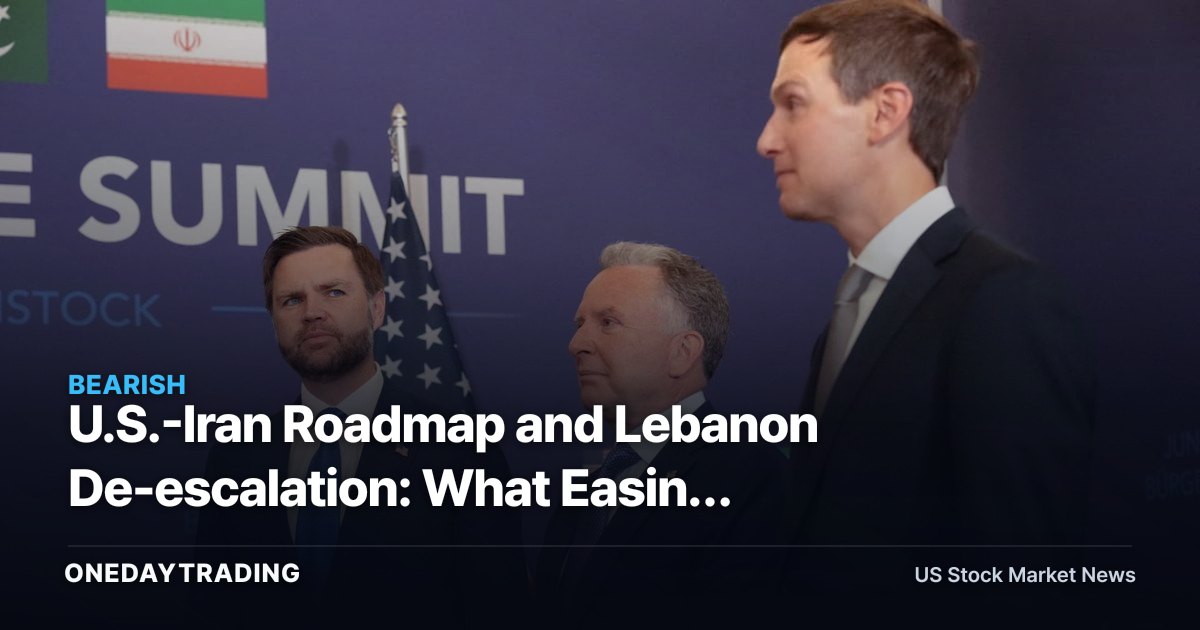
The United States and Iran agreed on a roadmap toward a final deal and outlined a plan to end military operations in Lebanon. These were the first round of negotiations conducted under a memorandum of understanding signed the prior week.
That memorandum extended an already fragile ceasefire by 60 days, giving negotiators a defined window to convert a pause in fighting into a more durable framework. The 60-day clock matters: it sets a concrete deadline that markets can trade around, rather than an open-ended hope.
Background and Context
Middle East flashpoints have repeatedly added a fear premium to oil because the region sits astride critical supply and shipping routes. When conflict escalates, traders price in the tail risk of disrupted barrels; when tensions ease, that premium tends to bleed out even if no actual supply ever moved. A roadmap plus a Lebanon de-escalation works through exactly this channel.
Market and Stock Impact
- Oil majors (XOM, CVX): A shrinking geopolitical premium pressures crude prices, and integrated majors lever directly to the per-barrel realization on their upstream output. Lower oil compresses the highest-margin segment of their earnings.
- Defense primes (LMT, RTX, NOC): A credible end to operations and a path to a final deal trims the perceived demand for munitions and missile-defense restock, the very narrative that supported order-book optimism during the conflict.
- Airlines and transports (DAL, UAL): Fuel is a top variable cost, so a softer crude tape is a direct margin tailwind, the mirror image of the energy trade.
- Broad equities (SPY, QQQ): Lower oil eases an input-cost and inflation overhang, modestly supportive for rate-sensitive growth names if it filters into the inflation outlook.
Investor Checkpoints
- Watch the 60-day window: any headline of a breakdown or extension resets the premium immediately.
- Track WTI and Brent levels as the cleanest real-time gauge of whether markets believe the de-escalation.
- On energy names, focus on management commentary about realized prices and capital discipline at the next earnings round, not just headline output.
- For defense, monitor backlog and book-to-bill guidance for any softening tied to reduced near-term conflict demand.
Outlook
The bull case for risk assets is straightforward: a durable framework removes a recurring source of oil-price spikes and inflation noise. The risk is symmetry. A roadmap is not a signed deal, ceasefires of this kind have proven brittle, and OPEC supply decisions plus global demand can move crude far more than any single diplomatic headline. Energy and defense investors should treat the de-escalation as a probability shift rather than a settled outcome, sizing positions for the chance the 60-day window lapses without a final agreement.
📊 Analysis
Signal Bearish
Why Geopolitical de-escalation tends to drain the risk premium from oil and soften near-term defense demand, pressuring energy and defense equities.
Tickers$XOM$CVX$LMT$RTX$DAL
This article was independently written by OneDayTrading from public reporting. Read the original (CNBC)