Summary
If a U.S.-Iran agreement is implemented and tanker traffic through the Strait of Hormuz normalizes, the most immediate market effect is the unwinding of the geopolitical risk premium embedded in crude prices. That is a headwind for oil producers and a tailwind for fuel-consuming industries, even as data firm Kpler cautions that transits may not snap back to prewar levels right away.
The Full Story
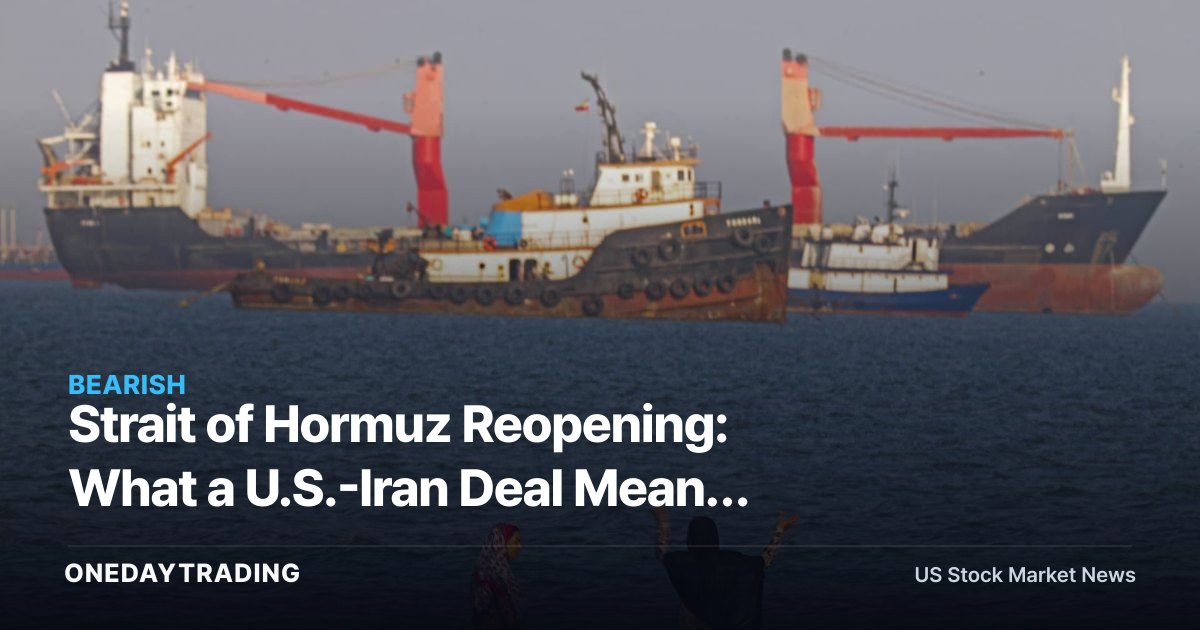
The Strait of Hormuz is the single most important chokepoint in the global oil trade, and any disruption there forces shippers to price in the risk that barrels cannot reach buyers. A reopening tied to a U.S.-Iran deal would do the opposite: it signals that the supply route is functioning again and that the worst-case scenario of a closed strait is off the table for now.
The key nuance from Kpler is timing and magnitude. Tanker traffic could rebound quickly once a deal is in place, but it is far from certain that volumes return to pre-conflict levels. Insurers, charterers and crews do not all re-engage at the same speed, and shipowners may keep demanding war-risk surcharges until confidence is rebuilt. For markets, that means the relief in crude prices could be front-loaded on the headline, then stall if actual transit data lags the political agreement.
Structural Background
Crude has carried an elevated risk premium precisely because so much seaborne oil and condensate must pass through Hormuz. When that premium inflates, it lifts the realized prices oil majors capture; when it deflates, the same companies see margins compress on the price side even if volumes are steady. Tanker economics work differently: operators are paid on freight rates and ton-miles, so a normalization can cut elevated war-risk rates while restoring routine cargo volume.
Stock & Sector Ripple
- ExxonMobil (XOM), Chevron (CVX): A falling risk premium pressures crude realizations; upstream-heavy majors see the most direct hit to per-barrel margins.
- Frontline (FRO), Scorpio Tankers (STNG): Mixed read — restored Hormuz flows revive cargo volume, but a calmer security backdrop erodes the lucrative war-risk rate spikes that boosted recent earnings.
- Delta (DAL), United (UAL): Lower jet-fuel input costs from softer crude support airline margins, a classic offset to energy weakness.
- Energy ETFs (XLE): Broad sector exposure tracks the crude move and amplifies the producer-side drag.
Bull vs Bear Scenarios
Bear case for oil bulls: The deal holds, transits climb toward prewar throughput, the risk premium evaporates and crude grinds lower, squeezing producer cash flow and capex appetite.
countervailing view: Kpler itself flags that a return to full prewar volumes is uncertain. If transits disappoint, lingering insurance friction or a fragile agreement could keep a floor under prices — and any sign the deal is unraveling would re-inflate the premium sharply.
Investor Action Points
- Track Kpler and tanker-tracking data for actual Hormuz transit counts versus the political timeline — the gap between headline and throughput is the trade.
- Watch war-risk insurance premiums and clean-tanker freight rates as the real-time gauge of normalization for FRO and STNG.
- For XOM and CVX, focus on the next quarterly realized-price disclosures and any capex commentary tied to a lower price deck.
- Use jet-fuel crack spreads as the checkpoint for whether airline beneficiaries actually capture the input-cost relief.
📊 Analysis
Signal Bearish
Why A reopened Strait of Hormuz under a U.S.-Iran deal would unwind the geopolitical risk premium in crude, pressuring oil-producer realizations even if tanker volumes do not fully recover.
Tickers$XOM$CVX$FRO$STNG$DAL
This article was independently written by OneDayTrading from public reporting. Read the original (CNBC)