Key Takeaways
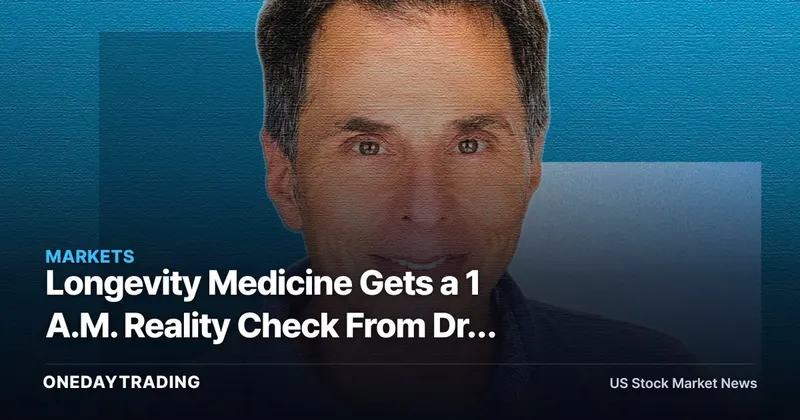
Longevity medicine in CNBC's profile of Dr. Ronald Primas is investable only as a demand signal for personalized healthcare, not as proof that any listed company has a new earnings catalyst. The sharp fact is behavioral: Dr. Ronald Primas, a longevity physician, still has a 1 a.m. bedtime while trying to tick as many longevity boxes as he can.
For retail investors, the read-through sits in healthcare services, preventive care, concierge medicine and wellness plans, where consumer willingness to pay matters before clinical claims become revenue durability.
What Happened
CNBC reported that Dr. Ronald Primas is a longevity physician who provides concierge services, including personalized health plans for clients. CNBC's supplied article focuses on Dr. Ronald Primas's own wellness practices rather than trial data, reimbursement codes, pricing, margins or patient volumes.
The 1 a.m. bedtime matters because the profile cuts against the clean marketing version of longevity medicine. Dr. Ronald Primas's routine suggests that even expert-led optimization operates inside trade-offs, not a laboratory setting where every variable is controlled.
Longevity medicine is healthcare aimed at extending healthspan, meaning the years a person lives with good function, often through personalized plans, preventive screening and lifestyle protocols. CNBC's source article gives no quantified outcomes for Dr. Ronald Primas's clients, so the investment case must stay anchored to consumer behavior rather than proven medical efficacy.
Background & Context
Concierge healthcare converts patient demand for time, access and personalization into a service model that can sit outside traditional insurance-heavy care. Dr. Ronald Primas's personalized health plans point to a market where affluent consumers pay for guidance before the public market can easily measure retention, unit economics or clinical endpoints.
David Thompson's lens is simple here: separate the data from the wellness narrative. CNBC's profile gives one concrete schedule detail, one physician identity and one service category; CNBC's profile does not provide revenue, patient count, outcomes, or regulatory milestones.
Market & Stock Impact
- Healthcare services: Concierge longevity demand supports the idea that some consumers will pay for access and personalization, but CNBC's source article provides no pricing or volume data.
- Preventive care platforms: Personalized health plans can raise engagement if clients follow protocols, but the article gives no adherence rate or measured health outcome.
- Wellness and diagnostics providers: Longevity clients often create demand for monitoring and screening, but CNBC's supplied facts do not identify any diagnostic company or testing volume.
- Traditional healthcare payers: Concierge models can bypass insurance reimbursement, but CNBC's source article gives no payer exposure or claims-cost data.
Investor Checkpoints
- Watch whether public healthcare services companies disclose concierge-care revenue, membership growth or retention in the next earnings cycle.
- Track whether personalized health plans become reimbursed medical services or remain cash-pay wellness products.
- Demand measured endpoints before valuing longevity claims as medical innovation rather than premium consumer service.
- Use patient count, average revenue per client and churn as the first hard metrics if a listed company ties itself to longevity medicine.
Outlook
The bull case is that Dr. Ronald Primas's concierge model reflects real consumer appetite for preventive, personalized healthcare, especially among clients willing to pay for time and access. The risk is that CNBC's profile shows interest, not evidence: without outcomes, retention and pricing data, longevity medicine remains a narrative before it becomes a forecastable public-equity driver.
FAQ
What is longevity medicine?
Longevity medicine is healthcare focused on extending healthspan through personalized plans, preventive practices and lifestyle management. CNBC's supplied article identifies Dr. Ronald Primas as a longevity physician who offers concierge services and develops personalized health plans.
Why does Dr. Ronald Primas's 1 a.m. bedtime matter for investors?
Dr. Ronald Primas's 1 a.m. bedtime matters because the CNBC profile shows that longevity optimization involves practical trade-offs even for a physician in the field. Investors should treat the story as a consumer-demand signal, not as clinical proof.
Which stocks benefit from concierge longevity medicine?
CNBC's supplied article does not name any listed company tied to Dr. Ronald Primas's concierge longevity services. The relevant investable areas are healthcare services, preventive care and wellness infrastructure, but ticker-level impact requires company-specific revenue data.
📊 Analysis
Signal Neutral
Why The source shows demand for concierge longevity healthcare but provides no public-company exposure, financial data or clinical outcomes.
This article was independently written by OneDayTrading from public reporting. Read the original (CNBC)